
AI MVP Development: Why AI MVPs Fail & How to Build Them Right
Is your AI MVP hitting scalability or performance issues? Learn why AI MVPs fail, what to audit before rebuilding, and how to avoid costly mistakes.
AI has made it much easier to build MVPs. A founder with a clear idea can now launch a working product in days, using AI coding tools like Cursor, Bolt.new, or v0, or no-code platforms. Three years ago, the same product needed a full development team.
That is the good news. But there is a hard truth behind it: the challenge is no longer building an MVP - it is building one that survives real users.
We see this pattern all the time in our rescue work. A founder ships fast and gets early users. Then problems start. The app becomes slow. The AI gives strange answers. Every new feature takes longer than the last one. The monthly API bill grows faster than revenue. The demo that impressed investors was exactly that - a demo, not a production system.
Many founders think a working demo is a production-ready product. It is not. And when things break, the first instinct is to rebuild everything from zero. Sometimes that is right. Often it is not. Before you spend another development cycle, you should understand what actually went wrong.
This article gives you a practical technical checklist. Use it to decide if your AI MVP can be improved, or if it really needs a rebuild.
What Is an AI MVP?
An AI MVP (minimum viable product) is the smallest version of an AI-powered product that can prove one thing with real users: that the AI does a specific job well enough to be worth using. It is not a demo and not a prototype. A demo shows what the model can do on a good day; an MVP has to survive real inputs, real users and real edge cases, with enough monitoring that you know when it fails.
How do you develop an AI MVP? In practice it comes down to five moves:
- Pick one narrow job the AI must do, and write down how you will know it did it correctly.
- Collect 30 to 100 real examples of that job, including the messy ones. This becomes your first evaluation set.
- Build the thinnest working path from input to output, using an existing model through an API before considering anything custom.
- Put it in front of a small group of real users with logging switched on.
- Measure against your evaluation set weekly, and only add scope once the first job works reliably.
Most failed AI MVPs skip steps 1 and 2. They build features first and discover afterwards that nobody can say what "good" looks like.
What does it cost to hire someone to build an AI MVP? It depends mainly on how much of the product is AI and how much is ordinary software around it: integrations, authentication, dashboards, data pipelines. We do not publish fixed prices because two products that both "use AI" can differ by a large multiple. Our MVP cost framework shows how to budget, and AI software development cost covers what changes when AI is involved. Both will give you a better number than any headline figure.
When not to build an AI MVP: if the job can be done reliably with rules, a spreadsheet or a plain database query, build that instead. AI earns its place when the input is unstructured (text, voice, images) or the decision logic is too fuzzy to hand-code.
Why Do AI MVPs Fail After Launch?
Quick answer: Most AI MVPs fail because they were built to validate an idea - not to support real users at scale. Weak architecture, poor AI model implementation, unreliable integrations, no monitoring, and growing technical debt become serious problems after launch. A structured technical audit finds these issues before you decide to rebuild.
Let's look at the most common failure reasons we find when we audit AI MVPs.
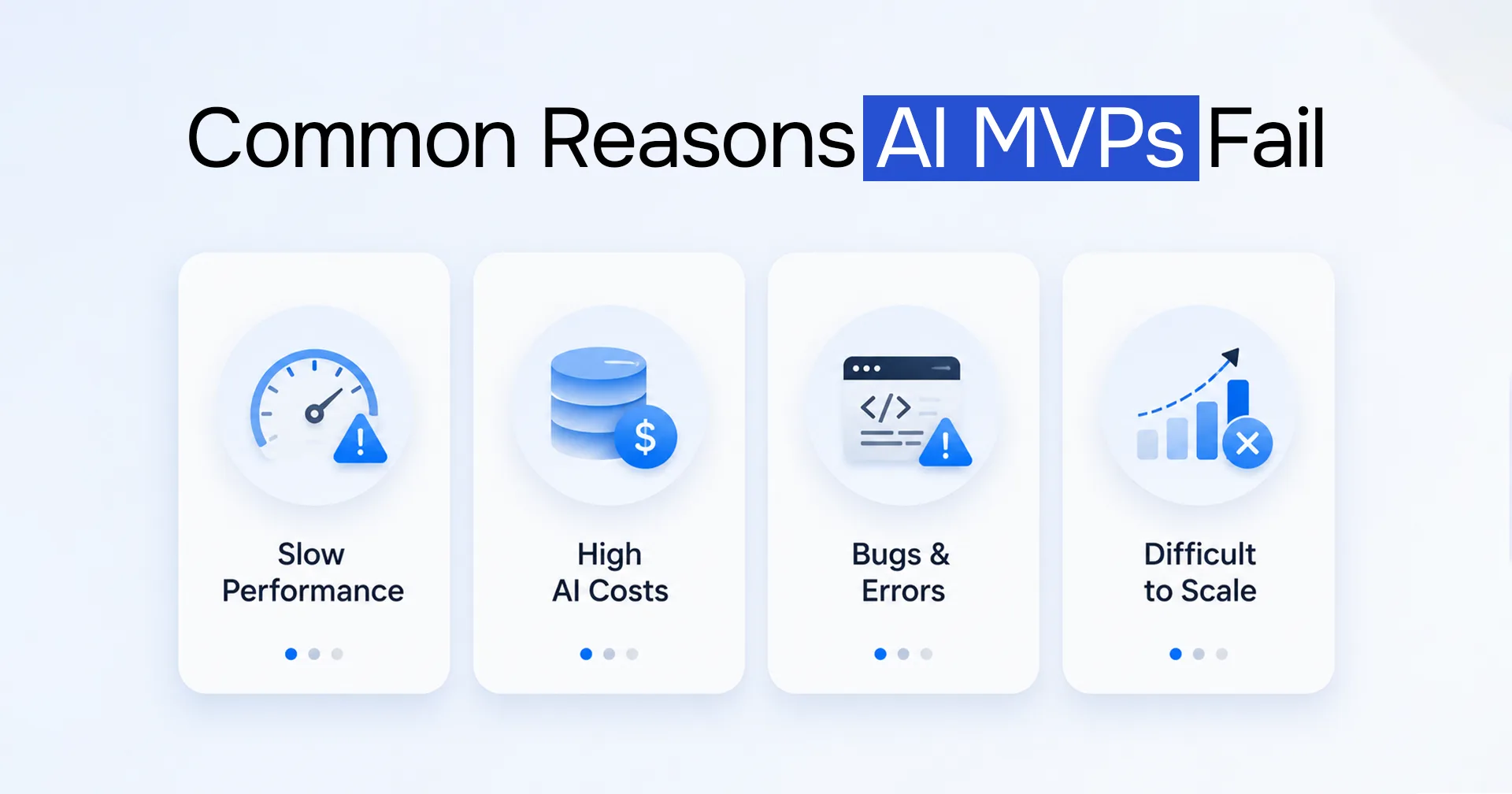
Was your AI MVP built only to validate an idea?
There is nothing wrong with a quick MVP built to test an idea. That is what MVPs are for. The problem starts when this prototype quietly becomes the real product, without anyone deciding it should.
Prototype code makes different trade-offs than production code: hardcoded values, no error handling, one single environment, secrets stored in the code, and "we will fix it later" everywhere. These trade-offs are fine for a two-week test. They become serious risks the moment paying customers depend on the system.
Ask yourself honestly: did anyone ever engineer this product? Or did the prototype just keep growing feature by feature?
Is your application architecture ready for production?
AI coding tools and no-code platforms are built to put something on screen fast. They do not make architecture decisions for you. So by default, you get whatever structure came out of a series of prompts.
Common signs of prototype-level architecture:
- Everything in one file or one function. Business logic, AI calls, database queries, and UI code all mixed together.
- No separation between the AI layer and the rest of the app. Changing the model or provider means rewriting core features.
- Everything runs synchronously. The app freezes while waiting 20 seconds for an LLM response, instead of doing that work in the background.
- No separate environments. Testing happens in production because there is nowhere else to test.
None of these matter with 10 users. All of them matter with 1,000.
Are you relying too heavily on AI models instead of good engineering?
We often see this pattern: the LLM is doing work that normal code should do. Parsing structured data, applying business rules, validating input, formatting output - all sent to the model, because writing a prompt felt faster than writing code.
This creates three problems that grow together. It is slow (a database lookup takes milliseconds; a model call takes seconds). It is expensive (you pay per token for work that code does for free). And it is unreliable (models are probabilistic; your invoice total calculation should not be).
Good AI products use models for what models are good at - understanding language, handling unclear input, generating content, and normal code for everything else.
Has technical debt slowed future product development?
The clearest business signal of a failing MVP is that development gets slower and slower. The first feature took two days. Six months later, a similar feature takes three weeks and breaks two other things.
That is technical debt growing over time: no tests to catch mistakes, no documentation to bring in help, the same logic copied in five places, and a data model that fights every new requirement. At some point, working around the debt costs more than fixing it. An audit tells you where that point is.
How Can You Tell If Your AI MVP Needs Improvement?
You do not need to wait for a big failure. These are the early warning signs.
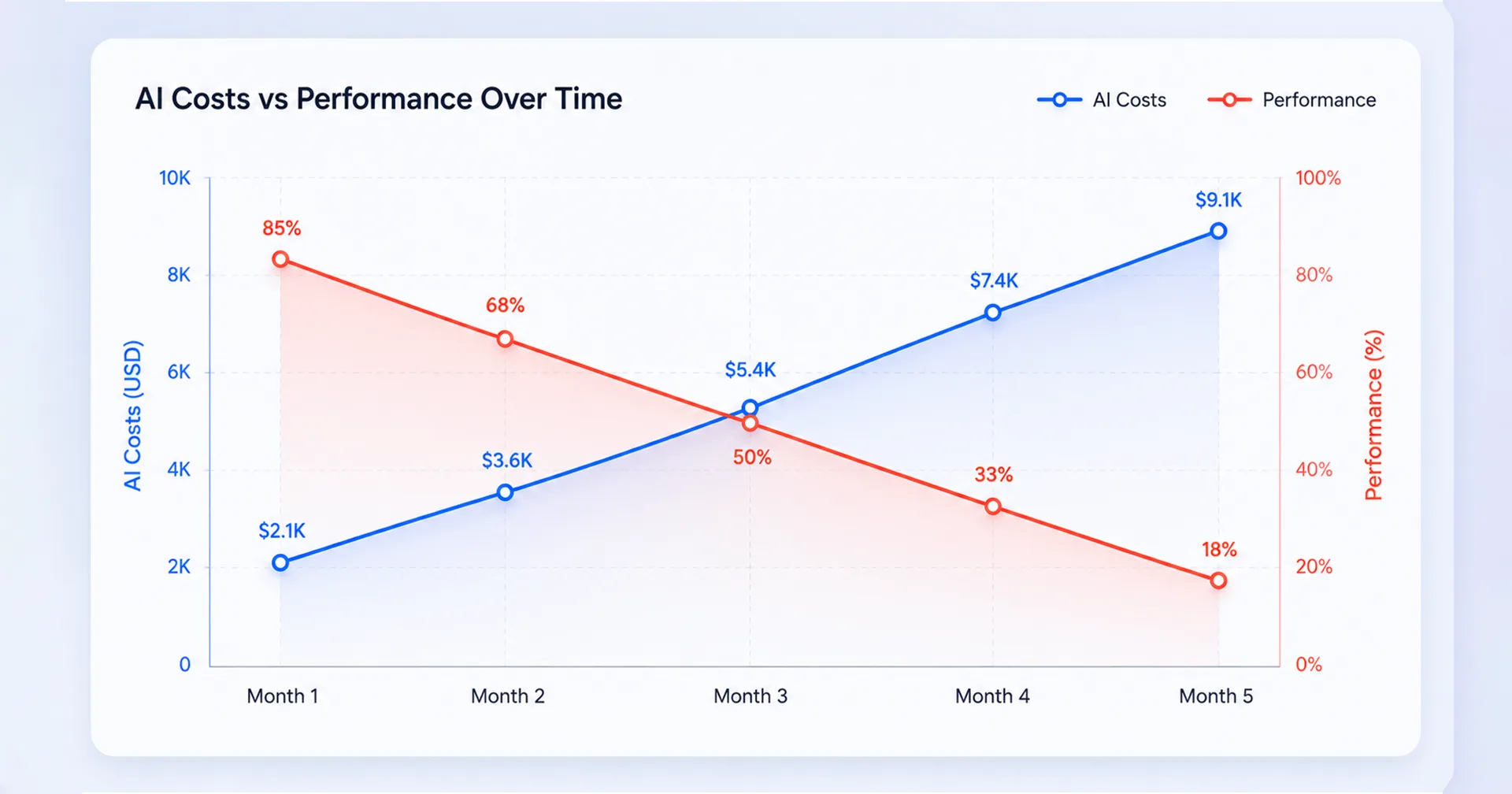
Is your AI producing inconsistent or inaccurate responses?
If the same input gives very different outputs, or the model confidently invents facts that your users then act on, you have an AI quality problem. Common root causes: prompts that changed over time with no version control, no test set to catch quality drops when prompts or models change, missing context that forces the model to guess, and no checks on the output before users see it.
Are users experiencing slow performance?
AI adds some delay, that is true. But most "the AI is slow" complaints we investigate are actually engineering problems: model calls running one after another when they could run in parallel, no caching of repeated queries, database queries without indexes, context windows that are too large, or a UI that freezes instead of streaming the answer. If pages are slow even when no AI is involved, the problem is the architecture - not the model.
Are new features becoming harder to build?
Track your own delivery honestly. If a feature estimated at "a few days" regularly becomes weeks, and every deploy needs a manual test of everything because nothing is automated, the codebase is telling you something. This slowdown is measurable, and it almost never fixes itself.
Is your AI product difficult to maintain or scale?
Some questions that show maintenance problems quickly:
- Could a new engineer make a safe change in their first week?
- If your main developer left tomorrow, could anyone else run the system?
- If traffic doubles, do costs double, or do costs jump 4x while the app goes down?
- When something breaks at 2 a.m., do you learn it from monitoring or from angry users?
If most of your answers are "no," "no," "we don't know," and "users" - the system needs attention, no matter how well the product idea is doing.
AI MVP Development Technical Checklist Before You Rebuild
Before you make any rebuild-or-refactor decision, go through this audit checklist. It is the same structure we use in professional audits. You can do a first pass yourself in a few hours.
Product Validation
Start with the product, not the code. There is no point perfecting software that nobody wants.
- Are users actually using it? Look at retention, not signups. Do people come back?
- Which features create value? Usually 20% of features drive 80% of usage. Find them.
- What can be removed? Every feature you drop before a rebuild is work you do not pay for twice.
Architecture Review
- Is there separation between UI, business logic, data access, and AI integration?
- Can you change one part without touching everything else?
- Are there separate dev, staging, and production environments?
- Is configuration (API keys, model choices, limits) outside the code, or hardcoded?
- Could the system run two instances behind a load balancer today?
Database Health
- Is there a real schema with types and constraints, or JSON blobs everywhere?
- Do your slowest pages have indexed queries behind them?
- Are there backups, and has anyone ever tested restoring one?
- Is the same data stored in several places where it can go out of sync?
- Will the current data model survive 100x more rows?
AI Integration
- Are prompts versioned and stored outside the code?
- Is there a test set that catches quality drops when you change prompts or models?
- What happens when the model provider has an outage - does the app degrade nicely, or fail completely?
- Are you using the right-sized model for each task, or the most expensive model for everything?
- Is there validation between the model's output and anything a user sees or the system acts on?
- Do you track token costs per feature, so you know what each capability costs to run?
Security
- Are secrets out of the codebase and out of the git history?
- Is user input checked before it reaches your database or your prompts (SQL injection and prompt injection)?
- Does authorization protect every route, or only the ones the UI shows?
- Is user data encrypted in transit and at rest?
- Are API endpoints rate-limited, or can one script run up your model bill overnight?
Performance
- What is the p95 response time for your five most-used actions?
- Are AI calls streamed or moved to the background, or does the UI freeze while waiting?
- Is anything cached - model responses, database queries, computed results?
- Where does the system break under load? Do you know this number from testing, or is it a guess?
Cost Optimization
- What is your cost per active user, and is it going up or down?
- What share of model calls could a cheaper model or plain code handle?
- Are you paying for infrastructure sized for the traffic you hoped for, instead of the traffic you have?
- Do you have alerts for cost spikes, or do you find out when the invoice arrives?
Score each section honestly. A section with mostly "no" answers is a red flag. The pattern across sections tells you if you need targeted fixes or if the problems are structural.
Should You Rebuild or Refactor?
This is the decision the whole audit leads to. Make it on evidence, not on frustration.
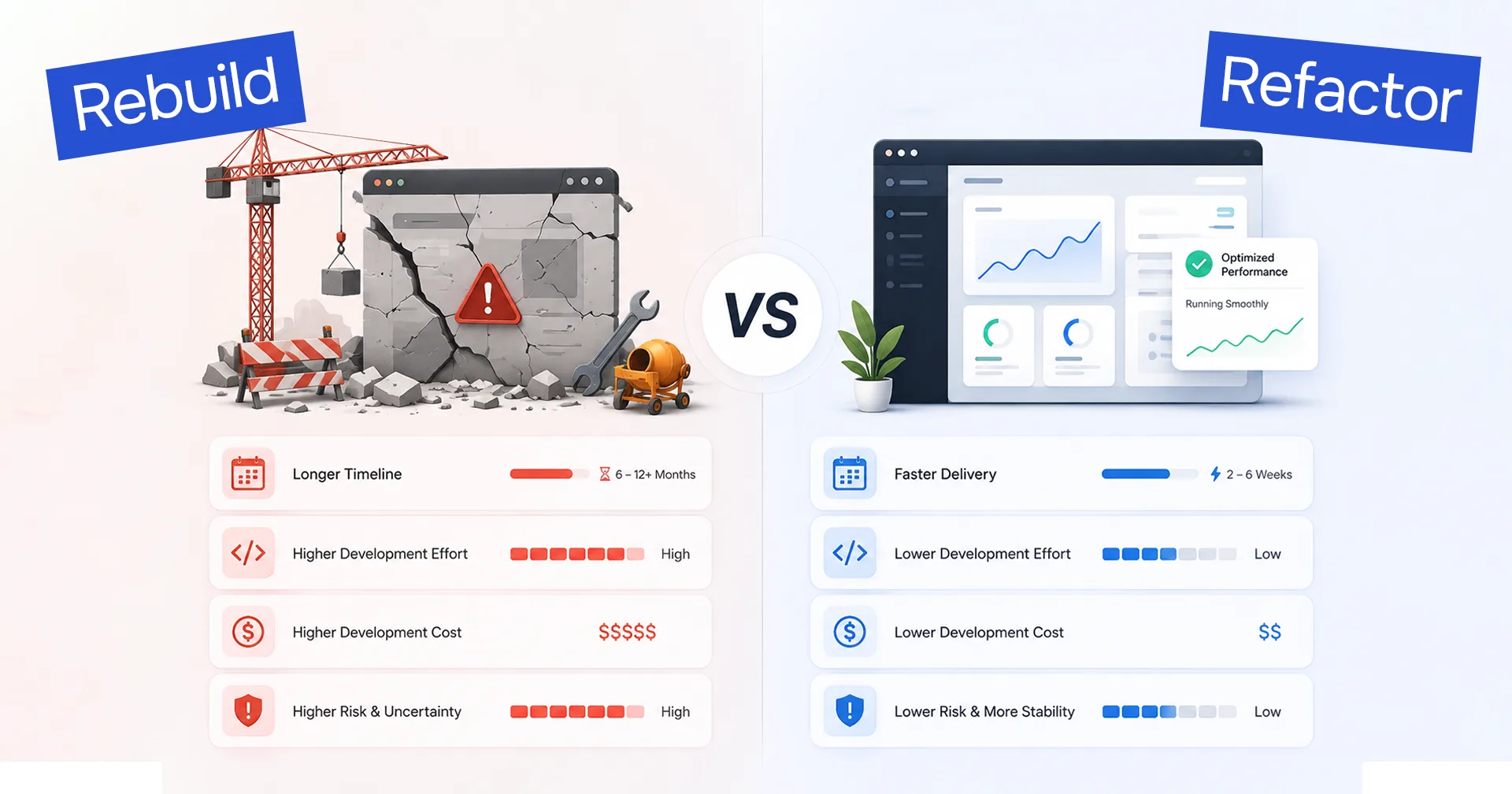
| Rebuild when… | Refactor when… |
|---|---|
| The architecture is fundamentally broken | Issues are local and fixable |
| Scaling is impossible without structural change | You mainly need performance improvements |
| Security problems are everywhere | The code needs cleanup, not replacement |
| The tech stack is wrong for the product | Features need optimization, not reinvention |
| Technical debt touches everything | The foundation is stable |
Decision criteria that actually matter:
- How much code can be saved? If the audit shows 60-70% of the system is solid, refactor. If the problems are in the foundations - data model, core architecture - the percentage stops mattering.
- Cost of the waiting time. A refactor delivers value continuously. A rebuild delivers nothing until it ships. Can the business survive months without new features?
- Team reality. A rebuild done with the same process that produced the first system will produce the same problems. Something must change - the approach, the expertise, or both.
- Risk tolerance. Rebuilds fail more often than refactors. If the current system makes money, think carefully before interrupting it.
Our honest observation from rescue work: founders choose rebuilds too quickly. A rebuild feels like a fresh start. A refactor feels like admitting the mess is yours. But most systems we audit need a focused refactor of two or three subsystems - not a full rewrite. (We wrote about one such case in our failed AI project rescue case study.)
What to Do After Building an MVP With AI
Launch is the start of the expensive part. Once the MVP is live, the work shifts from building to learning, and the first month usually decides whether the product has a future.
- Read the logs, not the dashboard. Review a sample of real conversations or outputs every week. Failure patterns show up there long before a metric moves.
- Turn every failure into a test case. Add it to your evaluation set so the same mistake cannot return unnoticed. See our LLM evaluation guide for how to structure this.
- Decide what is working, what is not and what is missing. Keep, fix or cut features on evidence from users, not on what the team found interesting to build.
- Check the foundations before adding features. If the prototype was generated quickly with AI coding tools, audit it for security, error handling and data handling before it carries more load. That is the point where a refactor is cheapest.
- Plan version two around one new capability at a time. Resist the rewrite unless the technical checklist above says the foundation cannot hold. A rebuild is justified far less often than founders expect.
If you are unsure whether to refactor or rebuild, that is exactly the decision our rescue work is built around.
AI MVP Development Best Practices
Whether you are fixing an existing MVP or starting a new one, these practices separate AI products that scale from products that get stuck.
Validate before adding features
Every feature you build before validation is a blind bet. Ship the smallest thing that tests your core idea, measure real usage, and let retention data - not excitement - decide the roadmap.
Design for scalability
You do not need complex infrastructure on day one. You need decisions that will not block scaling later: a real database with a real schema, stateless application code, background jobs for slow work, and configuration outside the code. These cost almost nothing extra at the start and save a rebuild later.
Choose AI models strategically
Match the model to the task. Classification, extraction, and routing usually work fine on small, fast, cheap models. Save the expensive models for the work that really needs them. The strongest systems use a mix, and are built so that changing models is a config change, not a rewrite.
Build observability early
You cannot fix what you cannot see. From the first week, log every AI call with its latency, token cost, and result. Track error rates per feature. Set alerts on cost spikes. Adding observability early is cheap. Adding it during an incident is painful.
Separate business logic from AI
Your business rules - pricing, permissions, calculations, validation - belong in normal code, fully testable, completely outside the prompt. The AI layer should be a clear boundary that the rest of the system calls. This one decision does more for maintainability than anything else on this list.
Keep infrastructure simple
Boring infrastructure is a feature. A managed platform, a managed database, and a job queue cover most AI MVPs. Every extra moving part is one more thing that can break at 2 a.m. Add complexity when scale demands it, not before.
Continuously test prompts
Prompts are code and deserve the same discipline: version control, a test set of real example inputs with expected outputs, and a test run before every prompt or model change. Teams that skip this find out about quality drops the same way their users do.
AI MVP Development Process for a Successful Rebuild
If the audit says rebuild, here is the process that keeps a rebuild from becoming a second failure:
1. Discovery - Understand what the product must do, who uses it, and what the current system does well. The goal is a clear scope before anyone writes code.
2. Technical Audit - Map the existing system: what can be saved (often the data, sometimes whole modules), what cannot, and where the real problems are.
3. Architecture Planning - Design the target system: boundaries, data model, AI integration layer, and infrastructure. This is where scalability is won or lost.
4. Prioritization - Rank features by real usage. A rebuild is your one chance to not rebuild the features nobody used.
5. Rebuild Strategy - Choose the migration path: run both systems in parallel with a staged cutover, replace module by module, or do a clean cutover with a rollback plan. Users should not notice anything.
6. Development - Iterative sprints with working software at every step - including tests, CI/CD, and monitoring from the first sprint, not the last.
7. Testing - Functional testing, load testing with realistic traffic, AI quality tests against your quality bar, and a security review.
8. Launch - Staged rollout with real users. Validate the data migration with counts and spot checks. Keep the old system ready until you have earned confidence in the new one.
9. Monitoring - After launch, watch the numbers that failed you last time: latency, error rates, AI quality, and cost per user. The rebuild is finished when the metrics prove it worked - not when the code ships.
When Should You Hire AI MVP Development Services?
Not every situation needs outside help. These situations usually do:
Need an architecture audit
An internal team is often too close to the system to judge it objectively, and too invested to deliver bad news. An external audit gives you an evidence-based picture in one to two weeks, before you commit months of budget.
Existing MVP isn't scaling
If you already tried adding servers and fixing the obvious slow queries, and the system still struggles as you grow, the problem is structural. Structural problems need architecture experience, not more patches.
AI costs are too high
When the model bill grows faster than usage, you are paying an architecture tax: wrong-sized models, repeated calls, missing caches, or work the AI should not be doing at all. Reducing AI costs is a specific skill, and it usually pays for itself within months.
Investors require technical due diligence
A funding round often triggers a technical review. An audit before due diligence lets you fix the findings on your own timeline, instead of explaining them across the table.
Team lacks AI engineering expertise
Building with AI APIs is easy. Building reliable AI systems is not. If your team is strong on product but new to evaluation sets, prompt management, and failure handling, targeted expert help is faster than learning through incidents.
Need fractional CTO guidance
Early-stage companies often need senior technical judgment - architecture decisions, hiring plans, vendor choices - without a full-time CTO salary. Fractional guidance covers this gap while the product finds its direction.
What to Look for in AI MVP Development Companies
If you decide to bring in help, check AI MVP development companies against these criteria:
Startup experience
Enterprise consultancies and startup work run at different speeds. Look for teams that have shipped MVPs under startup conditions: limited budget, changing requirements, and constant urgency.
Architecture expertise
Anyone can build a demo with today's tools. Ask how they would structure a system for 100x growth, and listen for specifics: data modeling, service boundaries, background processing, caching. Vague answers predict vague architecture.
AI engineering knowledge
Go deeper than API familiarity: How do they measure model quality? How do they handle provider outages? How do they control token costs? Teams that have run AI in production give immediate, specific answers.
Audit capabilities
A company that starts with an audit - before quoting a rebuild - is showing you that their interests match yours. Be careful with anyone who recommends a full rebuild without reading your code.
Scalability experience
Ask for a concrete story: a system they took from prototype to real scale, what broke on the way, and how they fixed it. Real experience always comes with specific details.
Post-launch support
Shipping is the middle of the journey, not the end. Understand what happens after launch: monitoring, incident response, optimization, and how knowledge is transferred to your team.
Transparent communication
You should always know what is being built, what it costs, and what the risks are. If the sales process avoids questions about trade-offs, the project will too.
How We Help Founders Rescue AI MVPs
At Eunix Tech, this problem is our specialty. We stabilize AI MVPs, fix platform issues, and harden LLM apps for production - including products started on Replit, Bolt.new, v0, Lovable, and Bubble.
Our engagements start with the question that matters most: should you rebuild at all? A structured technical audit - covering the same architecture, AI integration, security, performance, and cost areas as the checklist above - shows you what is actually wrong and what the smallest effective fix is. Sometimes that is a focused refactor of two subsystems. Sometimes it is a staged rebuild. Either way, you decide with evidence instead of guessing.
Senior engineers handle the work from audit to delivery, and every engagement ends with your team owning the system - code, documentation, and the knowledge to run it. You can see how this works in practice in our case studies, or read more about our approach to custom product engineering and legacy modernization.
Not Sure What's Holding Back Your AI MVP?
Before investing in a complete rebuild, it helps to understand what is actually causing the problem. A technical audit can uncover architecture issues, AI performance gaps, and scalability risks - helping you make informed development decisions instead of expensive guesses.
Book a free strategy call with the Eunix Tech team to discuss your AI MVP.
Conclusion
Rebuilding should be a strategic decision, not a reflex. Most AI MVPs fail because of architecture shortcuts, technical debt, or poor planning - not because the product idea is wrong. That is actually good news: ideas are hard to fix, but engineering problems have known solutions.
A structured technical audit shows you whether targeted improvements are enough, or whether a rebuild is the better investment. Either way, you spend your next development cycle on evidence instead of hope.
If your AI MVP shows the warning signs in this article, get an expert audit before starting another build. It is the cheapest protection against making the same mistakes twice.
FAQs
Why do AI MVPs fail after launch?
Most AI MVPs fail because they were built to validate an idea, not to serve real users at scale. The usual causes: weak architecture, using AI models for work that normal code should do, no monitoring, uncontrolled AI costs, and technical debt that grows until development stops. The product idea is often fine - the engineering under it is not.
Should I rebuild my AI MVP or refactor it?
Refactor when the problems are local: slow queries, messy code, a few unreliable features on a stable foundation. Rebuild when the problems are structural: broken architecture, a data model that cannot scale, security issues everywhere, or a fundamentally wrong tech stack. A technical audit is the reliable way to tell the difference. In our experience, most founders assume they need a rebuild when a focused refactor would be enough.
How long does an AI MVP audit take?
A thorough technical audit usually takes one to two weeks, depending on the size and complexity of the codebase. It covers architecture review, AI integration, security, performance, and cost analysis, and ends with a prioritized report and a clear rebuild-or-refactor recommendation.
What does an AI MVP audit include?
A complete audit covers six areas: architecture (structure, separation of concerns, scalability), database health (schema, indexes, backups), AI integration (prompt management, quality testing, fallbacks, model choice), security (secrets, input validation, authorization, rate limiting), performance (latency, caching, behavior under load), and cost (per-user economics, model spend, infrastructure sizing). The result is a prioritized findings report, not a generic checklist.
How do I know if my AI MVP needs improvement?
Watch for four signals: inconsistent or wrong AI answers, performance that gets worse as usage grows, features taking longer and longer to ship, and rising infrastructure or model costs per user. One signal suggests targeted fixes. Several together suggest structural problems worth auditing.
What is included in AI MVP development services?
Typical services cover the full lifecycle: technical audits of existing products, architecture design, MVP development, AI integration (model selection, prompt engineering, quality testing), rebuild and migration projects, performance and cost optimization, and post-launch support. Good providers also offer fractional CTO guidance for teams that need senior technical judgment without a full-time hire.
How do I choose the right AI MVP development company?
Prefer teams with real startup experience, deep architecture skills, and production AI engineering knowledge - not just API familiarity. Good signs: they propose an audit before quoting a rebuild, they can walk you through a real prototype-to-scale story, and they are open about trade-offs and costs. Ask who actually does the work; senior involvement matters more than a polished sales team.
Can an existing AI MVP be improved without rebuilding it?
Usually, yes. In most audits we run, the majority of the system can be saved - the problems concentrate in a few areas like the data layer, the AI integration, or a performance bottleneck. Targeted refactoring fixes these while the product keeps running and shipping features. Full rebuilds are the right choice in a minority of cases, usually when the core architecture or data model cannot support the product's future.
What are the biggest mistakes startups make during AI MVP development?
The five we see most often: treating a validation prototype as a production product without ever hardening it; using AI models for work that normal code should do; skipping monitoring, so problems appear as user complaints; ignoring AI costs until the invoice becomes a crisis; and rebuilding from zero without understanding why the first version failed, which reliably repeats the same failure on a newer stack.
