
Custom AI Software Development: Benefits, Cost & Process
Learn everything about custom AI software development: benefits, development process, costs, use cases, and how to choose the right AI development company.
AI adoption is growing fast. McKinsey's 2025 State of AI survey reports that 88% of organizations now use AI regularly in at least one business function, up from 78% a year earlier. Most of them start with ready-made tools like ChatGPT or off-the-shelf AI products.
These generic tools are a good first step. But many businesses soon hit their limits. The tool does not understand your data. It does not fit your workflow. It cannot connect to your internal systems. And you cannot change how it works.
This is why more businesses are moving toward custom AI software development. Custom AI is built around your business - your data, your process, and your goals. It does exactly what you need, and you own it.
In this guide, you will learn what custom AI development is, why businesses invest in it, how it compares with off-the-shelf tools, what it costs, and how to choose the right development partner.
What Is Custom AI Software Development?
Custom AI software development means building AI-powered software that is designed for one specific business. Instead of buying a general tool and adjusting your work to fit it, you build a tool that fits your work.
A custom AI system can be many things: a chatbot trained on your company knowledge, software that reads invoices and enters the data for you, a dashboard that predicts next month's sales, or an internal tool that answers questions from your documents.
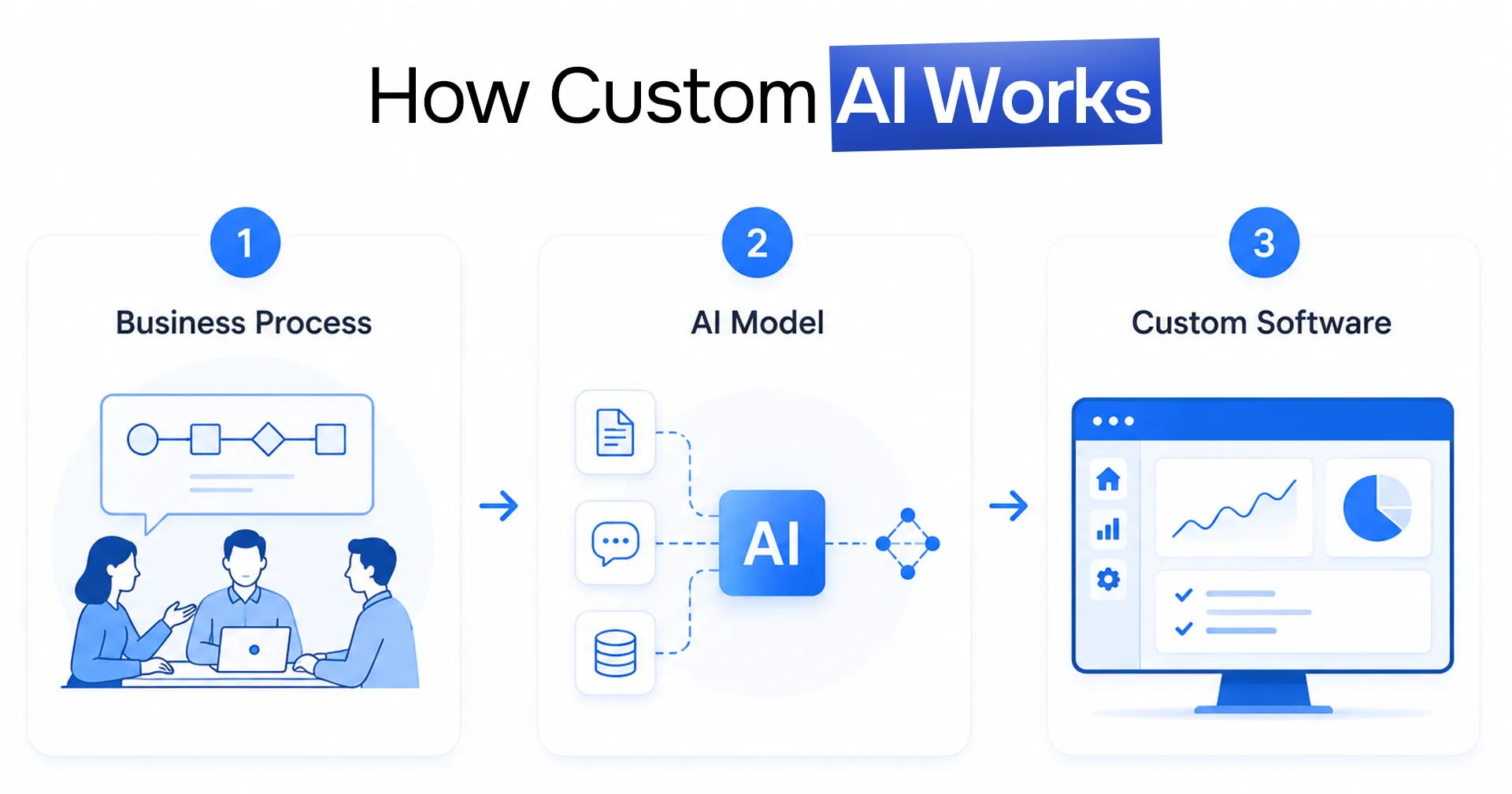
Custom AI Software Development: How It Works
The basic idea is simple. Developers combine three things:
- Your business logic - the rules, steps, and decisions your business already follows.
- AI models - models that can understand language, images, or patterns in data. These can be existing models (like GPT or Claude) or models trained on your own data.
- Software engineering - the application around the AI: user interface, database, security, and connections to your other systems.
The AI does the "thinking" part, like reading a document or answering a question. The software around it makes it safe, fast, and useful for daily work.
Difference Between Custom AI and Traditional Software
Traditional software follows fixed rules. If a task changes a little, the software breaks or needs an update. It can only handle situations that a developer planned for.
Custom AI software can handle messy, real-world input. It can read an email written in any style, understand a scanned document, or answer a question asked in normal words. It works with judgment, not only with rules.
The best systems use both. Fixed rules for things that must always be exact (like prices and permissions), and AI for things that need understanding (like reading text or classifying requests).
Why Businesses Are Investing in Custom AI Development
PwC estimates that AI could add $15.7 trillion to the global economy by 2030. Businesses invest in custom AI development because the returns are practical and direct. Here are the main reasons.
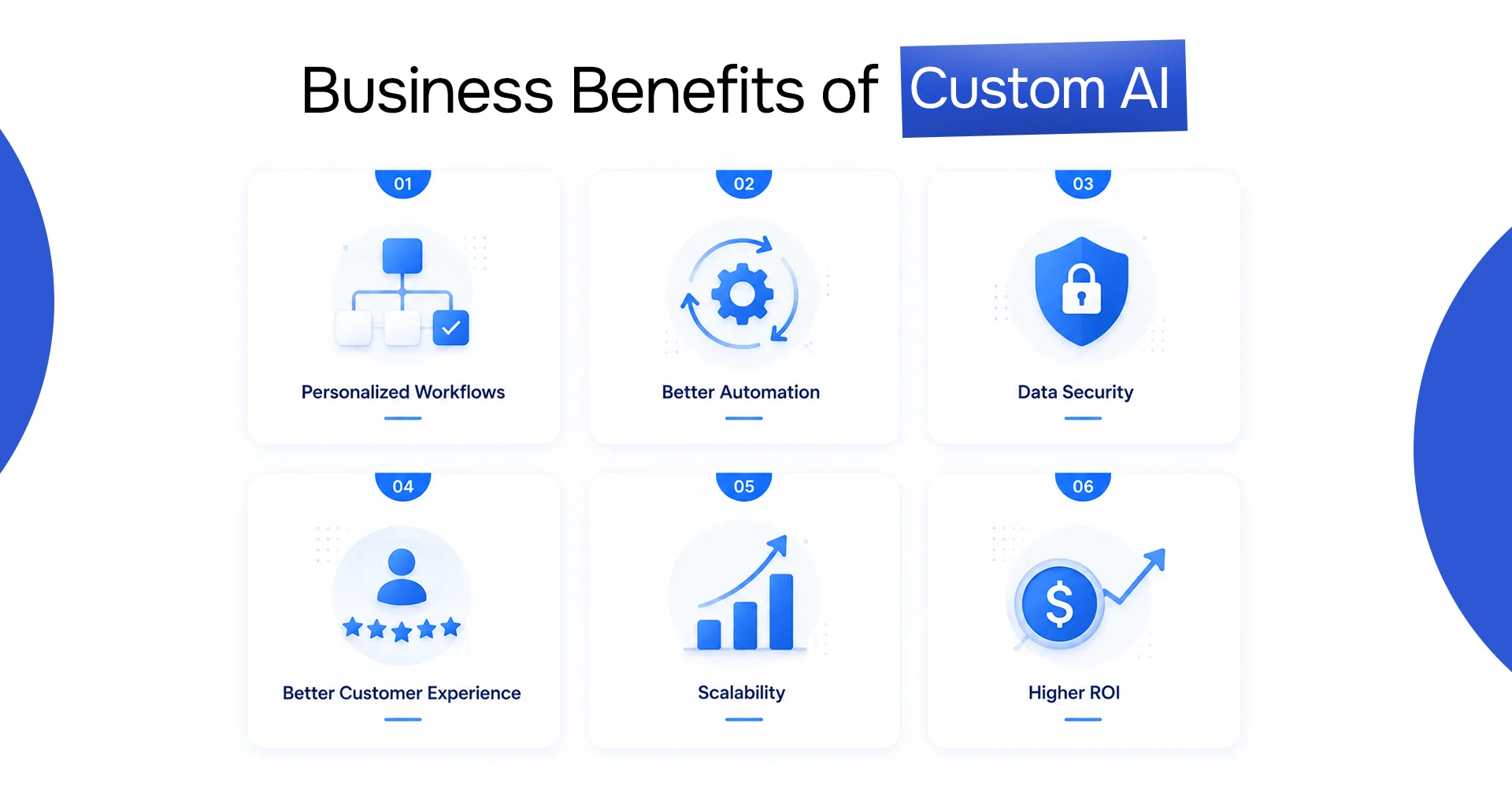
Personalized workflows
Generic tools force you to change your process. Custom AI fits the process you already have. Your team does not need to learn a new way of working - the software works the way they do.
Better automation
Off-the-shelf automation breaks when the input is not perfect. Custom AI can handle real, messy inputs: emails, PDFs, photos, and half-filled forms. This means you can automate work that was impossible to automate before.
Competitive advantage
Everyone can buy the same off-the-shelf tool, so it gives no advantage. A custom AI system trained on your data and your process is something competitors cannot copy easily.
Improved customer experience
Custom AI can answer customer questions using your real product data, your policies, and the customer's own history. Generic chatbots give generic answers. Custom ones give correct answers.
Scalability
When your business grows, a custom system grows with you. You control the infrastructure, so you can handle more users, more data, and more features without waiting for a vendor.
Data privacy
With off-the-shelf tools, your data often goes to someone else's servers under their rules. With custom AI, you decide where data lives, who can see it, and which model providers (if any) can touch it. For businesses in finance, health, or legal work, this is often the deciding reason.
Higher ROI
Custom AI costs more at the start but usually costs less over time. There are no per-seat fees that grow with your team. The system automates your most expensive tasks, not generic ones. And you own the software as an asset instead of renting it forever.
Custom AI Software vs Off-the-Shelf AI Solutions
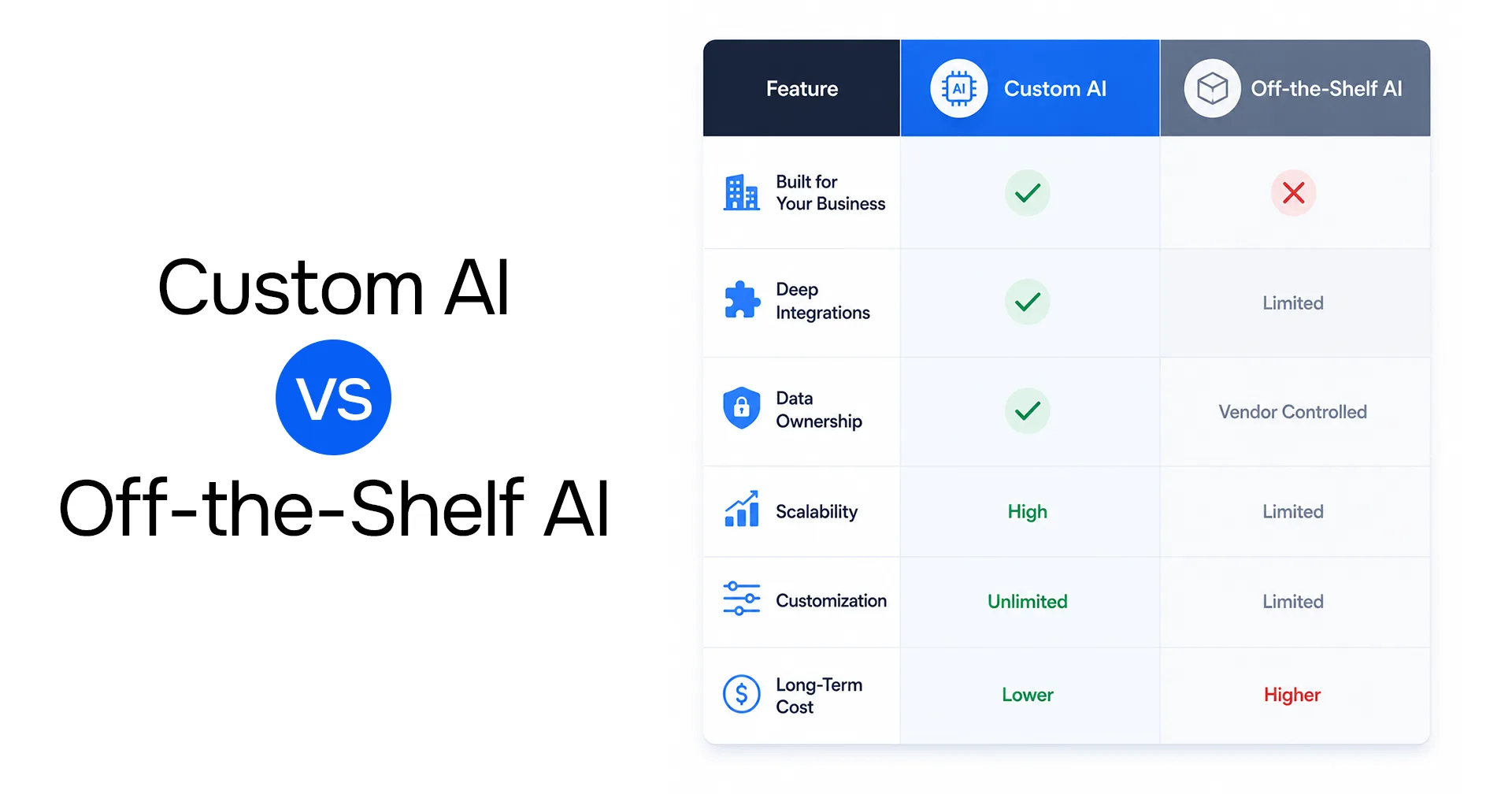
Both options have their place. This table shows the main differences:
| Factor | Custom AI Software | Off-the-Shelf AI Tools |
|---|---|---|
| Flexibility | Built for your exact needs; change anything | Fixed features; you adjust to the tool |
| Cost | Higher upfront, lower over time | Low to start, monthly fees grow with usage and team size |
| Security | You control data, access, and storage | Data goes to the vendor under their rules |
| Scalability | Scales the way you plan it | Limited by vendor plans and quotas |
| Ownership | You own the code and the system | You rent access; vendor can change or close the product |
| Maintenance | You (or your partner) maintain it | Vendor maintains it |
| Customization | Unlimited | Only what the settings allow |
| Integration | Deep integration with your systems | Only the integrations the vendor built |
A simple rule: if a ready-made tool covers 90% of your need, buy it. If your need is specific to your business, or the tool's limits are costing you money, build custom.
The Custom AI Software Development Process
A good AI custom software development project follows clear steps. Here is the process we recommend:
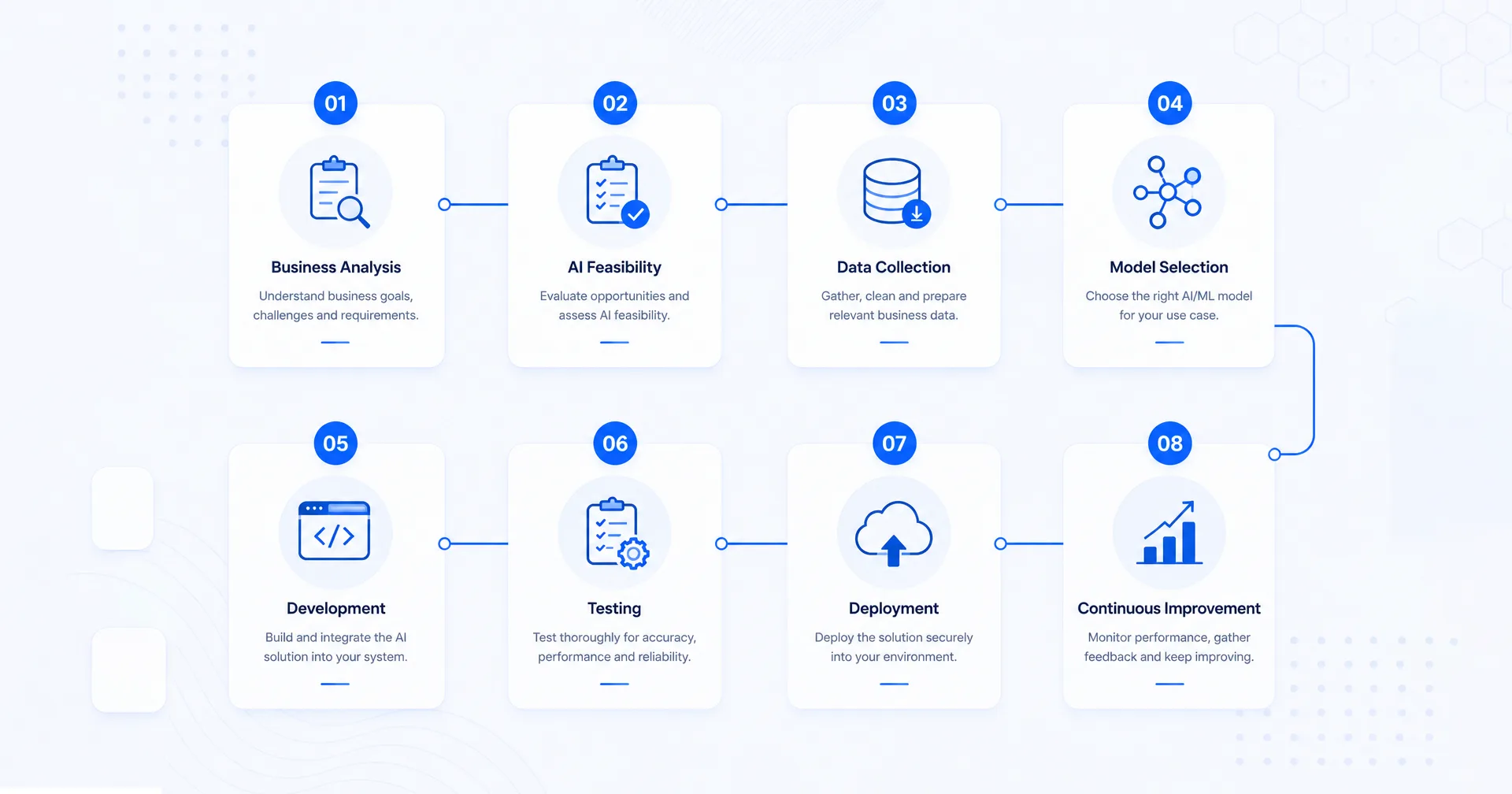
Business Requirement Analysis
First, understand the business problem. Which task takes too much time? Where do errors happen? What would success look like in numbers? AI is only useful when it solves a real, measurable problem.
AI Feasibility Study
Not every problem needs AI, and not every problem can be solved by AI. This step checks: Is the data available? Can current AI models do this task well? What will it cost to run? An honest feasibility study saves a lot of money later.
Data Collection
AI systems need data - documents, records, past examples. This step collects the data, cleans it, and checks its quality. In many projects, this is the step that takes the most effort.
Model Selection
Which AI model fits the task? Sometimes a large model like GPT or Claude is right. Sometimes a small, cheap model does the job. Sometimes you need a model trained on your own data. Choosing well here controls both quality and cost.
Model Training
If the project needs a trained model, this step builds it: preparing training data, training, and measuring the results against a quality target. For many projects that use existing models, this step is lighter - it focuses on prompts and testing instead.
Software Development
Now the full application is built around the AI: the user interface, the database, security, and integrations with your other systems. This is normal software engineering, and it matters just as much as the AI itself.
Testing
Testing an AI system has two parts. Normal software testing checks that the app works. AI testing checks that the model gives good answers - using a test set of real examples with known correct results.
Deployment
The system goes live, usually step by step. Start with a small group of users, watch the results, then roll out to everyone. A careful launch avoids surprises.
Monitoring & Continuous Improvement
After launch, the work continues. Monitor speed, errors, costs, and answer quality. AI systems can slowly get worse if data or usage changes, so regular checks and small improvements keep the system healthy.
Key Features of Successful AI Custom Software Development
Good custom AI systems share some common features. When you plan your project, make sure these are included:
API integrations
The AI system should connect to the tools you already use - your CRM, your ERP, your email, your payment system. An AI tool that cannot connect to anything creates more manual work, not less.
Real-time analytics
You should see what the system is doing: how many tasks it handled, how fast, at what cost, and with what accuracy. Without numbers, you cannot manage or improve the system.
Personalized dashboards
Different people need different views. A manager needs summaries and trends. An operator needs today's queue. Good custom software gives each role the view it needs.
AI automation
The core value: the system should complete real work from start to finish - read the document, extract the data, update the record, and only ask a human when it is unsure.
Secure architecture
Security must be part of the design, not an add-on. This means access control, encrypted data, safe handling of API keys, and protection against misuse (including prompt injection attacks on AI features).
Cloud deployment
Cloud infrastructure lets the system grow when you grow and keeps costs matched to usage. It also makes backups, monitoring, and updates much easier.
Human-in-the-loop systems
The best AI systems know their limits. When the AI is not confident, the task goes to a person. The person's decision can then be used to make the system better. This keeps quality high and builds trust with your team.
Custom AI Software Development Cost
The honest answer about custom AI software development cost: it depends on scope. But here are typical ranges you can use for planning:
| Project Type | Estimated Cost |
|---|---|
| Proof of concept / pilot | $5,000 - $20,000 |
| AI MVP (one core workflow) | $15,000 - $50,000 |
| Mid-size custom AI application | $50,000 - $150,000 |
| Enterprise AI platform | $150,000+ |
These are general market ranges. A well-scoped pilot is the smart way to start: it proves the value before you invest in the full system.
Factors Affecting Pricing
Complexity
A single clear task (like reading one type of document) costs much less than a system with many tasks and decisions.
Features
Every screen, report, integration, and user role adds work. Cutting features you do not need is the easiest way to control cost.
AI Models
Using an existing model through an API is cheaper to build. Training your own model costs more upfront but can be cheaper to run at high volume.
Integrations
Each system you connect to (CRM, ERP, accounting) adds effort - especially older systems without modern APIs.
Team Size
More developers move faster but cost more per month. A small senior team is often cheaper overall than a large mixed team.
Data Preparation
If your data is clean and organized, this is cheap. If data lives in scanned PDFs and old spreadsheets, preparing it can be a big part of the budget.
Infrastructure
Running costs matter too: model API fees, servers, and storage. A good partner designs the system so these costs stay predictable as usage grows.
Maintenance
Plan for ongoing costs of about 15-20% of the build cost per year: monitoring, updates, model improvements, and small fixes.
How to Choose a Reliable Custom AI Software Development Company
Choosing the wrong partner is the most expensive mistake in this whole process. Here is what to check before you sign:
AI expertise
Ask real questions: How do they test AI quality? How do they control model costs? What happens when the AI gives a wrong answer? A reliable custom AI software development company will have clear, specific answers.
Technical architecture experience
The AI is only one part. Ask how they design the full system - database, security, background jobs, scaling. Weak architecture is the most common reason AI projects fail after launch.
Portfolio
Look for real projects with real results, not only demos. Ask what the system does today, months after launch. Case studies with numbers are a good sign.
Data security practices
Your data will pass through their hands. Ask how they handle secrets, customer data, and access control. Ask which model providers they use and where your data goes.
Communication
You should always know the status, the cost, and the risks. If communication is unclear during sales, it will be worse during the project.
Agile development
Good partners deliver working software every one or two weeks - not a big surprise after six months. Regular demos keep the project honest.
Post-launch support
Ask what happens after launch. Who fixes issues? Who monitors costs and quality? A partner who disappears after delivery leaves you with a system nobody can maintain.
Cloud expertise
The system will live on cloud infrastructure. Your partner should know how to deploy, secure, and scale it there, and how to keep the monthly bill under control.
Experience with AI infrastructure
Running AI in production is a special skill: managing model APIs, handling outages, caching, evaluating quality over time. Ask for examples of AI systems they operate today.
Need AI software tailored to your business? Talk to Eunix Tech and build scalable AI products designed for long-term growth.
Conclusion
Custom AI software development is becoming a normal business decision, not an experiment. Generic AI tools are useful, but they all have the same limits: they do not know your business, they cannot connect deeply to your systems, and they give the same features to you and your competitors.
Custom AI is different. It fits your workflow, protects your data, grows with your business, and becomes an asset you own. The upfront cost is higher, but for the right problem, the long-term value is much greater.
The key is to start smart: pick one process with clear value, run a feasibility check, build a small pilot, and measure the results. If you want help with any of these steps, talk to the Eunix Tech team - we build practical AI systems and custom products for businesses worldwide.
Frequently Asked Questions (FAQ)
What is custom AI software development?
Custom AI software development is the process of building AI-powered software designed for one specific business. It combines AI models (for understanding text, images, or data) with normal software engineering (interfaces, databases, security, integrations) to solve a specific business problem - instead of using a generic, one-size-fits-all tool.
How much does custom AI software development cost?
Typical market ranges: $5,000-$20,000 for a pilot, $15,000-$50,000 for an MVP with one core workflow, $50,000-$150,000 for a mid-size application, and $150,000+ for enterprise platforms. The main cost drivers are complexity, integrations, data preparation, and the choice between API-based models and custom-trained models.
How long does it take to build custom AI software?
A pilot usually takes 2-6 weeks. An MVP takes about 2-3 months. A full mid-size system takes 3-6 months. Projects go faster when the scope is small and the data is already clean.
Is custom AI better than using ChatGPT or other AI tools?
They solve different problems. ChatGPT and similar tools are great for general tasks. Custom AI is better when you need the system to know your business data, follow your rules, connect to your internal systems, or keep data private. Many businesses use both.
Which industries benefit most from custom AI software?
Any industry with repetitive document work, customer communication, or data-heavy decisions: finance, healthcare, logistics, construction, e-commerce, legal, real estate, and manufacturing. If your team spends hours on reading, sorting, entering, or answering - custom AI can likely help.
How do I choose the right custom AI software development company?
Check the essentials: real AI expertise (ask how they test quality and control costs), strong architecture skills, a portfolio with results, clear communication, and post-launch support. The section above covers the full list of nine criteria. Be careful with companies that promise a full system without first studying your data and process.
Can custom AI software integrate with existing business systems?
Yes - this is one of its biggest advantages. Custom AI can connect to your CRM, ERP, accounting software, email, and databases. Deep integration is usually what makes the automation valuable.
What technologies are commonly used in AI custom software development?
Common choices: Python and Node.js for backend, React and Next.js for interfaces, PostgreSQL for data, and AI models such as GPT, Claude, or open-source models. Cloud platforms (AWS, Vercel, Azure) handle hosting. The right stack depends on your project, not on fashion.
Do custom AI solutions require ongoing maintenance?
Yes. Plan for roughly 15-20% of the build cost per year. AI systems need monitoring for quality, cost, and errors - models, data, and usage change over time. A system without maintenance slowly gets worse.
Are custom AI software development services suitable for startups?
Yes, if the scope is right. Startups should start with a small pilot or an MVP focused on one workflow, not a big platform. This keeps cost low and proves value fast. Read our guide on AI MVP development for a detailed approach.
Who provides the best AI custom software development services for personalized business applications?
Look for a partner with senior engineers, real production AI experience, honest scoping, and clear post-launch support. At Eunix Tech, we build custom AI systems and personalized business applications for clients worldwide - starting with an audit or pilot, so you invest based on evidence, not promises.
