
How Much Does an MVP Cost? A Budget Framework
How much does an MVP cost? There is no flat price, but you can budget with confidence. See what drives MVP cost, how it splits by phase, and how to reduce it.
"How much will my MVP cost?" This is the first question almost every founder asks us. It is also the hardest one to answer in one sentence.
Quick answer: An MVP costs roughly what its scope costs. A landing page that tests demand sits at the low end. A single-flow mobile app and a SaaS product sit in the middle. Marketplaces and AI products sit at the high end, because they are really several products working together. Two things move the price more than anything else: how many features you insist on, and who builds it. The rest of this guide shows how to estimate your own number: the cost drivers, how the budget splits by phase, and what to check in any quote.
There is no universal price for an MVP, because no two products are the same. A simple landing page with a waitlist and a marketplace that matches buyers with sellers are both called "MVPs," but they are very different projects with very different budgets.
MVP development cost depends on the features you need, the technology stack, third-party integrations, the size and location of the team, AI complexity, compliance requirements, how much the product must scale, and how fast you want to launch.
At the same time, the question deserves a real answer, not just "it depends." Founders need a way to plan a budget, talk to investors, and compare proposals from development partners. And they need to balance two risks: spending too much on a product nobody wants, or spending too little and shipping something that breaks with the first real users.
This guide covers all of it: how MVP cost scales by product type, the factors that move the price up or down, MVP pricing models, a budget planning checklist, hidden costs most founders forget, and practical ways to reduce MVP development costs without hurting quality.
Why We Do Not Publish Fixed MVP Prices
You will notice this guide uses relative ranges, percentages, and timelines instead of dollar figures. That is deliberate.
A published price anchors your expectations before anyone knows your scope, and the same label ("SaaS MVP") can mean a six-week build or a six-month one. A number copied from a blog post is a guess dressed up as a fact. A scoped estimate is built from your actual features, platform, integrations, and team, so it is the only number worth planning around. If you want one, talk to us and we will give you a scoped, itemized estimate instead of a ballpark.
What Is an MVP?
An MVP - Minimum Viable Product - is the smallest version of your product that solves one real problem for real users. It is not a demo and it is not a prototype. People can actually use it, and you can actually learn from it.
The purpose of an MVP is learning, not perfection. Instead of guessing what users want and building for a year, you build the core in weeks or a few months, put it in front of real users, and let their behavior tell you what to build next.
The benefits are simple:
- Lower risk. You test the idea before you spend a large budget on it.
- Faster launch. You reach the market in months, not years.
- Real feedback. Users show you what matters. Your roadmap stops being a guess.
- Easier fundraising. A working product with early users is far more convincing to investors than a slide deck.
This is why startups build MVPs first. Most successful products you know today - Airbnb, Dropbox, Uber - started as small, focused MVPs. The early version cost a fraction of what the full product cost later, and it proved the idea was worth the bigger investment.
If your product involves AI, our AI MVP development guide covers what changes, and our guide to AI software development cost covers how AI features affect the budget.
How Much Does It Cost to Build an MVP? By Product Type
Cost scales with complexity. This table shows the relative investment for each MVP type and what drives it, along with realistic timelines.
| MVP Type | Relative Investment | What It Involves | Main Cost Driver | Typical Timeline |
|---|---|---|---|---|
| Landing Page MVP | Lowest | A page that explains the product, collects signups, maybe takes pre-orders | Design and copy quality | 3-7 days |
| Simple Mobile MVP | Low to moderate | One core flow, a small backend, basic accounts | Platform choice (cross-platform vs. native) | 2-4 weeks |
| SaaS MVP | Moderate | Subscriptions, billing, user roles, dashboards, one or two integrations | Billing logic, roles, integrations | 4-8 weeks |
| Marketplace MVP | Moderately high | Two user types, listings, search, payments, reviews | Two-sided workflows and payments | 6-12 weeks |
| AI MVP | Highest | Everything a SaaS MVP needs, plus model integration, prompt design, quality testing, AI infrastructure | AI complexity and ongoing usage costs | 8-16 weeks |
How to read this table:
- Landing Page MVP. The cheapest way to answer "does anyone want this?" before you build anything.
- Simple Mobile MVP. Think of a habit tracker or a booking app for one service. One flow, done well.
- SaaS MVP. The recurring-revenue model adds real engineering work: billing, plans, permissions, and usage tracking.
- Marketplace MVP. Two-sided products always cost more because you are really building two apps that must work together.
- AI MVP. Costs continue after launch because AI APIs charge per use. Quality testing for AI output is also a real line item, not an afterthought.
Why is the range so wide inside each category? Because scope (how many features you insist on) and team (who builds it, and where they are located) move the price more than anything else. A senior team in a high-cost market can charge several times the hourly rate of an equally experienced team in a cost-effective region. That difference alone can cut your build cost by half or more, as long as you judge teams by shipped work and not just the rate.
Why Is MVP Development So Expensive?
Founders are often surprised by the first quote. It is rarely because the vendor is padding. It is usually because of one of these:
- An MVP is still a real product. Authentication, payments, data storage, security, and deployment all have to work, even in a "minimal" version.
- You pay for people, not just code. A product needs a designer, developers, a QA tester, and someone managing scope. Their time is the cost.
- Unclear scope is expensive. Every vague requirement becomes extra discussion, rework, and contingency in the estimate.
- Quality is not optional. An MVP that breaks in front of your first users teaches you nothing.
The fix is almost always the same: cut scope before you cut quality. We cover how below.
Factors That Affect MVP Development Cost
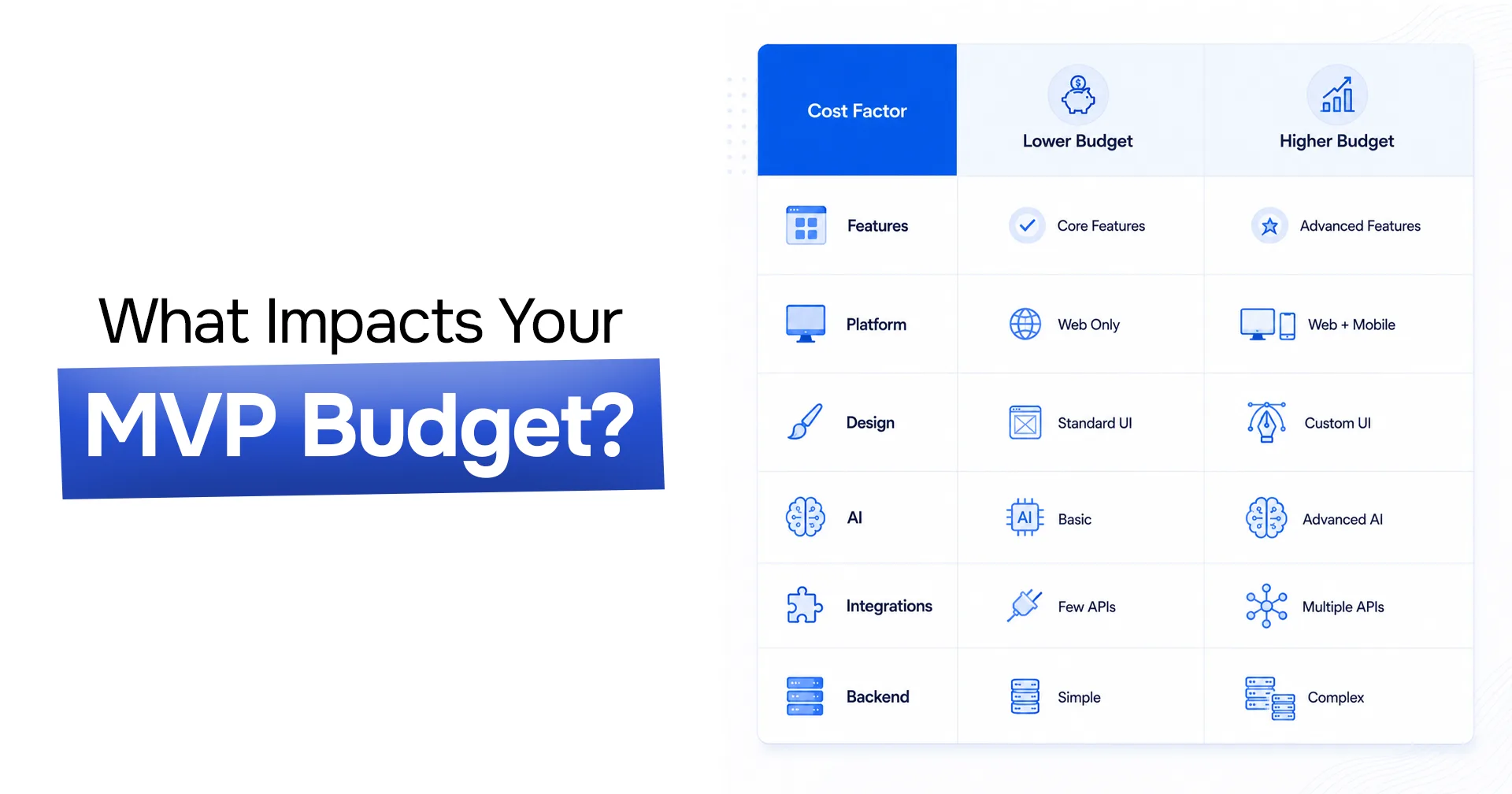
Every proposal you receive is really the sum of the factors below. Understanding them helps you read quotes, compare them fairly, and negotiate with confidence.
Features & Scope
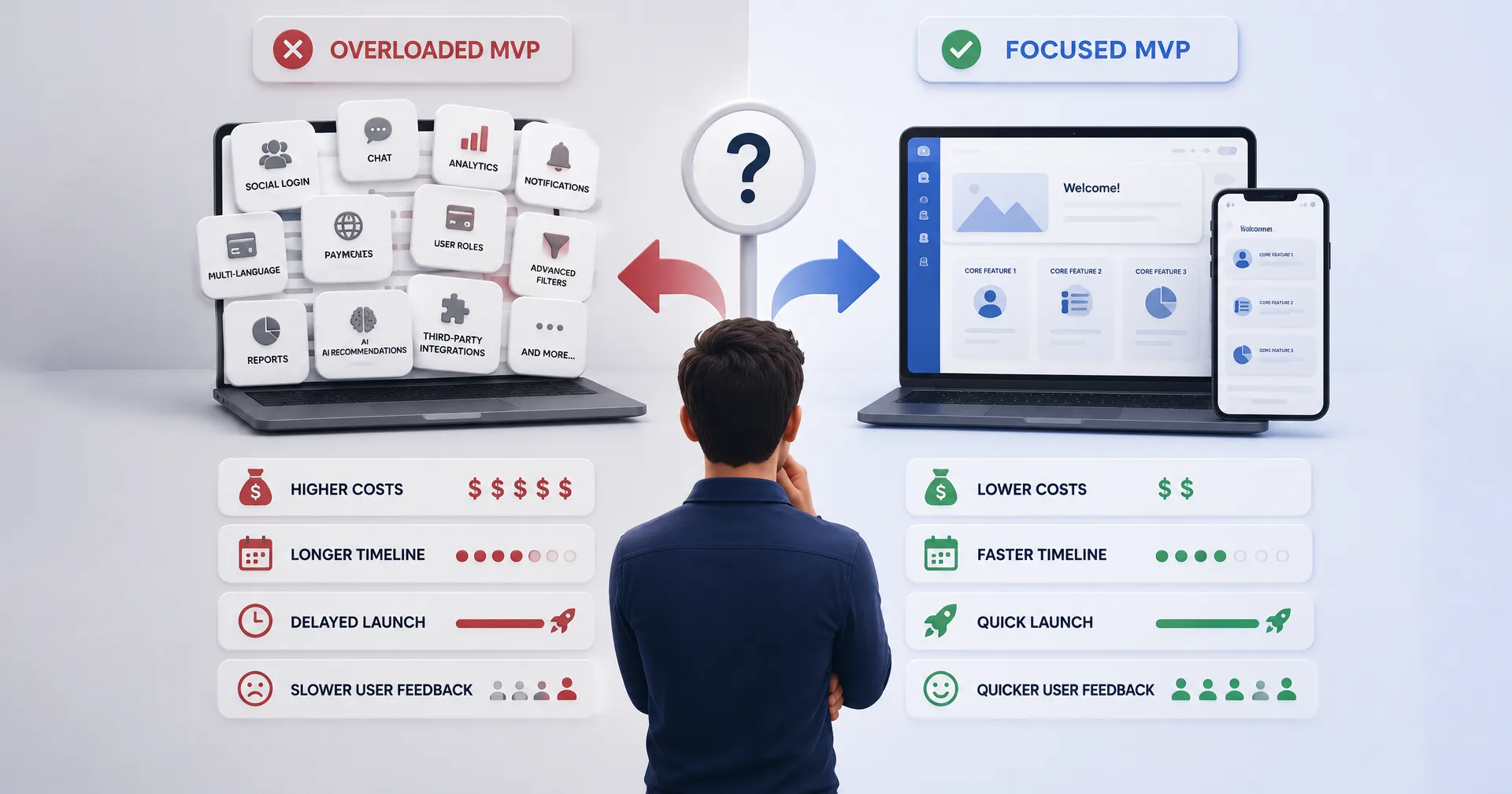
The biggest cost driver by far. Every screen, every user role, and every "small extra" adds design, development, and testing time. A good rule: your MVP should do one thing well. Each feature beyond the core problem adds cost and delays your launch.
Platform
Where your product runs changes the budget.
Web
Usually the cheapest starting point. One codebase, instant updates, no app store review. Most SaaS and marketplace MVPs should start on the web.
Mobile
Native iOS and Android apps mean two codebases, two release processes, and app store rules. Building both natively can nearly double the front-end budget.
Cross-platform
Frameworks like React Native and Flutter let one team ship one codebase to both iOS and Android. For most MVPs, this is the smart middle path - you save 30-40% compared to two native apps.
UI/UX Design
Design covers research, wireframes, visual design, and clickable prototypes. For an MVP, clean and simple beats custom and fancy. Using a proven design system keeps this at 10-15% of the budget instead of 25%.
Backend Complexity
The backend is everything users do not see: databases, business logic, and APIs. A simple CRUD backend is cheap. Real-time features, complex workflows, heavy data processing, or strict security requirements raise the cost quickly.
APIs & Third-Party Integrations
Payments, maps, SMS, email, calendars, CRMs - each integration saves you from building that feature yourself, but each one takes days of work to connect, test, and handle errors for. Integrations also add monthly fees that continue after launch.
Authentication
Basic email and password login is standard. Social login, two-factor authentication, single sign-on for business customers, and role-based permissions each add work. Enterprise SSO in particular is a feature founders underestimate.
AI Features
AI features add three costs: engineering (connecting models, designing prompts, handling failures), testing (AI output must be checked for quality, not just for bugs), and usage (AI APIs charge per call, forever). A chatbot on top of your own data can add weeks to the build and a real monthly bill after launch.
DevOps & Cloud Infrastructure
Someone must set up hosting, deployment pipelines, staging environments, and backups. Done early, this is a small, bounded piece of work. Skipped early, it becomes an expensive emergency after launch.
QA & Testing
Testing is usually 15-20% of the total effort. Cutting it does not remove the cost - it moves the cost to after launch, where bugs are more expensive and hurt your reputation with the exact early users you need to impress.
Post-launch Maintenance
An MVP is a starting line, not a finish line. Plan for roughly 15-20% of the initial build cost per year for updates, fixes, security patches, and small improvements.
MVP Estimation: Development Cost Breakdown by Phase
MVP estimation becomes much easier when you split the project into phases. This is how a typical MVP budget is distributed:
| Phase | Share of Budget | What It Covers |
|---|---|---|
| Discovery & Planning | 10% | Problem definition, feature cuts, user flows, itemized estimate |
| UI/UX Design | 15% | Wireframes, visual design, clickable prototype |
| Development | 45% | Front end, back end, integrations |
| Testing & QA | 15% | Functional, device, and quality testing |
| Deployment & Launch | 5% | Hosting, pipelines, release |
| Maintenance (first months) | 10% | Fixes and small improvements after launch |
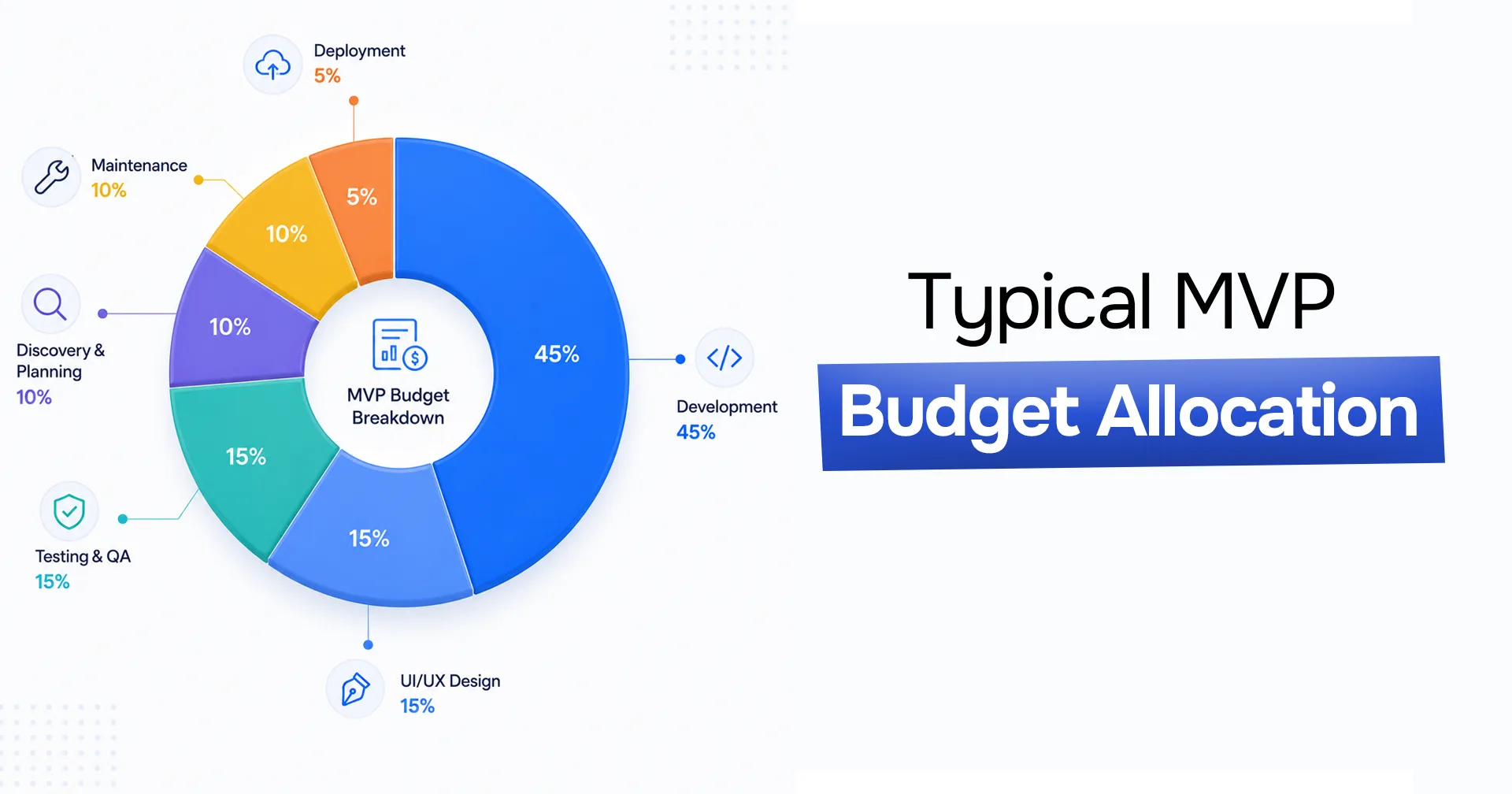
Two lessons from this table.
First, development is less than half the budget. Founders who only budget for "coding" run out of money before launch. Discovery, design, testing, and deployment are not optional extras - they are the difference between a product and a pile of code.
Second, discovery is the cheapest phase and prevents the most expensive mistakes. A good discovery phase defines the core problem, cuts unnecessary features, and produces an estimate you can trust. Skipping it to "save 10%" is how projects go 100% over budget. If you are asking how much a discovery phase should cost, the answer is a small, fixed slice of the total, and it should end with an itemized scope and estimate you own.
How Much Should You Spend on an MVP?
This is the question behind the question, and it has a different answer from "what does an MVP cost."
Spend the minimum needed to prove your core assumption, and no more. That assumption might be "people will pay for this," "users will come back weekly," or "a business will integrate this into its workflow." Work out what the cheapest credible test of that assumption looks like, and build only that.
A few practical guides:
- Match the spend to the risk. If the riskiest assumption is demand, a landing page test costs far less than a full build and answers the question faster.
- Leave room to iterate. An MVP that uses the whole budget on version one gives you no money to act on what users tell you. Plan for at least two rounds of post-launch changes.
- Do not spend to impress investors. Investors respond to evidence of demand, such as users, engagement, and early revenue, not to polish.
- Keep a contingency buffer. Add 15-20% on top of the estimate for the things that always change.
And sometimes the honest answer is: do not build yet. If you have not talked to ten potential customers, or a no-code tool can test the idea in a weekend, do that first. We would rather tell you that than sell you a build you do not need.
MVP Pricing Models Explained
How you pay matters as much as how much you pay. These are the four common MVP pricing models:
Fixed Price
You agree on a scope and a price before work starts. This works well when the scope is small and clear - like a landing page MVP or a well-defined single-flow app. The risk: any change costs extra, and vendors add a safety margin to protect themselves. Best for small, well-defined MVPs.
Time & Material
You pay for actual hours worked. This fits MVPs well, because MVPs change - user feedback is the whole point. You keep flexibility to adjust scope every sprint. The risk: the budget needs active management. Agree on a monthly cap and weekly progress reviews.
Dedicated Team
You pay a monthly rate for a full team (for example: two developers, a designer, and a project manager) that works only on your product. This makes sense when you plan to keep building after the MVP launch. It gives you speed and consistency, but it is oversized for a small first version.
Staff Augmentation
You already have a technical team and add specific specialists - for example, an AI engineer for three months. You manage the work; you pay for the extra hands. This is the right model when the missing piece is skills, not a whole team.
For most startups building a first MVP, we recommend time & material with a capped budget, or fixed price if the scope is genuinely small and stable. If you are comparing partners, our guide to MVP development services for startups covers what to look for.
Is a Very Cheap MVP Quote Realistic?
Sometimes. A landing page or a no-code prototype can be built very cheaply, and that is fine. But when a quote for a "production-ready" product is far below every other quote you received, treat it as a warning and ask these questions:
- Is it itemized by phase? Discovery, design, development, testing, and deployment should each appear. A single line item hides what is missing.
- Is testing included? If QA is not in the quote, you will pay for it later in bugs.
- Who exactly will work on it? Ask for named people and their seniority, not just "a team."
- Who owns the code and the accounts? You should own the repository, the hosting, and the domain from day one.
- What happens after launch? Check whether support, fixes, and handover are included.
- Can you see shipped work? Ask for live products and references, not mockups.
The cheapest quote is rarely the cheapest outcome. We have rescued many products built on unrealistically low estimates, and the rescue is almost always more expensive than building it properly would have been. We wrote about that in how to fix a failed automation project.
MVP Budget Planning and Estimation Checklist
Before you ask anyone "how much?", work through this checklist. It will make every conversation with a development partner faster and every estimate more accurate.
Business goals
Write down what the MVP must prove. "Get 100 paying users in 3 months" leads to a different build than "show a working demo to investors." The goal defines the scope, and the scope defines the budget.
Must-have features
List every feature you can imagine. Then mark each one: must have for launch, or nice to have later. Be brutal. If the product works without it, it is not a must-have. This single exercise usually cuts the first quote by around 30%.
Timeline
Decide your launch date and work backwards. A hard deadline (a trade show, an investor meeting) may justify a bigger team. A flexible timeline lets a smaller team build the same product for less.
Contingency
Add a 15-20% buffer on top of the estimate. Something always changes - a new insight from users, an API that behaves badly, a feature that takes longer. A buffer keeps surprises from becoming crises.
Infrastructure
Budget the monthly running costs separately: hosting, databases, third-party APIs, monitoring, and AI usage. For a typical MVP these are small next to the build, but AI-heavy products can grow quickly with usage.
Maintenance
Reserve 15-20% of the build cost per year for maintenance from day one. If your MVP succeeds, this is the budget that keeps it alive while you raise the next round.
Hidden MVP Costs Most Founders Forget
The build quote is not the full picture. These are the costs that surprise founders after launch:
Cloud hosting
Free tiers end. As users grow, hosting bills grow with them. Budget for it from month one.
Third-party APIs
Payment processors take a percentage of every transaction. Maps, SMS, and email services charge by usage. Ten small subscriptions add up to a real monthly number.
Analytics
You built the MVP to learn, so you need analytics, event tracking, and maybe session recording. Some tools are free at the start; the useful tiers are not.
App Store fees
Apple and Google both charge developer account fees and take a commission on in-app purchases and subscriptions, with reduced rates for small businesses. For subscription products, this changes your pricing math.
Security
SSL, secure storage of user data, dependency updates, and periodic security reviews. Cheap compared to one data breach.
Scaling
The architecture that serves 100 users may fail at 10,000. If your MVP succeeds, some parts will need rework. Good initial architecture makes this cheaper, but never free.
Legal compliance
Privacy policies, terms of service, GDPR if you have European users, and industry rules if you touch health or financial data. Compliance for a health app can add real cost before launch.
Monitoring
Error tracking, uptime alerts, and log storage. Without monitoring, your users become your alert system, and they resign from that job quickly.
Maintenance
Operating systems update, browsers change, dependencies release security patches. Software that nobody maintains slowly breaks by itself.
None of these costs should scare you. They are all manageable, but only if they are in the budget before launch, not discovered after.
How to Reduce MVP Development Costs Without Compromising Quality
The goal is not to spend as little as possible. The goal is to spend only on what matters. These strategies reduce MVP development costs without hurting the product:
Build only core features
The single biggest saving. Solve one problem for one user type. Every feature you postpone saves money now and keeps your product easier to change later.
Use proven frameworks
Next.js, Django, Rails, Laravel - mature frameworks come with authentication, security, and structure already solved. Custom-built foundations burn budget and add bugs.
Cross-platform development
One React Native or Flutter codebase instead of separate iOS and Android apps saves 30-40% on mobile development, with quality that is more than good enough for an MVP.
Open-source technologies
PostgreSQL instead of a proprietary database, open-source libraries instead of paid components. Modern open-source tools are production-grade and free.
Prioritize backlog
Review priorities every one or two weeks. Feedback changes what matters. A backlog that is actively re-ranked means the team always works on the most valuable item, so every unit of budget buys learning.
Reuse components
UI component libraries, ready-made admin panels, and services like Stripe, Auth0, or Firebase let you buy solved problems instead of rebuilding them.
Continuous testing
Test throughout development, not in one big phase at the end. Bugs found early cost minutes; the same bugs found after launch cost days and users.
Outsource strategically
An experienced external team in a cost-effective region often delivers the same MVP at a fraction of the cost of local hires - with no recruiting time and no long-term payroll. The key word is experienced: a cheap team that delivers unmaintainable code is the most expensive option of all.
Why Choose an Experienced MVP Development Partner
The cheapest quote is rarely the cheapest outcome. Here is what an experienced MVP development partner actually changes:
Technical architecture
Experienced teams make the boring early decisions - clean separation of layers, sensible data models, proper environments - that make every later feature cheaper to build.
Scalability
Your MVP should be minimal in features, not in engineering quality. A partner who has taken products past launch knows which corners are safe to cut and which ones will collapse under real users.
Product strategy
A good partner challenges your feature list, pushes back on scope, and helps you find the smallest product that tests your idea. Sometimes the most valuable sentence in discovery is "you don't need that yet."
Future-ready code
Readable, tested, documented code means the next developer, or the next funding round's bigger team, can build on the MVP instead of rewriting it.
Faster iteration
After launch, speed of learning is everything. A well-built MVP lets you ship changes in days. A badly built one turns every small change into a week of fear.
Lower long-term costs
This is the real payoff. A slightly higher initial investment in quality typically pays for itself within the first year through lower maintenance, fewer emergencies, and no rebuild.
At Eunix Tech, we build MVPs for startups and businesses - web apps, mobile apps, SaaS platforms, and AI products. Our product engineering solutions cover the full path from discovery to launch and beyond. We have also rescued many MVPs that were built cheaply and failed under real users, so we know exactly which mistakes to avoid. If you want a realistic estimate for your idea - not a sales pitch - talk to us. We will tell you what your MVP really needs, what it can wait for, and what it will cost for your scope.
Conclusion
There is no single answer to "how much does an MVP cost," but there is a clear framework:
- Every MVP has different costs. Simple products sit at the low end; most serious MVPs land in the middle; AI and marketplace products reach higher.
- Focus on solving one core problem. Scope is the cost lever you control completely.
- Invest in scalable architecture. Minimal features, yes. Minimal engineering quality, no.
- Choose the right technology partner. Experience, honest estimation, and clean code matter more than the lowest hourly rate.
- Prioritize long-term ROI over the lowest initial quote. The cheapest MVP that must be rebuilt is more expensive than the right MVP built once.
Plan the budget with the phase breakdown, add a contingency buffer, remember the hidden costs, and your MVP estimation will be close to reality, which is more than most first-time founders can say.
Frequently Asked Questions (FAQ)
How much does it cost to build an MVP?
It depends on scope, platform, integrations, and the team. A landing page MVP sits at the lowest end, a simple mobile or SaaS MVP in the middle, and marketplace or AI MVPs at the highest end. Timelines run from a few days for a landing page to several months for an AI product. The only reliable number is an itemized estimate built from your own feature list.
How much does it cost to develop an MVP for a startup?
For a startup, the cost is driven mostly by how many features you insist on at launch and by whether you build on web, cross-platform mobile, or native apps. Cut the feature list to the one problem you must prove, start on the web or with a cross-platform framework, and your first quote will usually fall sharply.
How much should I spend on an MVP before seeking investors?
Spend the minimum needed to prove your core assumption. Investors want evidence of demand (users, engagement, early revenue), not a polished full product. Many founders validate demand with a landing page test before building the real MVP, and only then commit to a build.
Why is MVP development so expensive?
Because an MVP is still a real product. Authentication, payments, data storage, security, testing, and deployment all have to work, and a real team's time pays for them. Unclear scope makes it worse. Cutting scope, not quality, is the most effective way to bring the cost down.
What is included in MVP development pricing?
A complete MVP quote covers discovery and planning, UI/UX design, development, testing and QA, deployment, and early post-launch support. Be careful with quotes that only include "development" - design, testing, and infrastructure are not optional, and you will pay for them either way.
How can startups reduce MVP development costs without sacrificing quality?
Cut scope, not quality: build only core features, use proven frameworks and open-source tools, choose cross-platform development for mobile, reuse existing components and services, test continuously, and work with an experienced team in a cost-effective region. Avoid cutting testing, architecture, or discovery - those savings always come back as bigger costs.
Is a very cheap MVP quote realistic?
Only for very small scope, such as a landing page or a no-code prototype. For a production-ready product, a quote far below the others usually means missing testing, missing discovery, a junior team, or no post-launch support. Ask for an itemized breakdown, named people, and code ownership before you accept it.
What is the cost difference between iOS, Android, and cross-platform MVPs?
A cross-platform MVP (React Native or Flutter) typically saves 30-40% compared with building two native apps. Building separate native apps for both platforms costs meaningfully more, which is why most startups should start cross-platform or launch on one platform first.
How is MVP estimation calculated before development begins?
Through a discovery phase: the team defines the core problem, lists must-have features, designs the main user flows, and estimates each part in hours. The estimate is then multiplied by the team's rates, with a 15-20% contingency buffer added. A serious estimate is itemized by feature and phase - a one-line price is a guess.
Who provides cost effective mobile app MVP development services?
Specialized MVP development agencies with experienced teams in cost-effective regions such as India or Eastern Europe usually offer the best balance of cost and quality. Judge providers by shipped MVPs, code quality, and client references, not by the hourly rate alone. Eunix Tech provides exactly this: senior-level MVP development built around your scope.
What factors influence the cost of a mental health app MVP?
Health-related apps carry extra cost drivers: privacy and compliance requirements (HIPAA in the US, GDPR in Europe), secure storage of sensitive data, content for therapy or wellness programs, possible integrations with wearables, and careful UX for vulnerable users. Expect a meaningfully higher investment than a comparable consumer app, mostly because of compliance and security work.
What is the best budget-friendly application development consulting for MVPs?
Look for consulting that starts with a short, fixed-scope discovery phase producing a scoped feature list, an architecture plan, and an itemized estimate. This small investment protects the much larger build budget. Eunix Tech offers exactly this kind of consulting - we help founders define the smallest product worth building before they commit to full development.
