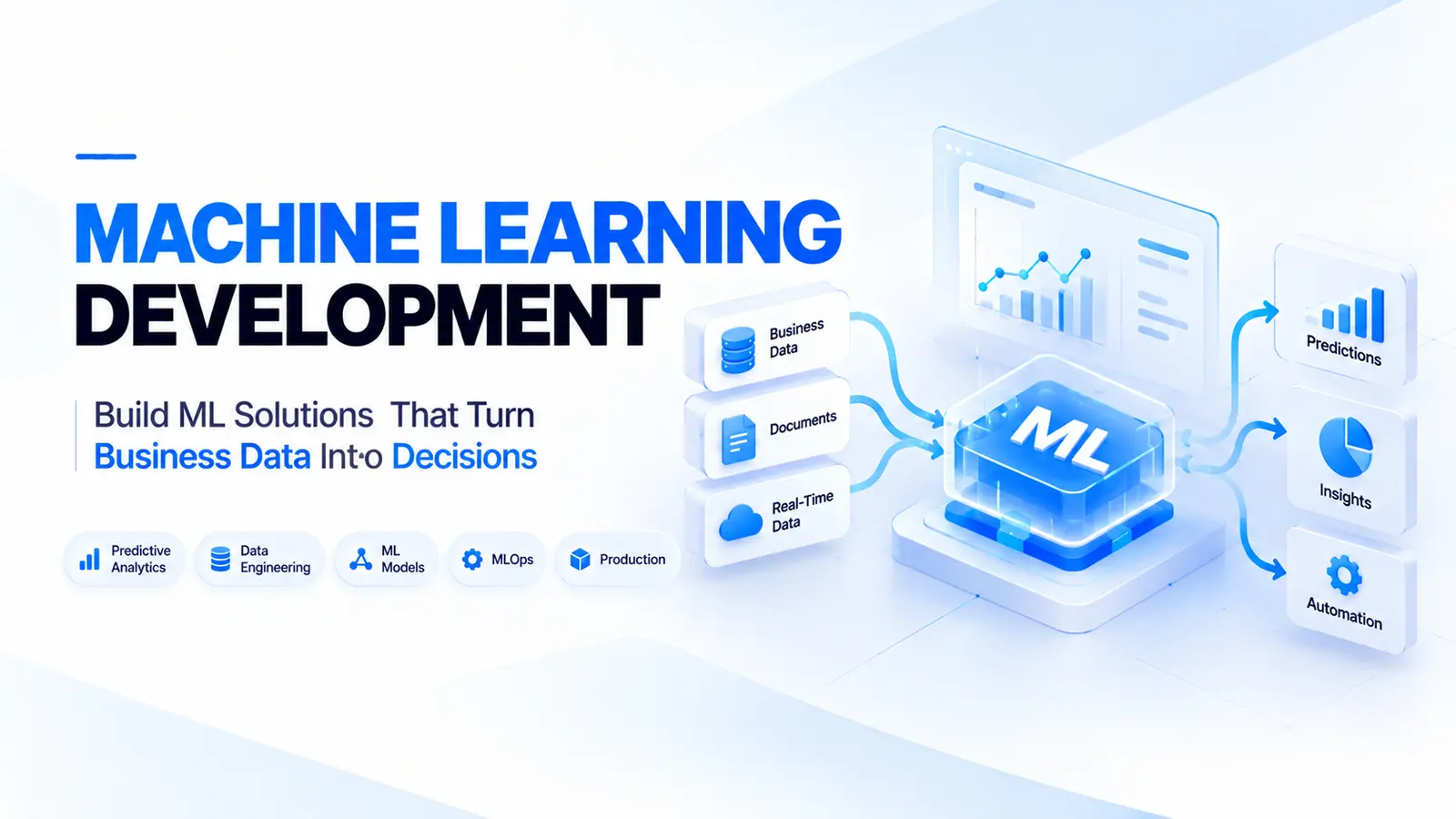
Generative AI has taken most of the attention over the past few years, and in the process a great deal of practical machine learning has been quietly overlooked. Forecasting demand, detecting fraud, scoring churn risk, segmenting customers, predicting equipment failure - these are prediction problems, and a well-trained conventional model solves them more accurately, faster and far more cheaply than a language model ever will.
Machine learning development is the discipline of building those systems: not just training a model, but assembling the data pipelines, integrations, deployment infrastructure and monitoring that turn a prediction into a business action. The model is usually the smallest part of the work, which is the single most common misunderstanding in ML projects. Google Cloud's MLOps architecture guide makes the same point: only a small fraction of a real-world ML system is the ML code.
This guide covers what ML development involves, how the process runs end to end, the types of machine learning and where each fits, business use cases, architecture and technology, what drives cost, MLOps, and how to evaluate machine learning development services.
What Is Machine Learning Development?
Machine learning development is the process of building software systems that learn patterns from data and use them to make predictions, classifications or recommendations - then delivering those predictions into a business process where someone or something acts on them.
The concept in its simplest form:
Business Problem → Data → ML Model → Prediction/Insight → Business Action
It differs from traditional software development in an important way. In conventional software, a developer writes the rules. In ML, the rules are derived from data - you supply examples and the model infers the pattern. That makes ML powerful where rules are too numerous or subtle to write down, and it makes ML systems dependent on data quality in a way ordinary software is not.
Machine learning sits inside the broader AI field. Generative AI and large language models are one branch; conventional ML - classification, regression, clustering, forecasting - is another, and remains the right tool for most prediction problems businesses actually have.
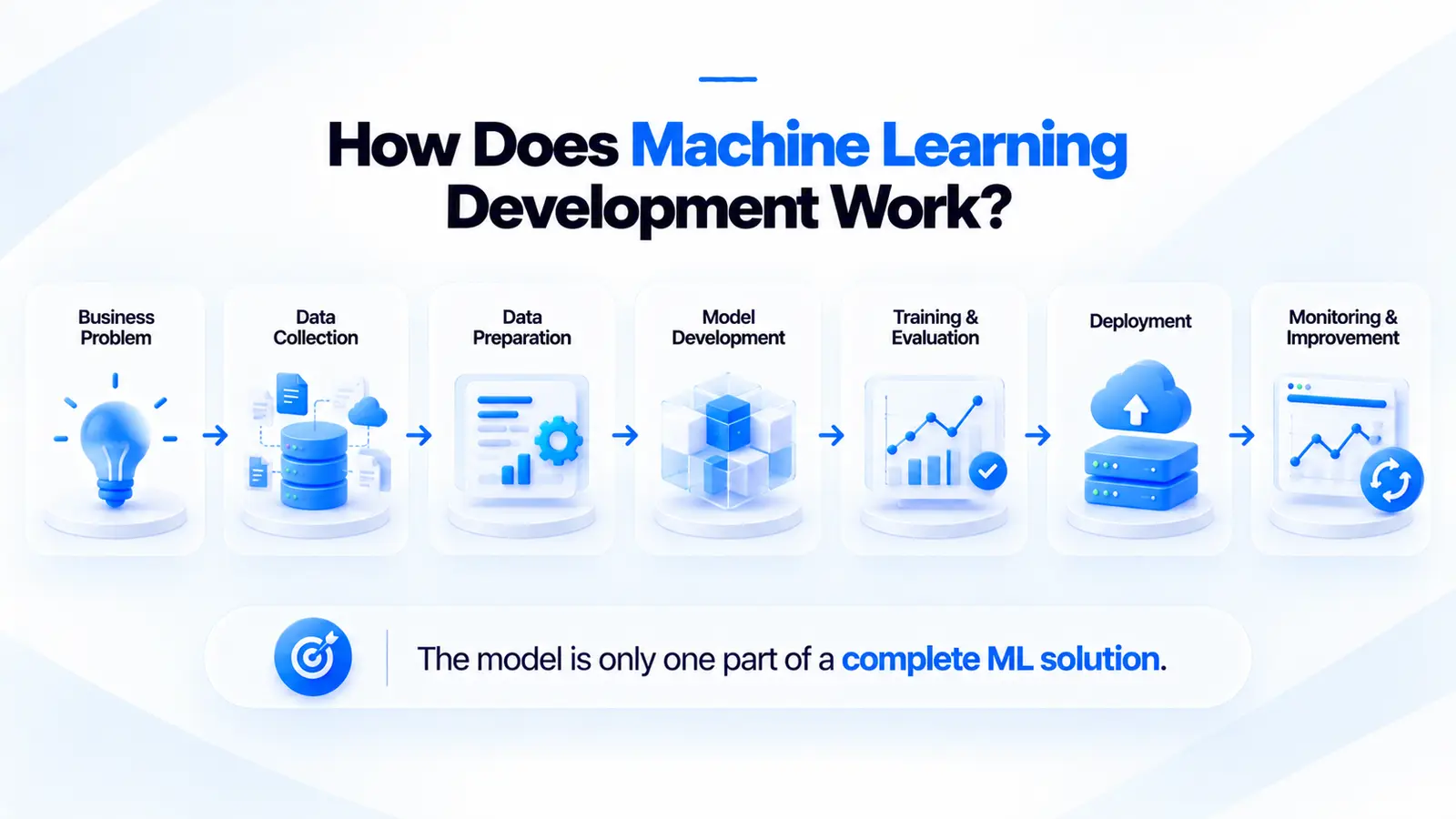
How Does Machine Learning Development Work?
Business Requirement → Data Collection → Data Preparation → Model Development → Training → Evaluation → Deployment → Monitoring
1. Define the Business Problem
Business objectives, target users, the problem being solved, expected outcomes and success metrics. "Predict churn" is not yet a specification; "identify accounts likely to cancel within 60 days so customer success can intervene" is.
2. Collect Relevant Data
Internal databases, customer data, transaction data, sensor data, application data, third-party and public datasets. The critical question is whether you have historical examples of the outcome you want to predict - without labelled outcomes, supervised learning is not available.
3. Prepare and Clean the Data
Cleaning, handling missing values, removing duplicates, transformation, normalisation, labelling and feature engineering. This routinely consumes the majority of a project's effort, and feature engineering - constructing the inputs that actually carry signal - often improves results more than changing algorithms.
4. Select the Machine Learning Model
Model choice follows the problem: classification, regression, clustering, recommendation, forecasting or anomaly detection. Start simple. Google's Rules of Machine Learning advise keeping the first model simple and getting the infrastructure right. A well-tuned gradient-boosted tree beats a neural network on most tabular business data, as benchmark research on tabular data shows, trains in minutes, and can be explained to a stakeholder.
5. Train the Model
Training, validation and test datasets kept properly separate, model training, and hyperparameter optimisation. Data leakage between these sets is the most common cause of a model that scores brilliantly in development and disappoints in production.
6. Evaluate Model Performance
Accuracy, precision, recall, F1, ROC-AUC, mean absolute error - plus business-specific KPIs. The technical metric and the business metric are not the same thing, and the second is what matters.
7. Deploy the Model
APIs, cloud infrastructure, application integration, real-time versus batch prediction, and production environments. A model that is not deployed produces no value, and a surprising number never get here.
8. Monitor and Improve the Model
Model performance, data drift, model drift, prediction quality, system performance and retraining. ML systems degrade quietly as the world changes underneath them - this is the defining operational difference from conventional software.
Types of Machine Learning
Supervised Learning
Learning from labelled examples to perform classification or regression - predicting churn, forecasting revenue, scoring risk. The great majority of business ML is supervised, and it requires historical outcomes to learn from.
Unsupervised Learning
Finding structure without labels: clustering, pattern discovery, customer segmentation and anomaly detection. Useful when you want to know what groups exist rather than to predict a known outcome.
Reinforcement Learning
Learning through rewards and actions in an environment. Genuinely powerful in areas like pricing, logistics and control systems, but harder to deploy safely and rarely the right first ML project for a business.
Deep Learning
Neural networks applied to image recognition, natural language processing, speech and complex prediction problems. Deep learning excels on unstructured data (images, audio, text) and is frequently unnecessary for structured business data, where it costs more and explains less.
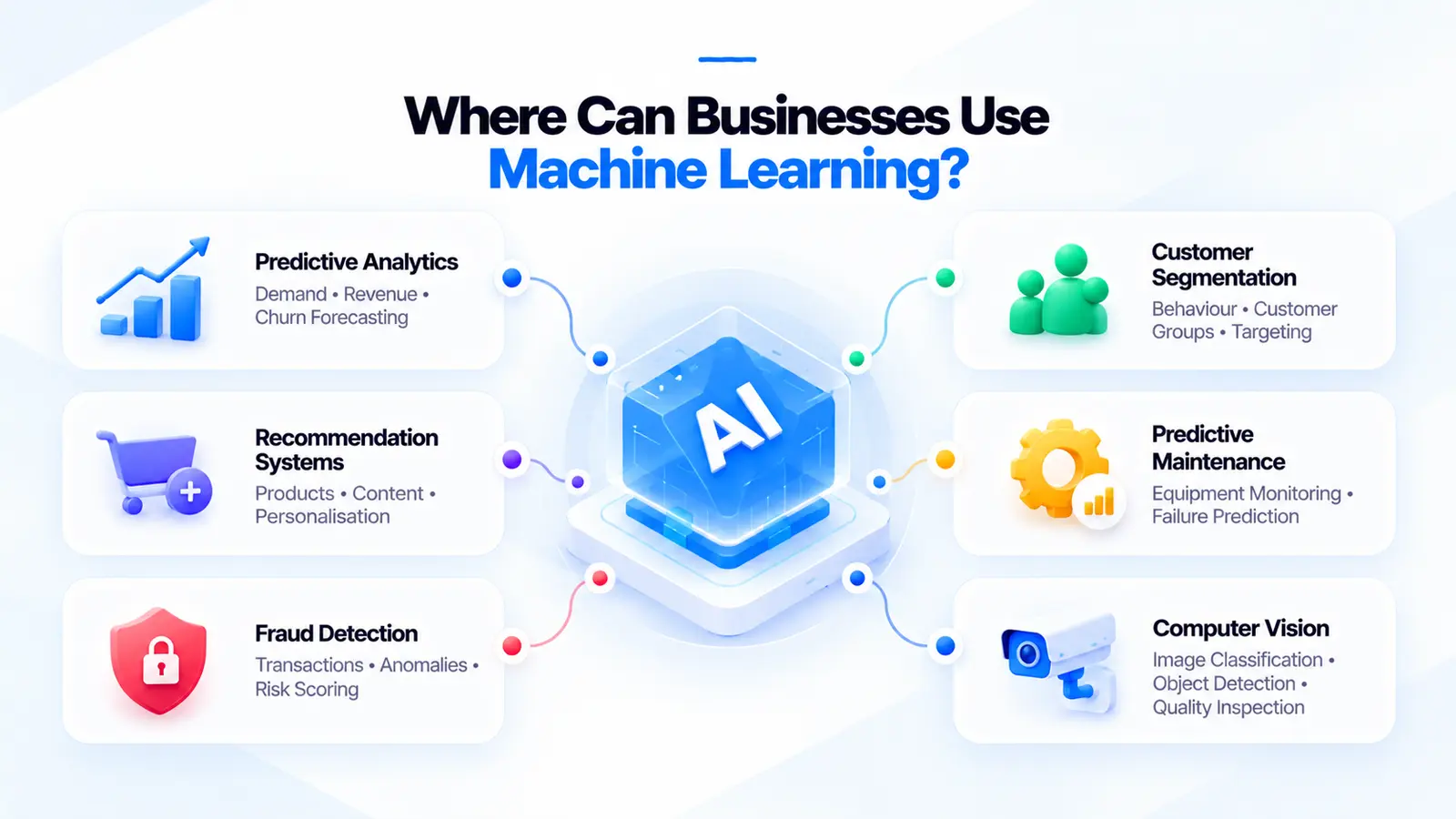
Machine Learning Development Use Cases for Businesses
Predictive Analytics
Demand forecasting, sales forecasting, revenue prediction and customer churn prediction - usually the highest-return starting point because the historical data already exists.
Recommendation Systems
Product and content recommendations and personalised experiences, driving both engagement and average order value.
Fraud Detection
Transaction monitoring, anomaly detection, risk scoring and suspicious activity detection, where the cost asymmetry between false positives and false negatives shapes the whole design.
Customer Segmentation
Identifying customer groups from behaviour and characteristics, informing marketing, pricing and product decisions.
Predictive Maintenance
Equipment monitoring, failure prediction and maintenance scheduling - high value in industrial settings where unplanned downtime is expensive.
Natural Language Processing
Text classification, sentiment analysis, document processing, search and language understanding. Worth noting that LLMs now handle many NLP tasks without training a model, which changes the build-versus-call calculation.
Computer Vision
Image classification, object detection, quality inspection and visual analytics, particularly in manufacturing and logistics.
Benefits of Machine Learning Development for Businesses
Automating complex decisions that resist rules, improving forecast accuracy, reducing operational costs, increasing efficiency, personalising customer experiences, detecting fraud and anomalies at a scale humans cannot review, improving decision quality, processing large datasets, creating new AI-powered products, and building advantages competitors cannot easily copy, because your data is yours.
That last point is the strategic one. Foundation models are available to everyone; a model trained on your operational history is not.
Custom Machine Learning Development vs. Pre-Built ML Solutions
| Factor | Custom ML Development | Pre-Built ML Solution |
|---|---|---|
| Customisation | High | Limited |
| Business-specific requirements | Strong fit | May be limited |
| Development time | Longer | Faster |
| Initial cost | Higher | Usually lower |
| Data control | Greater | Provider dependent |
| Scalability | Highly customisable | Platform dependent |
| Integration | Custom integrations | Available integrations |
| Model control | Greater | Often limited |
Pre-built solutions fit standard problems - generic demand forecasting, off-the-shelf recommendation engines, cloud vendor APIs for vision and speech. Custom development earns its cost when your data is a genuine differentiator, when the problem is specific to how your business operates, or when the model is close enough to your core operation that platform limits become business limits.
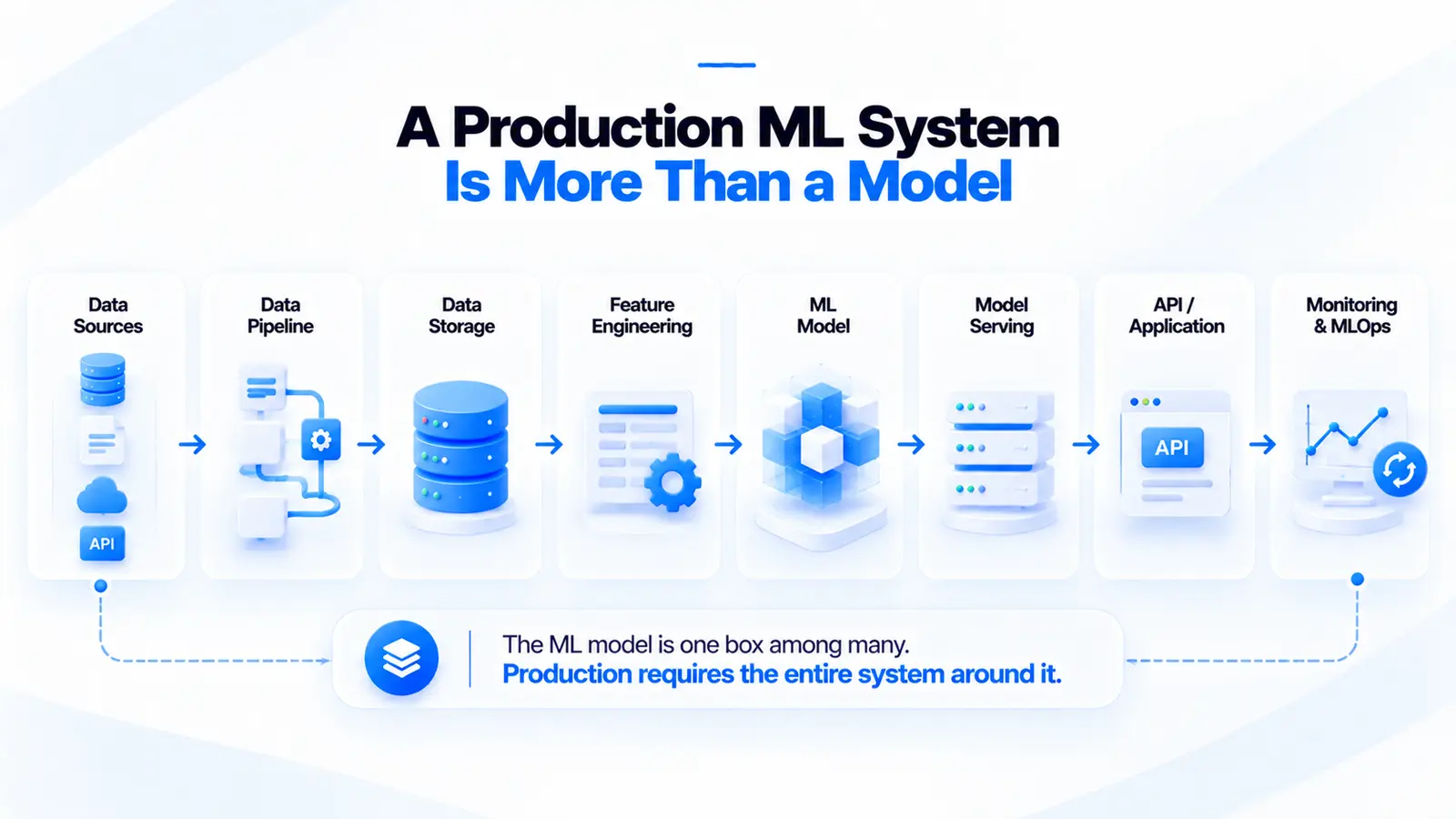
Machine Learning Development Architecture
Data Sources → Data Pipeline → Data Storage → Feature Engineering → ML Model → Model Serving → Application/API → Monitoring
| Component | Purpose |
|---|---|
| Data sources | Provide training and operational data |
| Data pipeline | Collects and processes data |
| Data storage | Holds structured and unstructured data |
| Data processing | Cleans and transforms information |
| Feature engineering | Creates useful model inputs |
| ML model | Learns patterns and generates predictions |
| Model registry | Manages trained model versions |
| Model serving | Makes predictions available to applications |
| API layer | Connects models to applications |
| Monitoring | Tracks model and system performance |
| MLOps | Automates deployment and lifecycle management |
Reading that list makes the central point of this guide obvious: the ML model is one box among eleven. Projects that budget for data science and not for data engineering, serving infrastructure and monitoring produce accurate models that never reach production.
Machine Learning Development Technology Stack
| Layer | Common Technologies / Considerations |
|---|---|
| Programming | Python, R, Java, C++ |
| ML frameworks | TensorFlow, PyTorch, Scikit-learn |
| Data processing | Pandas, NumPy, Apache Spark |
| Databases | PostgreSQL, MySQL, MongoDB |
| Cloud | AWS, Azure, Google Cloud |
| Data warehousing | Snowflake, BigQuery, Redshift |
| Model serving | APIs, containers, cloud ML platforms |
| MLOps | MLflow, Kubeflow, cloud MLOps platforms |
| Visualisation | Tableau, Power BI |
| Monitoring | ML and application observability tools |
No stack is universally best. Scikit-learn handles most tabular business problems without the complexity of a deep learning framework, and choosing tooling your team can operate matters more than choosing the most capable option.
Machine Learning Development Process
1. Define the Business Objective
The problem, target users, expected outcome and success metrics - including what decision changes as a result of the prediction.
2. Assess Data Availability
Data sources, volume, quality, accessibility and privacy constraints. This assessment decides whether the project is viable, and it belongs before any modelling work.
3. Prepare the Data
Cleaning, transformation, labelling, feature engineering and validation - normally the largest single block of effort.
4. Develop a Proof of Concept
Test feasibility with an initial model, validate assumptions and establish baseline performance. Compare against the simplest possible approach; if a three-rule heuristic performs nearly as well, that is important information. The first rule in Google's Rules of Machine Learning is not to be afraid to launch without machine learning, because a simple heuristic often gets you part of the way.
5. Train the ML Model
Training, validation, hyperparameter tuning and optimisation, with careful separation of datasets.
6. Test and Evaluate
Accuracy, reliability, generalisation to unseen data, performance and business impact.
7. Integrate the Model
APIs, existing software, databases, business workflows and user interfaces - connecting the prediction to the decision it should inform.
8. Deploy the ML Solution
Cloud deployment, containers, production infrastructure, and real-time or batch prediction depending on how the output is consumed.
9. Monitor Production Performance
Model accuracy, data drift, model drift, latency, infrastructure health and errors.
10. Continuously Improve
Retraining on new data, model optimisation, feature improvements, user feedback and changing business requirements.
How to Build a Custom Machine Learning Solution
A practical sequence: identify the business problem; define measurable objectives; collect relevant data; assess data quality honestly; prepare and label it; select appropriate algorithms; build a proof of concept; train and evaluate; integrate with business software; deploy to production; monitor performance; retrain and optimise.
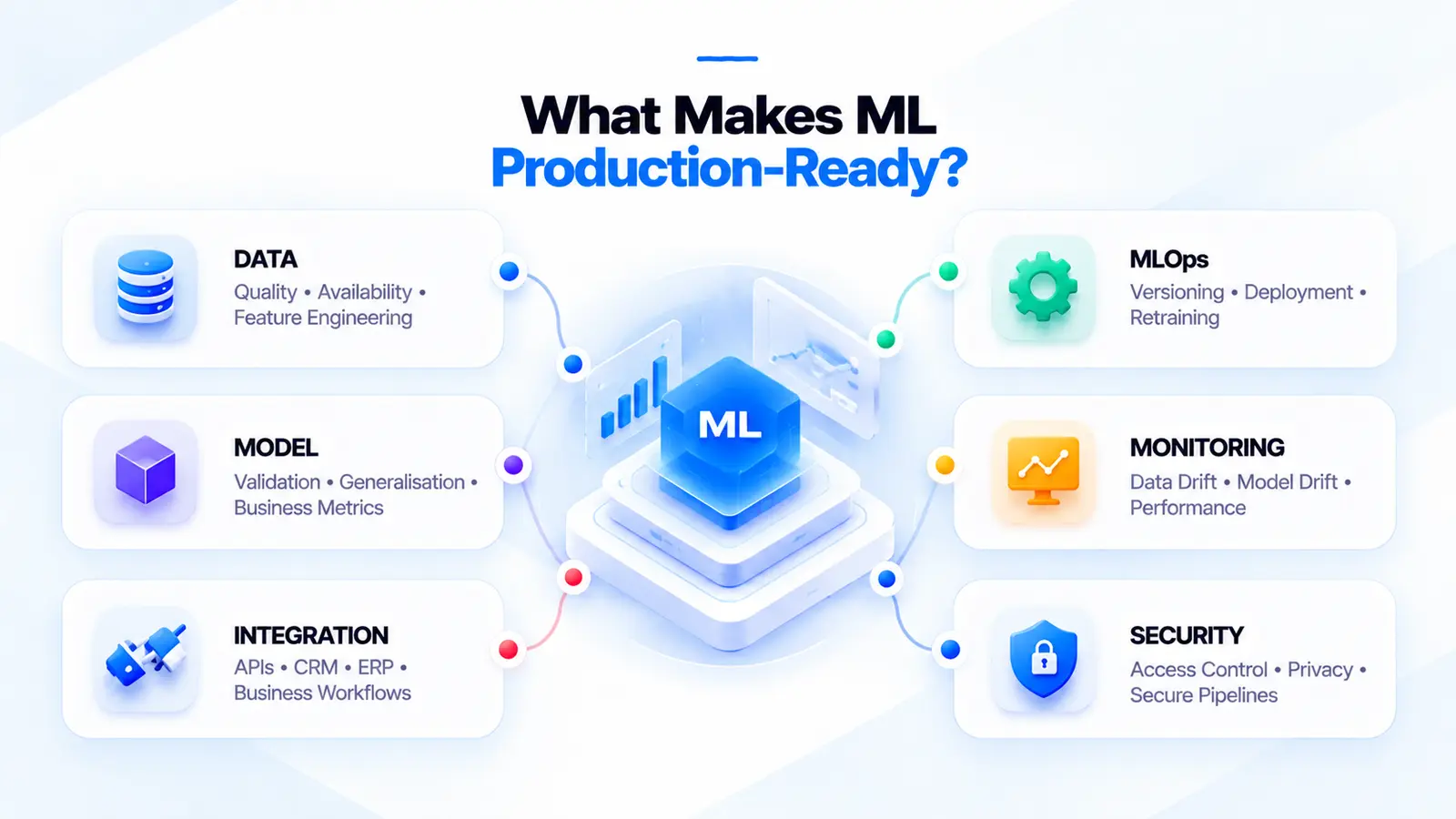
The point worth repeating: the model is only one part of a complete ML solution. Data pipelines, infrastructure, application integration, monitoring and maintenance are equally important, and they are where most of the engineering time goes. A brilliant model with no serving layer, no monitoring and no integration is a research result, not a business capability.
How Much Does Machine Learning Development Cost?
| Cost Factor | Potential Impact |
|---|---|
| Data volume | Larger datasets increase processing and infrastructure |
| Data quality | Poor data requires substantial preparation |
| Model complexity | Advanced models require more development |
| Custom algorithms | Increase research and development effort |
| Data engineering | Complex pipelines drive cost |
| Integrations | ERP, CRM and APIs add complexity |
| Cloud infrastructure | Training and inference both cost |
| MLOps | Production automation is development work |
| Security | Enterprise requirements add architecture |
| User volume | Higher usage raises inference costs |
| Maintenance | Models need ongoing monitoring and retraining |
Data quality and data engineering are the two that most often exceed expectations. A business with a clean warehouse and labelled history can move quickly; one with data spread across systems and no labelled outcomes has a data project before it has an ML project. Our guide to AI software development cost covers the wider budgeting framework.
How Long Does Machine Learning Development Take?
The stages - discovery, data assessment, data preparation, proof of concept, model development, application development, testing, deployment and monitoring - are consistent, but their durations are not.
Data availability and quality influence the timeline more than anything else. A well-scoped predictive model on clean, labelled, accessible data can reach a validated proof of concept quickly. The same problem with data spread across three systems, inconsistent history and no labels can spend months before any modelling starts. When an estimate feels uncertain, the uncertainty is almost always in the data, which is why an assessment should precede any commitment.
Machine Learning Development Services: What Should They Include?
Full machine learning development services span ML strategy, consulting, data engineering, data preparation, model development and training, custom ML solutions, ML application development, API integration, cloud deployment, MLOps, model monitoring, performance optimisation and maintenance.
The two that separate a production engagement from a research one are data engineering and MLOps. A proposal heavy on modelling and light on pipelines, serving and monitoring is describing a proof of concept, whatever it is called.
Machine Learning Development vs. AI Development
| Factor | Machine Learning Development | AI Development |
|---|---|---|
| Scope | Focuses on ML systems | Broader AI category |
| Data learning | Core component | May or may not involve ML |
| Predictive models | Central | One of several approaches |
| Generative AI | Not necessarily | Frequently included |
| NLP | Can use ML | ML and other techniques |
| Computer vision | Can use ML | Broader vision applications |
| Primary focus | Learning patterns from data | Simulating intelligent behaviour |
Machine learning is a major area within AI; AI development covers a broader range including generative models, agents and rule-based systems. The practical relevance is that "we need AI" often turns out to mean "we need a prediction", which is an ML problem with well-understood methods - see our guide to AI consulting services for how that decision gets made.
Machine Learning vs. Deep Learning
Machine learning covers all methods that learn patterns from data. Deep learning is a subset using multi-layer neural networks, which learn features from raw input rather than requiring hand-engineered ones.
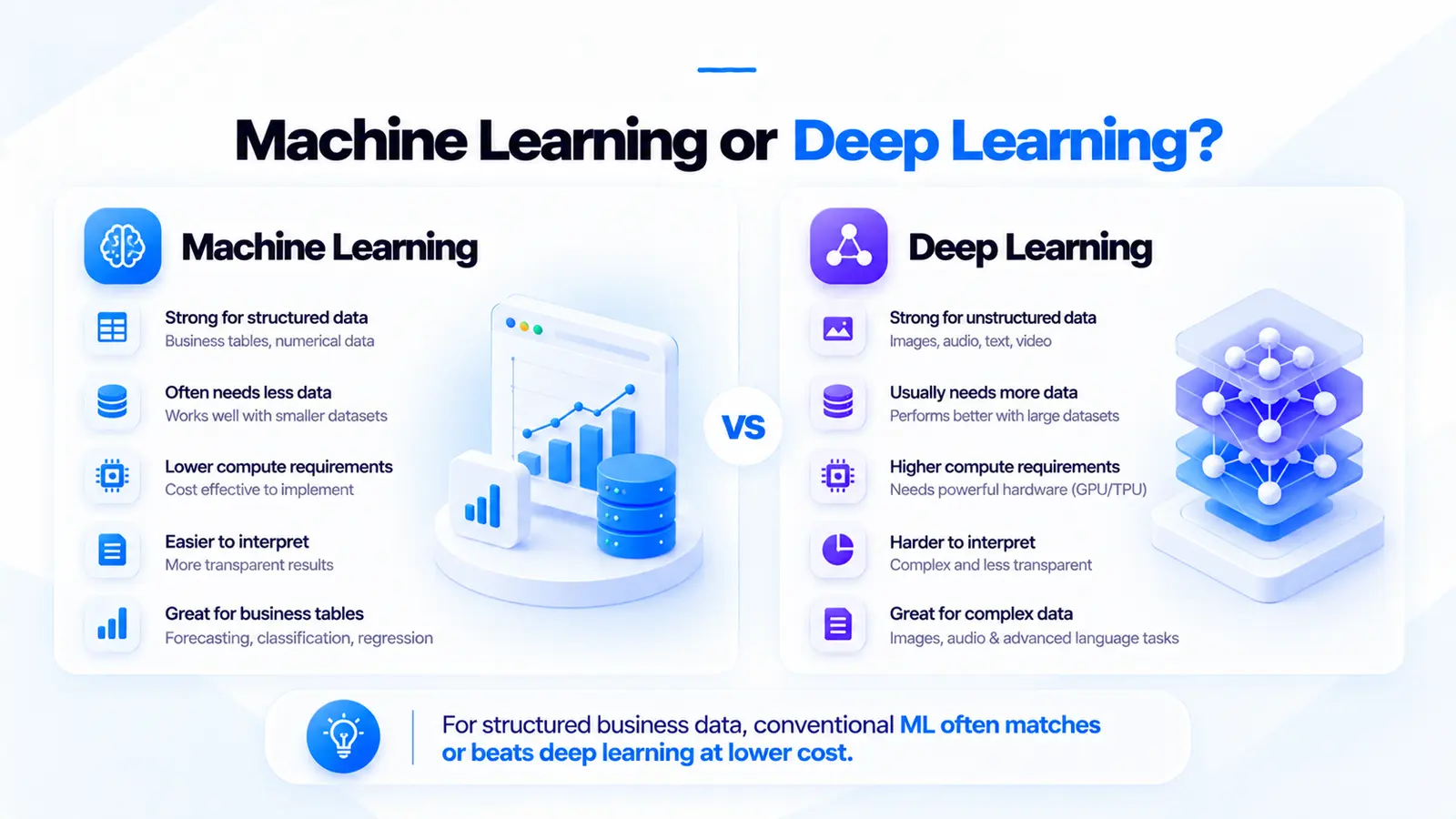
That capability comes at a price: deep learning generally needs far more data, substantially more compute, and produces models that are harder to interpret. It is the right choice for images, audio, video and complex language tasks. For structured business data - the tables in your warehouse - conventional methods usually match or beat it, train in a fraction of the time, and can be explained to the person whose decision they inform. Choosing deep learning by default is one of the more expensive habits in this field.
Machine Learning Development Challenges
Poor-quality data, the most common cause of disappointing results. Insufficient training data, especially for rare events like fraud. Data bias, which produces models that are accurate on average and unfair in particular. Overfitting, where a model memorises training data instead of learning a pattern. Model accuracy falling short of what the business case assumed. Integration with existing systems, frequently the largest engineering block. Scalability of both training and inference. Data privacy, particularly with personal data. Model drift, as the world changes underneath a trained model. And ongoing maintenance, which is permanent rather than occasional. The paper Hidden Technical Debt in Machine Learning Systems describes these ongoing maintenance costs in real-world ML systems.
Strong data practices, honest evaluation, MLOps, monitoring and governance address these. None are solved by a more sophisticated algorithm.
Machine Learning Security and Data Privacy
ML systems train on and infer from business data, often including personal information, which makes privacy a design input.
The requirements: data encryption, authentication, authorisation, role-based access, secure APIs, data anonymisation where possible, defined retention, careful handling of sensitive information, secure data pipelines, audit logging and cloud security controls.
The principle is that an ML system should follow the same security and access requirements as the underlying business data. Two ML-specific risks are worth naming: training data can embed personal information in ways that are difficult to remove afterwards, and predictions themselves can reveal sensitive attributes even when the inputs look innocuous. Both are cheaper to design around than to remediate.
How to Measure Machine Learning Model Performance
Classification Metrics
Accuracy, precision, recall, F1 and ROC-AUC. Accuracy alone is misleading on imbalanced problems - a fraud model that always predicts "legitimate" can be 99% accurate and completely useless, as Google's Machine Learning Crash Course shows, which is why precision and recall matter more.
Regression Metrics
MAE, MSE, RMSE and R². Which to optimise depends on whether large errors are disproportionately costly.
Business Performance Metrics
Revenue impact, cost savings, conversion rate, customer retention, processing time and automation rate.
The distinction that decides whether an ML project is judged a success: a technically accurate model is not necessarily a successful business solution. A churn model with excellent AUC delivers nothing if nobody acts on its output, and a modest model that reliably prioritises a retention team's calls can be worth a great deal. Define the business metric before training anything.
MLOps: Managing Machine Learning Models in Production
MLOps is the practice of operating machine learning systems reliably: model versioning, automated deployment, model monitoring, data monitoring, retraining pipelines, performance tracking, CI/CD adapted for ML, and model governance.
It exists because ML systems have a failure mode conventional software does not. Google Cloud's MLOps guide notes that models can decay in more ways than conventional software, because the data they see keeps changing. Ordinary software breaks visibly - an error, a crash, a failed test. A model degrades silently: it keeps returning confident predictions that are gradually less correct as customer behaviour shifts, a data source changes format, or the population it was trained on stops resembling the population it now serves. Nothing alerts, and by the time someone notices, the business has been acting on degraded predictions for months.
MLOps is how organisations catch that early and retrain deliberately rather than reactively. For a business running more than one or two models, it stops being optional.
How to Choose a Machine Learning Development Company
Machine Learning Expertise
Experience with ML algorithms, deep learning where relevant, predictive analytics, NLP, computer vision and recommendation systems, and the judgement to choose the simplest method that works.
Data Engineering Capabilities
Data pipelines, warehouses, processing, quality management, and both structured and unstructured data. ML projects succeed or fail here more often than in modelling.
MLOps and Cloud Experience
Cloud deployment, model serving, CI/CD, monitoring and lifecycle management - the difference between a model that reaches production and one that stays in a notebook.
Integration Capabilities
Experience integrating ML with CRM, ERP, SaaS platforms, mobile and web applications and enterprise APIs.
Security and Compliance
Data security, access control, encryption, privacy and any industry-specific requirements.
Post-Launch Support
Monitoring, maintenance, retraining, optimisation, scaling and model updates. Ask specifically how retraining is triggered - a partner without an answer has not run models in production.
Common Machine Learning Development Mistakes
Starting with the technology instead of the business problem. Using poor-quality data, which caps everything downstream. Choosing an overly complex model when a simpler one performs comparably and can be explained. Ignoring data privacy until late. Focusing only on model accuracy rather than business outcome. Failing to test with real-world data, so production distribution differs from training. Ignoring model drift, letting quality decay silently. Not planning for production deployment, stranding good models in notebooks. Underestimating ongoing maintenance. And building a model without a clear business outcome - the mistake that makes all the others irrelevant.
How to Know If Your Business Needs Machine Learning
- You hold large amounts of usable, reasonably clean data
- You need predictive insight rather than historical reporting
- Manual, repeated decisions could be automated
- Customer behaviour needs analysis at scale
- Personalised recommendations would change outcomes
- Fraud or anomalies need detecting in volume
- Forecasting is currently difficult or inaccurate
- Existing rule-based systems have grown unmaintainable
- You want to build an AI-powered product
- Data-driven decisions would create measurable value
Not every problem needs machine learning. If the rules are known and stable, write them - rule-based logic is faster, cheaper, fully explainable and easier to change. ML earns its complexity when the rules are too numerous, too subtle, or change too often to maintain by hand. A partner willing to tell you that is worth more than one who is not.
Why Professional Machine Learning Development Matters
Selecting an appropriate approach rather than a fashionable one, building reliable data pipelines, choosing suitable algorithms, developing models that generalise, integrating ML into existing software, implementing MLOps, managing cloud infrastructure, protecting business data, monitoring production performance, maintaining models over time and scaling them.
The recurring theme is that machine learning development is mostly software and data engineering with a modelling component - not the reverse. Teams strong only in modelling produce accurate models that never ship; teams strong only in engineering build infrastructure around models that were never going to work. Effective machine learning development services cover both.
For teams whose people are moving into applied AI work, our guide to AI automation development covers the minimum practical ML knowledge an engineer needs to build reliable AI systems without a research background.
Why Choose Eunix Tech for Machine Learning Development?
At Eunix Tech, we approach ML as a production engineering problem. Our work spans data pipelines and integration, model development, ML application development, cloud deployment, API reliability, monitoring, and integration with the business software that consumes predictions - with senior engineers involved from data assessment through to production.
We are also candid about scope. A meaningful share of our discovery work concludes that a business needs better reporting, cleaner data, or rule-based automation rather than a model, and saying so early is considerably cheaper for the client than finding out after six months of development.
Build a Machine Learning Solution for Your Business
Ready to turn your business data into a machine learning solution? The first useful conversation is about the decision you want to improve and the data you already hold, because those two things determine whether ML is viable long before any technology choice matters.
Our approach runs discover → assess data → build → integrate → deploy → monitor → optimise. Talk to us about your business problem, available data, ML requirements, existing software, integrations, security needs and deployment expectations, and if machine learning isn't the right answer, we will tell you what is.
Conclusion
Machine learning development lets businesses build software that identifies patterns, makes predictions, automates decisions and generates data-driven insight. Doing it successfully involves far more than selecting and training an algorithm: data preparation, model selection, testing, application integration, deployment, security, monitoring and ongoing optimisation all shape the outcome.
ML supports predictive analytics, personalisation, fraud detection, recommendations, predictive maintenance, NLP and computer vision, and businesses should establish whether it is genuinely appropriate before choosing a technology, because rule-based logic remains the better answer for stable, known rules.
When choosing a machine learning development company, evaluate ML expertise, data engineering depth, MLOps experience, integration capability, security practice and post-launch support. The model is the small part; everything around it is what makes it work.
For related reading, see our guides to AI application development and custom AI software development.
Sources
- Hidden Technical Debt in Machine Learning Systems - Sculley et al., NeurIPS 2015
- Rules of Machine Learning: Best Practices for ML Engineering - Martin Zinkevich, Google
- MLOps: Continuous delivery and automation pipelines in machine learning - Google Cloud
- Why do tree-based models still outperform deep learning on tabular data? - Grinsztajn, Oyallon and Varoquaux, 2022
- Common pitfalls and recommended practices: Data leakage - scikit-learn documentation
- Classification: Accuracy, recall, precision, and related metrics - Google Machine Learning Crash Course
Frequently Asked Questions
What is machine learning development?
Machine learning development is the process of building software systems that learn patterns from data to make predictions, classifications or recommendations, and delivering those predictions into a business process. It spans data pipelines, model development, integration, deployment and monitoring - not just training a model.
How does machine learning development work?
Define the business problem, collect relevant data, prepare and clean it, select a model suited to the problem type, train with properly separated datasets, evaluate against both technical and business metrics, deploy into production, then monitor for drift and retrain as needed.
What are the different types of machine learning?
Supervised learning (classification and regression from labelled examples), unsupervised learning (clustering and anomaly detection without labels), reinforcement learning (learning through rewards and actions), and deep learning (neural networks, particularly for images, audio and language). Most business ML is supervised.
What are the most common machine learning applications for businesses?
Predictive analytics such as demand and churn forecasting, recommendation systems, fraud detection, customer segmentation, predictive maintenance, natural language processing and computer vision. Predictive analytics is usually the highest-return starting point because the historical data typically already exists.
What is the difference between AI and machine learning?
Machine learning is a major area within artificial intelligence, focused on learning patterns from data. AI is broader and includes generative models, agents and rule-based systems. In practice, many requirements described as "AI" are prediction problems, which is machine learning with well-understood methods.
What is the difference between machine learning and deep learning?
Deep learning is a subset of machine learning using multi-layer neural networks that learn features directly from raw input. It excels on unstructured data like images, audio and text but needs far more data and compute and is harder to interpret. For structured business data, conventional methods usually match or beat it at a fraction of the cost.
How do you build a machine learning solution?
Identify the business problem, define measurable objectives, collect data, assess its quality honestly, prepare and label it, select appropriate algorithms, build a proof of concept against a simple baseline, train and evaluate, integrate with business software, deploy, monitor and retrain. The model is one part; pipelines, integration and monitoring are the rest.
What technology stack is used for machine learning development?
Typically Python with Scikit-learn, TensorFlow or PyTorch; Pandas, NumPy or Spark for data processing; a relational database and often a data warehouse such as Snowflake or BigQuery; a major cloud; containers or cloud ML platforms for serving; and MLflow, Kubeflow or a cloud equivalent for MLOps. Scikit-learn handles most tabular problems without deep learning complexity.
How much does machine learning development cost?
It depends on data volume and quality, model complexity, whether custom algorithms are needed, data engineering effort, integrations, cloud infrastructure for training and inference, MLOps, security requirements, usage volume and maintenance. Data quality and data engineering most often exceed expectations.
How long does it take to develop a machine learning solution?
The stages are consistent (discovery, data assessment, preparation, proof of concept, model development, integration, testing, deployment, monitoring), but data availability and quality influence duration more than anything else. Clean, labelled, accessible data can reach a validated proof of concept quickly; scattered or unlabelled data can add months before modelling begins.
What are machine learning development services?
They span ML strategy and consulting, data engineering, data preparation, model development and training, custom ML solutions, ML application development, API integration, cloud deployment, MLOps, monitoring, optimisation and maintenance. Data engineering and MLOps are what separate a production engagement from a proof of concept.
When should a business use custom machine learning?
When your data is a genuine differentiator, when the problem is specific to how your business operates, or when the model is close enough to your core operation that a platform's limits would become business limits. For standard problems, pre-built solutions and cloud APIs are usually the better financial decision.
How do I choose a machine learning development company?
Evaluate ML expertise alongside data engineering depth, MLOps and cloud experience, integration capability, security practice and post-launch support. Ask how retraining is triggered and how model drift is detected - those questions distinguish teams who have run models in production from teams who have built them.
What is MLOps and why is it important?
MLOps is the practice of operating ML systems reliably: model versioning, automated deployment, model and data monitoring, retraining pipelines, CI/CD for ML and governance. It matters because models degrade silently rather than failing visibly - they keep returning confident predictions that grow less accurate as data shifts, with nothing to alert you.
How do you measure machine learning model performance?
Classification models use accuracy, precision, recall, F1 and ROC-AUC; regression models use MAE, MSE, RMSE and R². Accuracy alone misleads on imbalanced problems. Alongside these, measure business metrics - revenue impact, cost savings, retention, automation rate, because a technically accurate model that nobody acts on delivers nothing.
How do you maintain a machine learning model after deployment?
Monitor prediction quality, data drift and model drift; track infrastructure performance and errors; retrain on new data when performance degrades or the underlying population shifts; and version models so changes are reversible. Maintenance is continuous, not occasional, and should be budgeted as a recurring cost.
What challenges are involved in machine learning development?
Poor-quality data, insufficient training data, data bias, overfitting, accuracy falling short of the business case, integration with existing systems, scalability, data privacy, model drift and ongoing maintenance. Data problems cause more ML failures than algorithmic ones.
Is machine learning suitable for every business?
No. If the rules governing a decision are known and stable, rule-based logic is faster, cheaper, fully explainable and easier to change. Machine learning earns its complexity when rules are too numerous, too subtle, or change too often to maintain, and when you hold enough quality data to learn from.
Can machine learning be integrated into existing business software?
Yes, and for most businesses this is the higher-value path - surfacing predictions inside the CRM, ERP or internal tools people already use, rather than in a separate dashboard. Integration is typically via APIs with either real-time or batch prediction, and it is usually the largest engineering portion of the project.
