AI Consulting Services: How to Choose the Right AI Strategy for Your Business in 2026
Explore AI consulting services, generative AI strategy, use cases, costs, and how to choose the right AI consulting partner for your business.
Most businesses no longer need convincing that AI matters. What they lack is a defensible answer to a harder question: where, specifically, would it pay off here? Enthusiasm arrives long before clarity, and the gap between them is where budgets get spent on impressive pilots that never reach production.
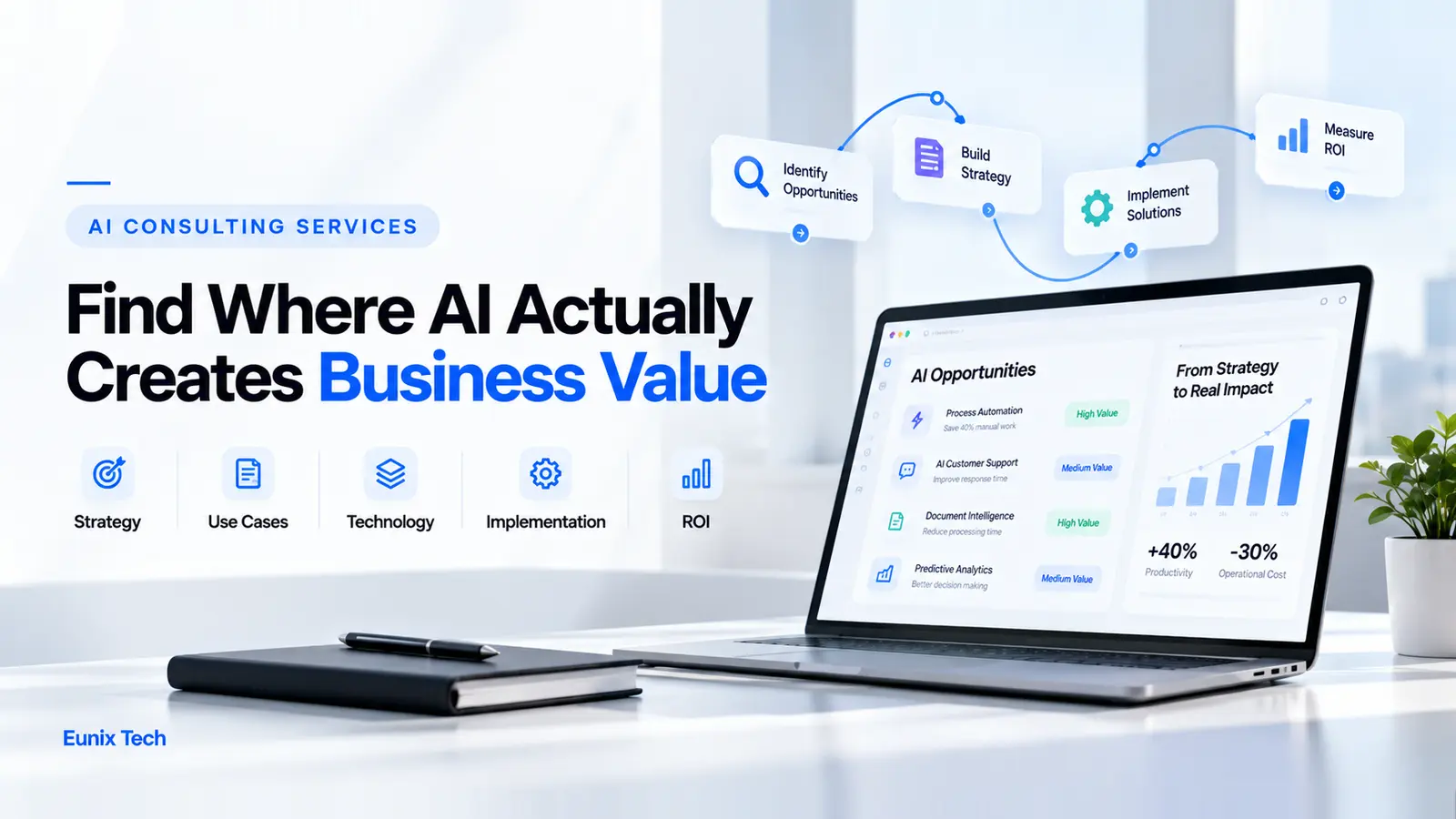
AI consulting services exist to close that gap. Good consulting is as much about ruling things out as recommending them - not every business problem needs AI, and some of the most valuable advice is that a database query, a process change, or conventional automation would solve the problem faster and cheaper. The work follows a simple arc: business problem → AI strategy → implementation → measurable results. This guide covers what AI consultants do, which services businesses actually need, how to pick a first use case, and how to choose a partner.
What Are AI Consulting Services?
AI consulting services help a business decide what to build with AI, why, and in what order. That covers AI strategy, opportunity assessment, technology selection, architecture, identifying automation opportunities, generative AI, integration with existing systems, an implementation roadmap, and honest ROI evaluation.
The distinction that matters commercially: AI consulting determines what should be built and why; AI development builds and deploys it. Consulting without engineering produces strategy decks that stall on contact with real systems. Engineering without consulting produces working software solving a problem that was not worth solving. The most useful AI consultancy services connect both - the people advising you should be able to explain how the recommendation would actually be implemented, because that is what makes the advice testable.
An AI consulting service engagement can be a two-week assessment or an ongoing advisory relationship. What should stay constant is that it ends with a decision you can act on, not a list of possibilities.
What Does an AI Consultant Do?
Identify AI Opportunities
Reviewing how work actually gets done and finding where AI creates measurable value - customer support, document processing, sales research, data analysis, business automation. The output is a ranked list, not an inventory.
Evaluate Existing Systems
Auditing the software, APIs, databases, business data, and existing automation. This step frequently reshapes the strategy: an appealing use case sitting behind a system with no usable API is a different project than it first appeared.
Recommend the Right AI Solution
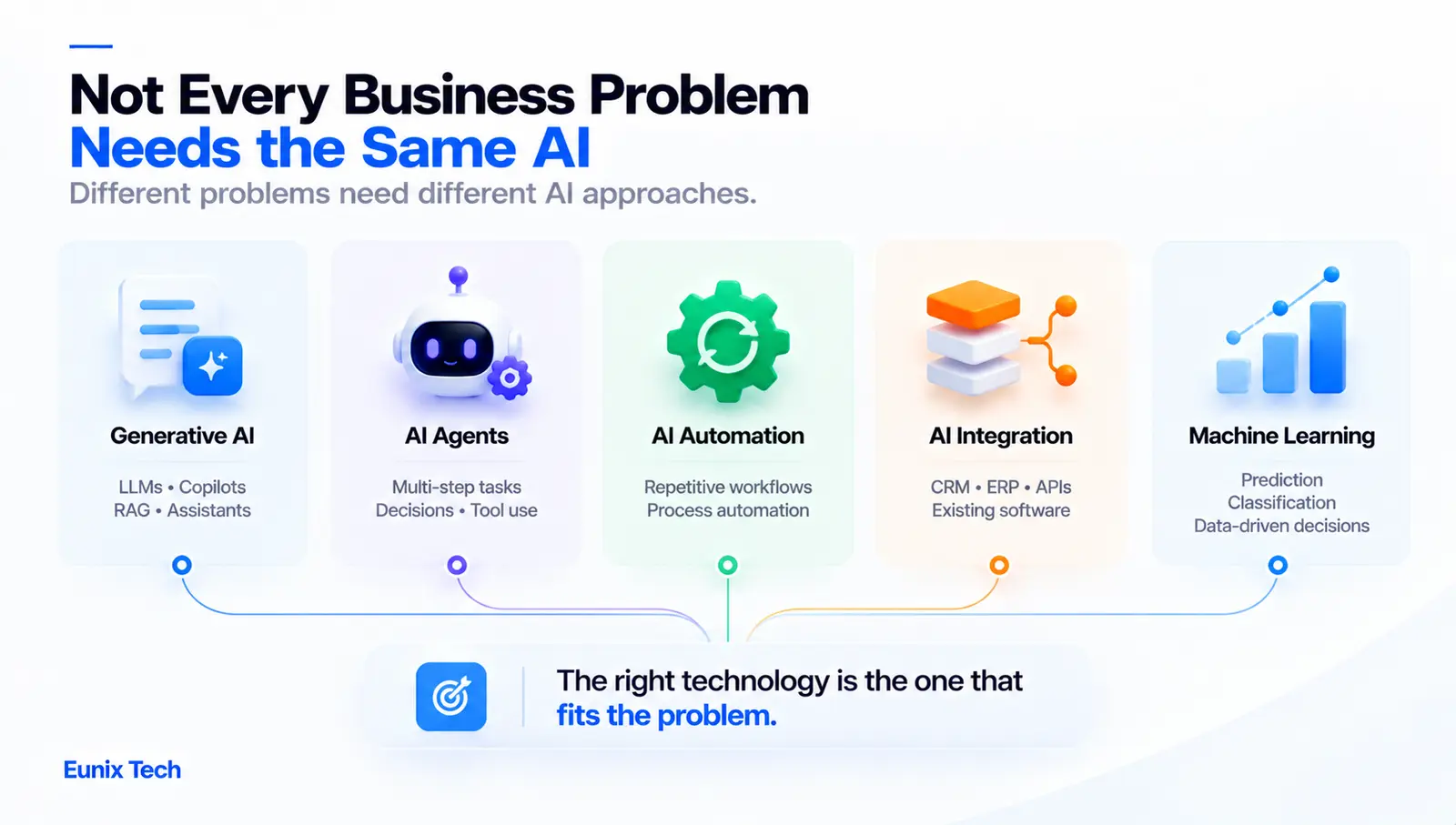
Matching the problem to the technology - generative AI, LLM applications, RAG, AI agents, conventional machine learning, or straightforward automation. Answering what services an AI expert consultant provides comes down to this judgement more than anything else: knowing when a small classification model beats a large language model, and when neither is needed.
Create an Implementation Roadmap
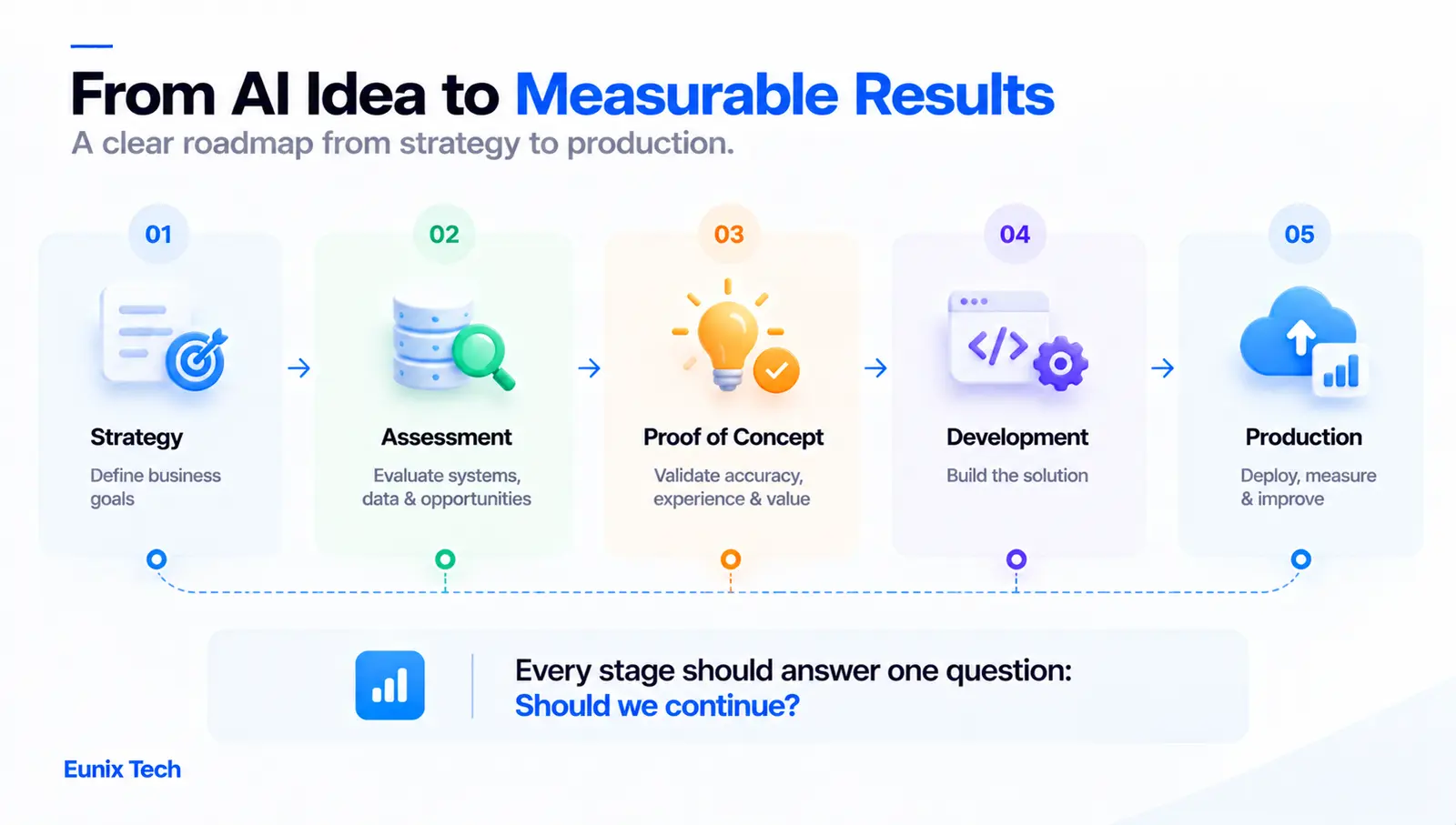
Sequencing the work: strategy → proof of concept → development → production. A roadmap should say what happens first, what evidence would justify continuing, and what would justify stopping.
Which AI Consulting Services Do Businesses Need?
AI Strategy Consulting
Connecting business goals to an AI roadmap and identifying which opportunities are worth pursuing. This is where most engagements should start, because everything downstream depends on picking the right problem.
Generative AI Consulting
Generative AI consulting services cover LLM applications, AI copilots, RAG systems, assistants, and generative workflows - the fastest-moving category and the one where the gap between a demo and a dependable product is widest.
AI Automation Consulting
Identifying repetitive business processes suited to automation, and - just as importantly, which ones are better left alone because the exception rate is too high or the error cost too great.
AI Integration Consulting
Connecting AI to CRM, ERP, APIs, databases, and existing software rather than replacing systems that work. For most established businesses this is the highest-return path; our guide to AI integration services covers it in depth.
AI Architecture Consulting
Model selection, system architecture, security, and scalability - the decisions that are expensive to reverse and therefore worth getting right before development starts. See our guide to LLM architecture for what this produces.
AI Consulting vs AI Implementation Services: What Is the Difference?
AI consulting decides what to build and whether it is worth building. AI implementation builds it. Consulting produces clarity: a prioritised use case, a feasibility check on your data, an architecture, a rollout plan and an honest view of risk. Implementation produces working software: integrations, models or agents wired into your systems, tested and deployed.
| AI consulting | AI implementation | |
|---|---|---|
| Main question | Should we do this, and how? | Build it and make it work |
| Output | Strategy, roadmap, architecture, recommendations | Working, deployed software |
| Typical timeline | Weeks | Months |
| Biggest risk if skipped | Building the wrong thing | Nothing ships |
You can buy them separately or together. Consulting alone suits teams with strong engineers who need direction. Implementation alone suits teams that already know exactly what they want. Most businesses get the best result when the same team that scoped the work also builds it, because nothing is lost in the handover. Whichever route you take, a good consultant should be willing to tell you when AI is not the right answer.
How to Choose the Right AI Use Case
Start with the problem, not the technology. Six questions filter most candidates quickly.
| Factor | Question |
|---|---|
| Business value | Can AI save money or increase revenue here? |
| Frequency | How often does the task happen? |
| Data | Is the required data available and usable? |
| Complexity | Can AI realistically solve it today? |
| Risk | What happens if the AI makes a mistake? |
| ROI | Is the expected benefit worth the investment? |
The risk question eliminates more bad candidates than the others combined. Where an error is caught cheaply and corrected easily, you can move fast. Where an error is expensive, irreversible, or invisible until much later, the use case needs human review, and the ROI has to survive that overhead.
Start Small With a High-Value Use Case
Automating invoice processing, customer support, internal knowledge search, lead qualification, or document extraction are common first projects because the manual baseline is measurable and the scope is containable. A focused proof of concept validates accuracy, user experience and value before a larger commitment, and teaches you your own data quality, which no strategy document can.
Generative AI Consulting: What Can Businesses Build?
The practical applications are well established: AI customer support, internal knowledge assistants, document analysis, content workflows, sales research, AI-powered reporting, AI agents, and software development assistants.
The consulting value is not in listing these - it is in evaluating them against your situation. Each should be assessed on accuracy achievable with your data, cost at your expected volume, security and privacy constraints, data requirements, integration effort, and business ROI. A use case that scores well on four of those and fails on one is not a use case yet.
Two areas deserve extra scrutiny because they are the most oversold. Agents can genuinely automate multi-step work, but reliability rather than capability is the limiting factor - see our guide to AI agent development. And any generative AI system needs systematic measurement before anyone can claim it works, which is the subject of our guide to LLM evaluation.
AI Consulting for Startups and Growing Businesses
Startups ask a different question than enterprises: not "where can AI help?" but "will this work before we run out of money?" That makes AI and ML consulting services helpful for startups in a specific way - validating the AI product idea, selecting the right model, scoping an AI MVP, avoiding infrastructure nobody needs yet, estimating AI running costs realistically, designing architecture that can scale later without a rewrite, and integrating AI into an existing product without destabilising it.
The most common startup mistake is building for a scale that has not arrived, and the second most common is choosing the largest available model by default. Both are expensive, and both are avoidable in a conversation.
Growing businesses face a different set: workflow automation, integrating AI with systems already in production, modernising applications that have accumulated constraints, and scaling AI features that worked fine at pilot volume and no longer do.
How Much Do AI Consulting Services Cost?
Consulting cost depends on project complexity, the number of use cases assessed, data requirements, AI model requirements, integrations, architecture depth, security requirements, and the scope of any proof of concept.
The useful thing to understand is the progression, because each stage is a decision point rather than a commitment to the next: AI strategy → AI assessment → proof of concept → development → production. A business can stop after the assessment with a clear roadmap and no further obligation, which is exactly what an assessment is for. Treat a consultant unwilling to scope a standalone assessment with some caution.
For the wider budgeting picture once you move into building, see our guide to AI software development cost.
How to Choose an AI Consulting Company
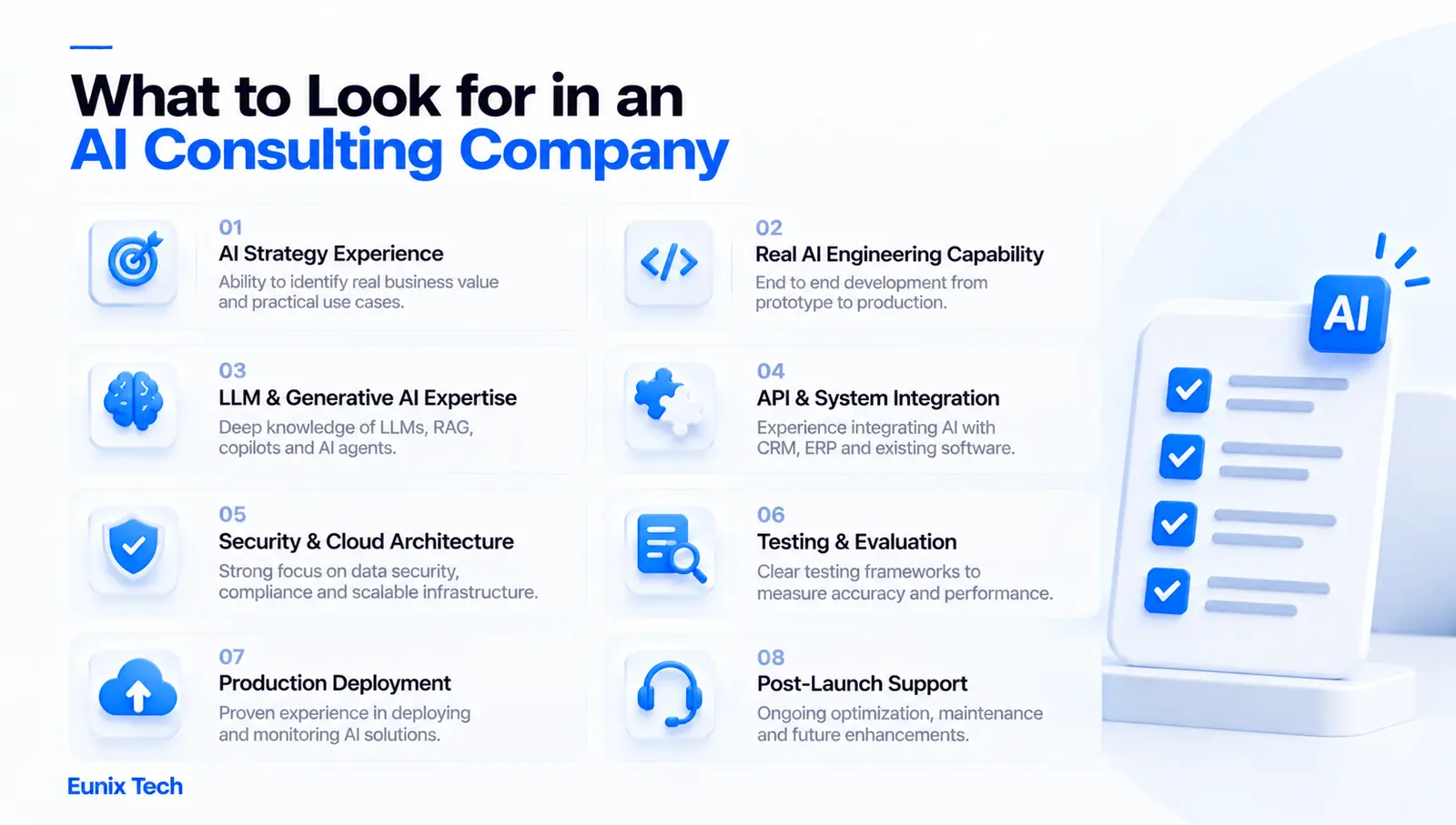
Evaluate AI consulting experience alongside genuine AI engineering capability, generative AI expertise, LLM knowledge, AI agent experience, API integration skill, cloud architecture, security practice, testing and evaluation methodology, production deployment history, case studies you can interrogate, and post-launch support.
The single most useful filter: can the same team take the work from strategy into production? Advice from people who have shipped and maintained AI systems is different in kind from advice by people who have only recommended them - they know which ideas survive contact with real data and real users, because they have watched some of theirs not.
Questions to Ask Before Hiring
- Have you built AI solutions similar to ours, and what happened after launch?
- How do you identify which AI use cases are worth pursuing?
- Which AI technology would you recommend here, and why that one?
- How will our existing systems be integrated?
- How will AI accuracy be evaluated?
- How will our business data be protected?
- Can your team take this from strategy through to production?
Question five is the one that separates serious partners from confident ones. A team without a concrete evaluation methodology has never had to prove an AI system worked.
Boutique AI Consultancy vs Large Consulting Firm
| Factor | Boutique Consultancy | Large Consulting Firm |
|---|---|---|
| Communication | Direct with the engineers | Multiple layers |
| Team | Specialised | Larger, broader |
| Flexibility | High | Varies by engagement |
| Speed | Often faster | Can be slower |
| Custom engineering | Usually strong | Depends on engagement |
Neither is universally better. Large firms suit organisation-wide transformation programmes, procurement requirements, and change management across thousands of staff. An AI services boutique consultancy suits focused, technically demanding projects where you want the people advising you to be the people building it. The deciding factor is the size and shape of the problem, not the size of the firm.
Eunix Tech's Approach to AI Consulting
We work through a consistent sequence:
1. Understand the business problem → 2. Assess systems and data → 3. Identify AI opportunities → 4. Select the right approach → 5. Build and validate a solution → 6. Deploy and monitor
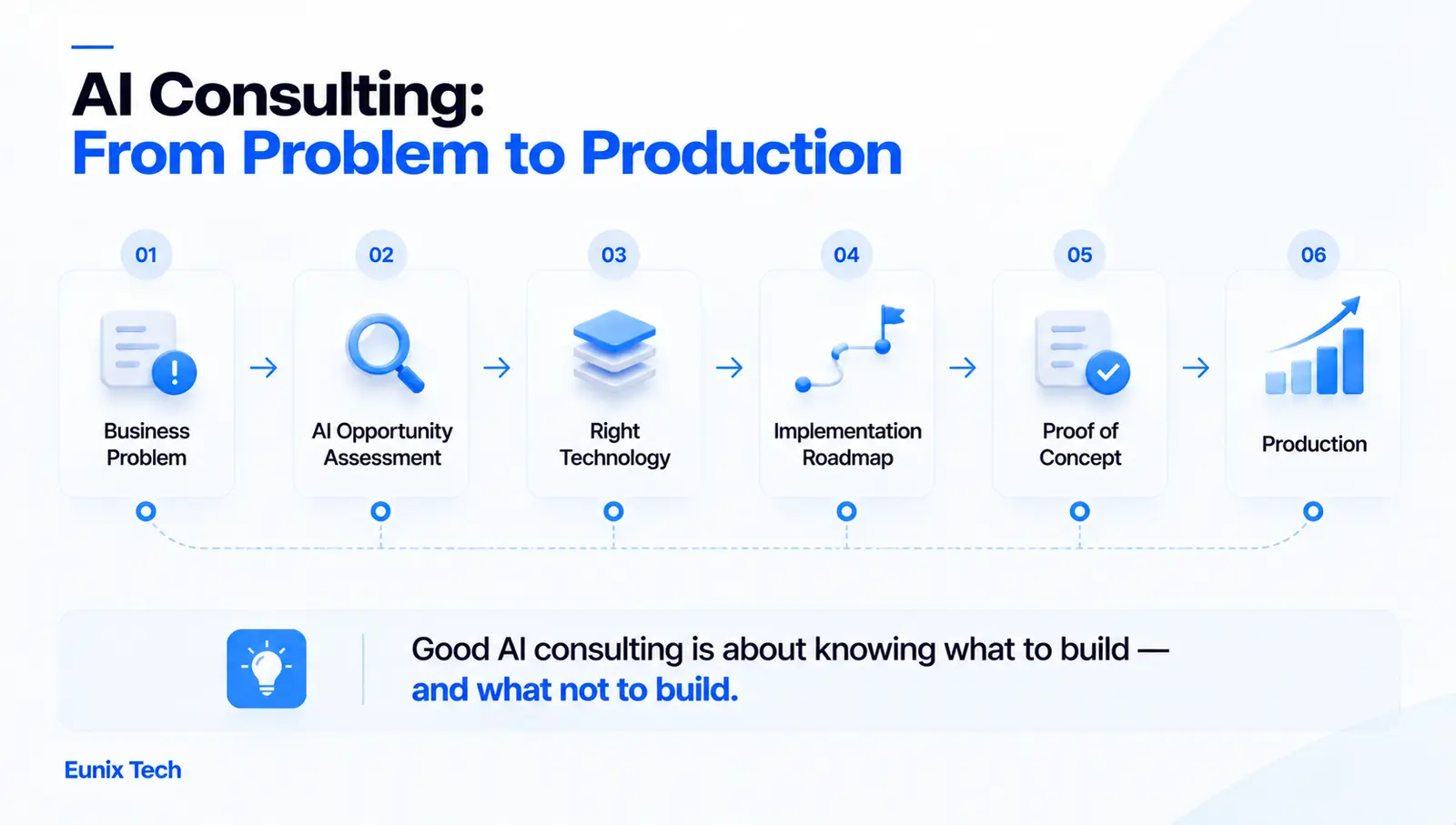
What makes this work is that consulting and engineering are the same team. We can recommend an architecture because we build them, and we can be specific about effort because we have done the integration work before. Senior engineers are involved from the first conversation.
Our AI invoice processing work is a fair example: a defined document-processing problem, assessed against the client's real data, built and validated before scaling. That sequence - problem, assessment, validation, production - is the whole method.
Frequently Asked Questions
What are AI consulting services?
AI consulting services help businesses decide what to build with AI and why. They cover AI strategy, opportunity assessment, technology selection, architecture, integration planning, implementation roadmaps, and ROI evaluation - determining what should be built, as distinct from AI development, which builds and deploys it.
What does an AI consultant do?
An AI consultant identifies where AI can create measurable value, audits existing software, APIs, databases and data quality, recommends the right technology for each problem, and produces an implementation roadmap running from strategy through proof of concept to production. Recommending against AI where it does not fit is part of the job.
What are generative AI consulting services?
Consulting focused on LLM applications, AI copilots, RAG systems, assistants and generative workflows. The work involves evaluating each use case for achievable accuracy, cost at your volume, security constraints, data requirements, integration effort and ROI - rather than assuming generative AI is the right tool.
How can AI consulting help startups?
By validating the AI product idea before significant spend, selecting an appropriate model, scoping an AI MVP, avoiding premature infrastructure, estimating running costs realistically, and designing architecture that scales later without a rewrite. The most common startup mistakes are building for scale that has not arrived and defaulting to the largest model.
How much do AI consulting services cost?
It depends on project complexity, the number of use cases assessed, data and model requirements, integrations, architecture depth, security needs, and proof-of-concept scope. The progression runs strategy → assessment → proof of concept → development → production, and each stage is a decision point rather than a commitment to the next.
How do I choose an AI consulting company?
Look for real AI engineering capability alongside consulting experience, generative AI and LLM expertise, integration and cloud architecture skill, security practice, and a concrete evaluation methodology. The most useful filter is whether the same team can carry the work from strategy into production and support it afterwards.
What is the difference between AI consulting and AI development?
Consulting determines what should be built and why - strategy, use-case selection, technology choice and roadmap. Development builds, integrates, tests and deploys it. Consulting without engineering tends to stall on contact with real systems; engineering without consulting tends to solve the wrong problem well.
Conclusion
AI consulting helps businesses find the AI opportunities that are genuinely worth pursuing, and the right strategy starts with a business problem rather than the technology. Generative AI, automation, agents and integration each solve different problems, and choosing between them requires an honest assessment of ROI, data readiness, security and technical feasibility.
The right partner should understand both AI strategy and software engineering, because advice you cannot implement is not much use.
Ready to identify where AI can create measurable value in your business? Talk to Eunix Tech about your AI strategy and implementation roadmap.
