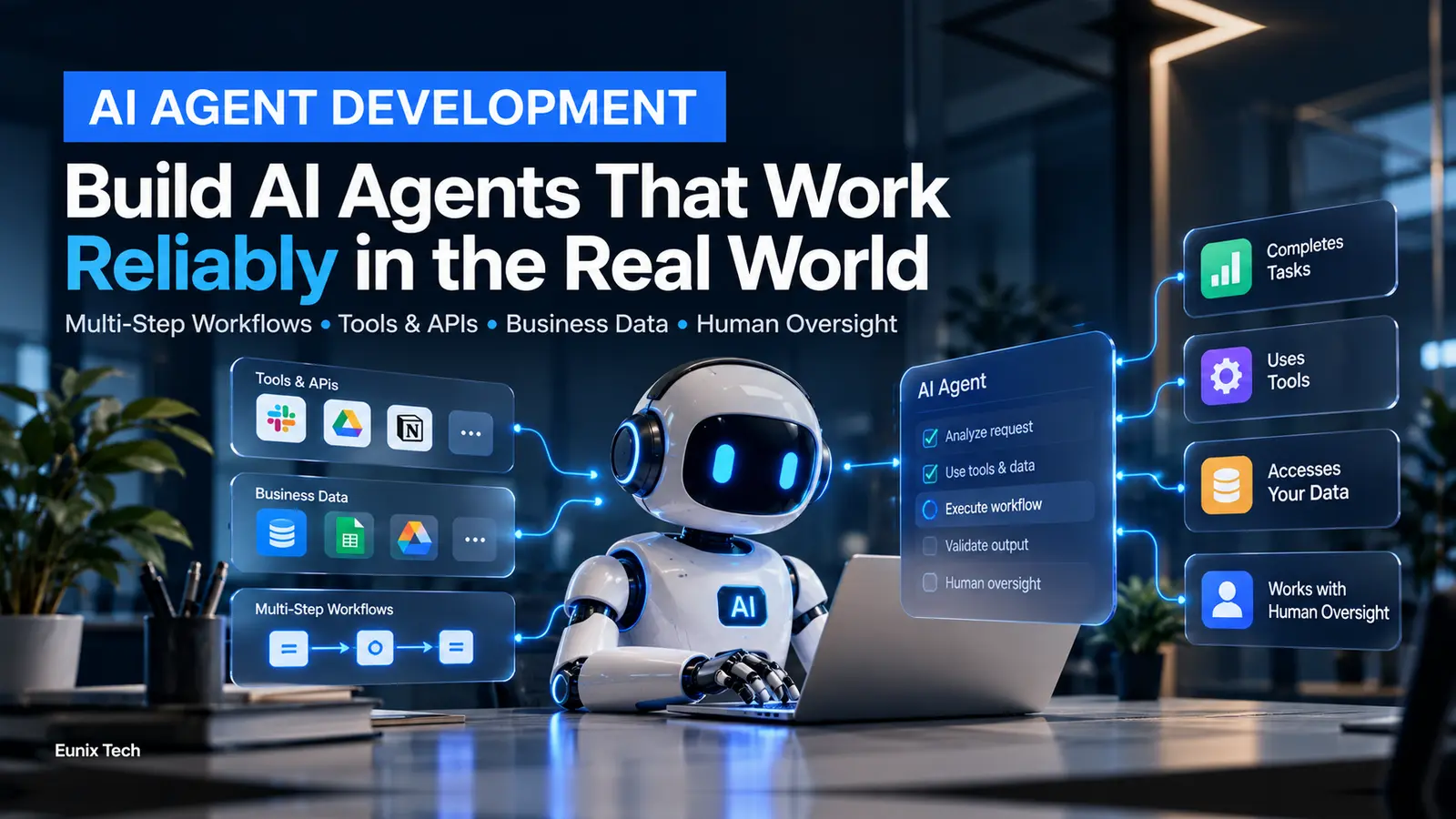
AI Agent Development: What It Takes to Build Reliable AI Agents for Business
Learn how AI agent development works, including architecture, use cases, security, costs, testing, and how businesses can build reliable AI agents.
Building an AI agent that works once is straightforward. Building one that works the four-hundredth time, on a request nobody anticipated, without quietly doing something expensive, is a different discipline entirely. That gap is what AI agent development is actually about.
The difficulty is structural rather than a matter of model quality. A single model call either succeeds or fails visibly. An agent that plans six steps has six opportunities to go wrong, and errors compound - a poor decision at step two produces confident nonsense by step five, delivered with the same fluency as a correct answer. Add the ability to call APIs, write to a CRM, or send a message, and the cost of that failure stops being a bad answer and starts being a bad action.
This guide covers what agent development involves, what separates a reliable agent from a demo, the architecture and process behind building one, security and human oversight, what drives cost, and how to evaluate AI agent development services. It also covers custom AI agent development and where agentic AI development services genuinely add value, and where a simpler approach would serve you better.
What Is AI Agent Development?
AI agent development is the design and engineering of AI systems that pursue a goal across multiple steps rather than responding to a single prompt. A business agent understands a request, reasons about the task, plans the steps, accesses business data, uses external tools, interacts with APIs, makes decisions inside defined boundaries, completes the task, requests human approval where required, and improves as feedback accumulates.
It helps to place agents against their neighbours. Traditional software executes fixed logic you wrote. Chatbots hold a conversation, usually within scripted or narrow bounds. AI assistants answer questions, generate content, and make recommendations, but the human drives every step. AI automation runs a defined workflow with AI handling interpretation at specific points. AI agents are given a goal rather than a script, and decide the steps themselves. Anthropic draws the same line: workflows follow predefined code paths, while agents direct their own process and tool use. Agentic AI systems coordinate several such capabilities - sometimes several agents - to complete a business process end to end.
The move from automation to agent is a genuine change in kind, not just capability. You stop specifying the path and start specifying the destination and the boundaries. That is powerful, and it is precisely why reliability engineering matters more here than anywhere else in applied AI.
How Are AI Agents Different From Traditional AI Applications?
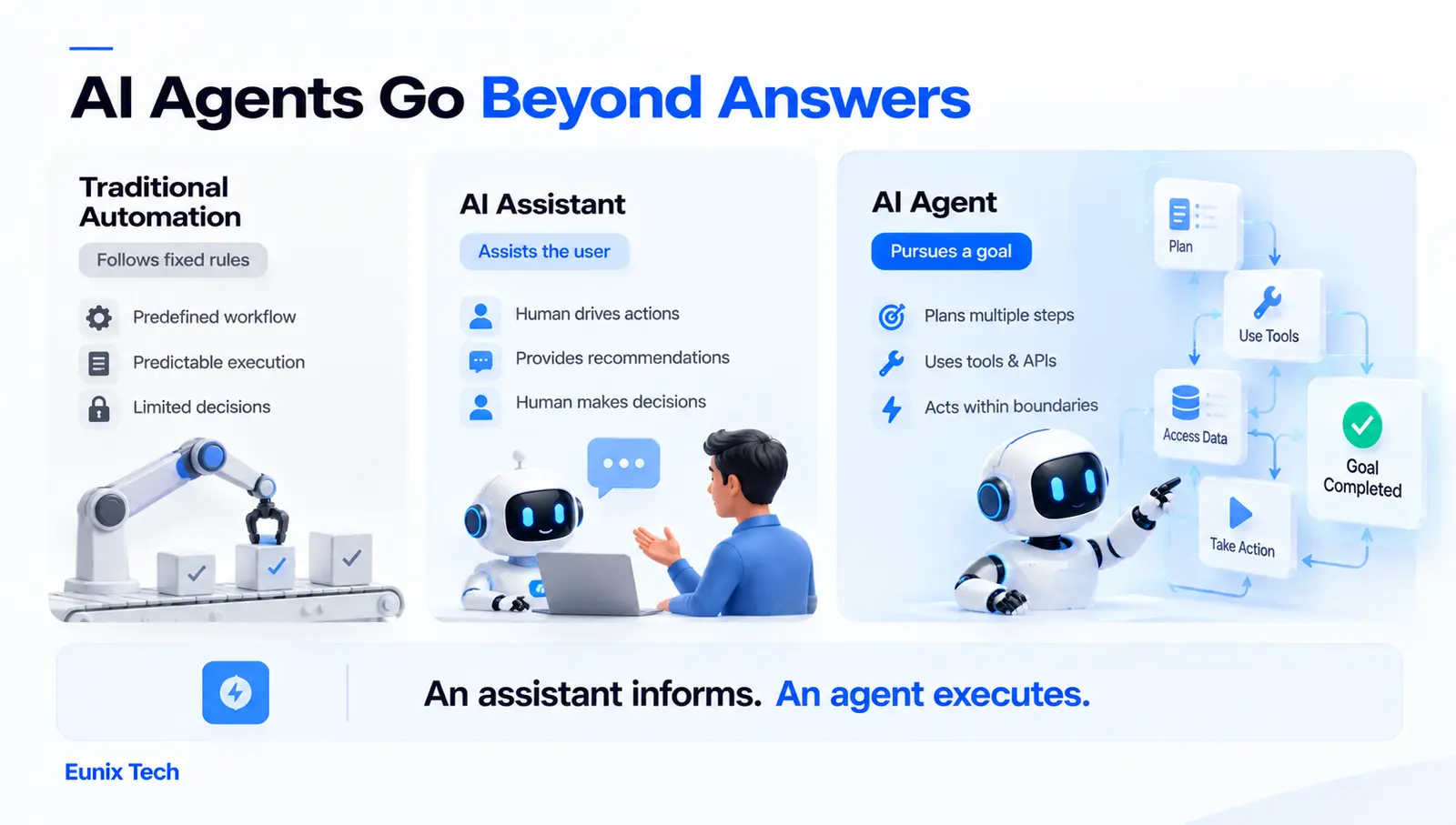
Traditional Automation
Fixed workflows, predefined rules, predictable inputs, and limited decision-making. Fast, cheap, and entirely predictable - properties worth keeping wherever the work allows.
AI Assistants
Interactive by nature: answering questions, generating content, making recommendations. The human remains the decision-maker and the executor; the assistant informs.
AI Agents
Goal-based execution with multi-step reasoning interleaved with actions, tool usage, dynamic decision-making, context awareness, and workflow execution. The agent decides how to reach the outcome, which is both the value and the risk.
Agentic AI Systems
Several AI capabilities working together - retrieval, reasoning, tool use, sometimes multiple specialised agents - to complete a business process. Developing an agentic AI system is more systems engineering than prompt engineering: orchestration, state, permissions, and failure handling dominate the work.
A caveat worth stating plainly, since the market rarely does: much of what is marketed as an agent is a workflow with one model call inside it, and would be better and more cheaply built that way. Anthropic's own guidance is to start with the simplest solution and add complexity only when needed. We have written about how loosely "agentic" gets used, and the distinction matters commercially - you should not pay agent prices for automation.
Why Are Businesses Investing in AI Agent Development?
Automate Multi-Step Business Processes
Lead qualification, customer onboarding, research, reporting, document processing, and internal workflows - processes with several steps, some judgement, and information spread across systems.
Reduce Manual Work
Agents absorb repetitive knowledge work: the reading, cross-referencing, summarising and record-updating that consumes skilled people's time without using their skill.
Improve Response Times
Customer support, sales enquiries, internal employee questions, and data requests get answered in seconds rather than queued for someone's attention.
Connect Multiple Business Systems
An agent can work across CRM, ERP, databases, APIs, communication platforms, and knowledge bases in a single task, which is often the real value, since the manual version of that task is a person switching between six tabs.
Scale Business Operations
Growing workload stops requiring proportional headcount. The caveat is that scale multiplies error rate as well as throughput, which brings us to the section that matters most.
What Types of AI Agents Can Businesses Build?
Customer Service AI Agents
Handling customer questions, classifying tickets, generating responses, retrieving from the knowledge base, and escalating what they should not handle. Escalation quality matters more than answer quality - an agent that knows what it does not know is worth more than one with a higher raw accuracy score.
Sales AI Agents
Lead qualification, prospect research, follow-up drafting, CRM updates, and sales recommendations - largely research and admin work that currently eats selling time.
Marketing AI Agents
Market and content research, campaign analysis, audience insights, and reporting.
Data and Analytics Agents
Data analysis, report generation, natural-language querying, anomaly detection, and business insight. Powerful and requiring careful database permissioning, as the security section covers.
Internal Knowledge Agents
Company documentation, policies, SOPs, employee questions, and knowledge retrieval. Usually the best first agent: internal audience, low blast radius, immediate feedback, and genuine daily value.
Coding and Developer Agents
Code generation, review, debugging, documentation, testing, and developer workflow support. This category has matured fastest, and it is reshaping how developer tools are priced and packaged - AI agents are changing developer tools and SaaS business models, shifting products from per-seat access toward outcome- and consumption-based pricing as the software starts doing work rather than merely enabling it.
Voice AI Agents
Voice-based customer service, appointment scheduling, lead qualification, and phone support. Voice agents and conversational AI product development adds constraints the text world does not have: latency budgets measured in hundreds of milliseconds, interruption handling, transcription errors compounding into misunderstanding, and no visual fallback when things go wrong. It also carries a distinct cost profile, which we break down in our guide to voice AI agent cost per month.
What Makes an AI Agent Reliable?
A reliable agent is not one that produces impressive answers. It is one that performs its task correctly and safely, repeatedly, including on the inputs nobody designed for. Six things produce that.
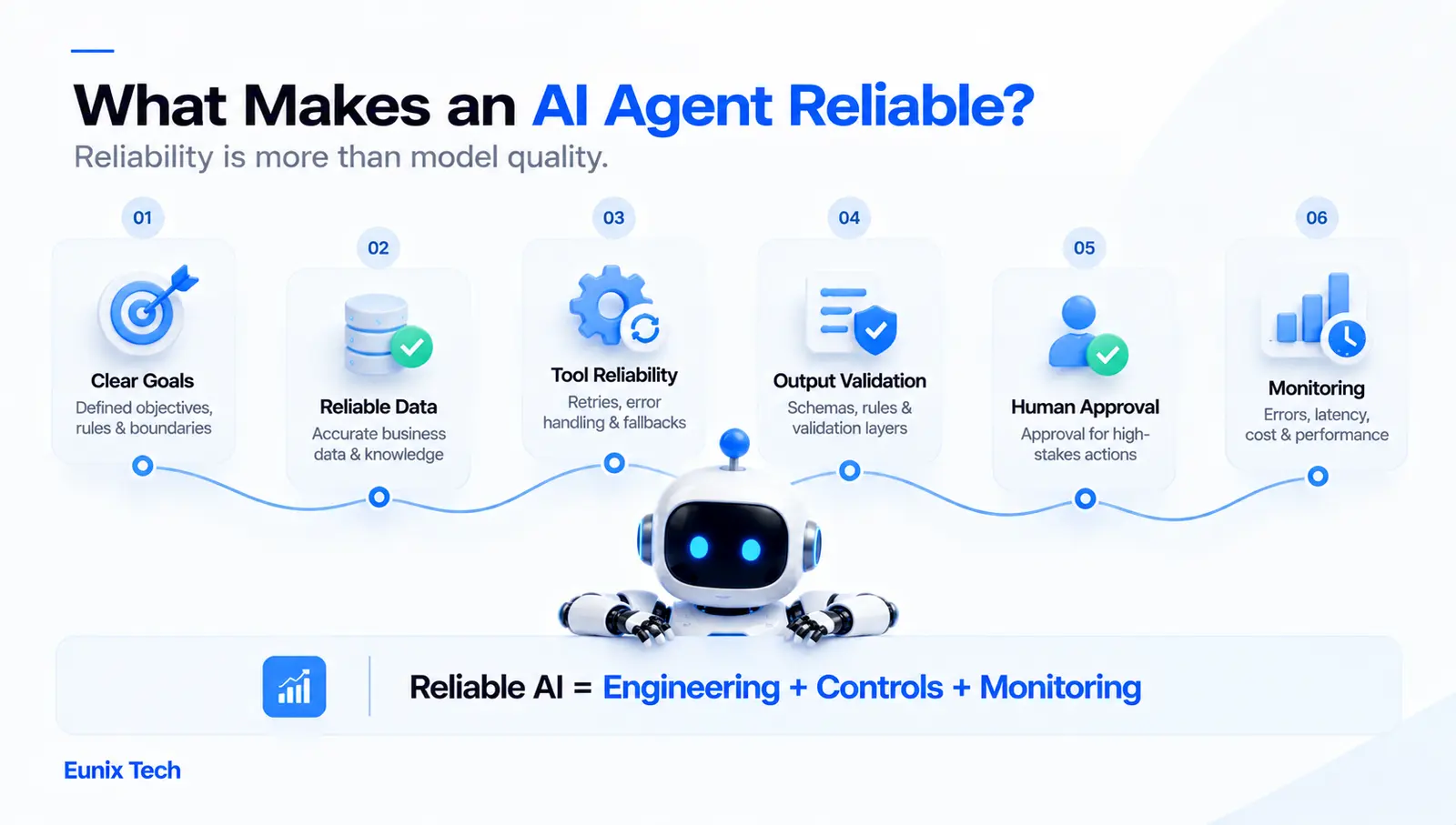
Clear Goals and Instructions
Defined objectives, explicit system instructions, encoded business rules, and hard task boundaries. Most erratic agent behaviour traces back to an under-specified goal - the agent is not malfunctioning, it is filling a gap you left.
Reliable Access to Business Data
Knowledge bases, databases, APIs, documents, and real-time business information, retrieved accurately. An agent reasoning over stale or incomplete data will be confidently wrong, and no amount of prompt work fixes that.
Tool and API Reliability
APIs fail, authentication expires, permissions change, rate limits bite, and calls time out. Every tool an agent uses needs error handling, retries with sensible backoff, and defined behaviour when the tool is simply unavailable. This is the least glamorous part of agent development and the one that most determines whether it survives production.
Output Validation
Structured outputs checked against schemas, business rules enforced in code, validation layers between the agent and any action, confidence checks, and human review where warranted. Validation belongs in the application, not in an instruction asking the model to be careful. OWASP makes the same point: use deterministic code to check that outputs match the expected format.
Human-in-the-Loop Controls
Some actions should always wait for a person: financial transactions, sensitive external communications, account changes, legal decisions, and anything irreversible. Approval gates are not a sign of an immature agent - they are how a capable agent is deployed responsibly.
Monitoring and Observability
Tracking agent actions, errors, latency, cost, model performance, tool usage, and user feedback. Multi-step systems need step-level tracing: when an agent produces a wrong outcome after six steps, you need to see which step failed, not just the final answer. Our guide to LLM evaluation covers measuring quality systematically.
How Does AI Agent Development Work?
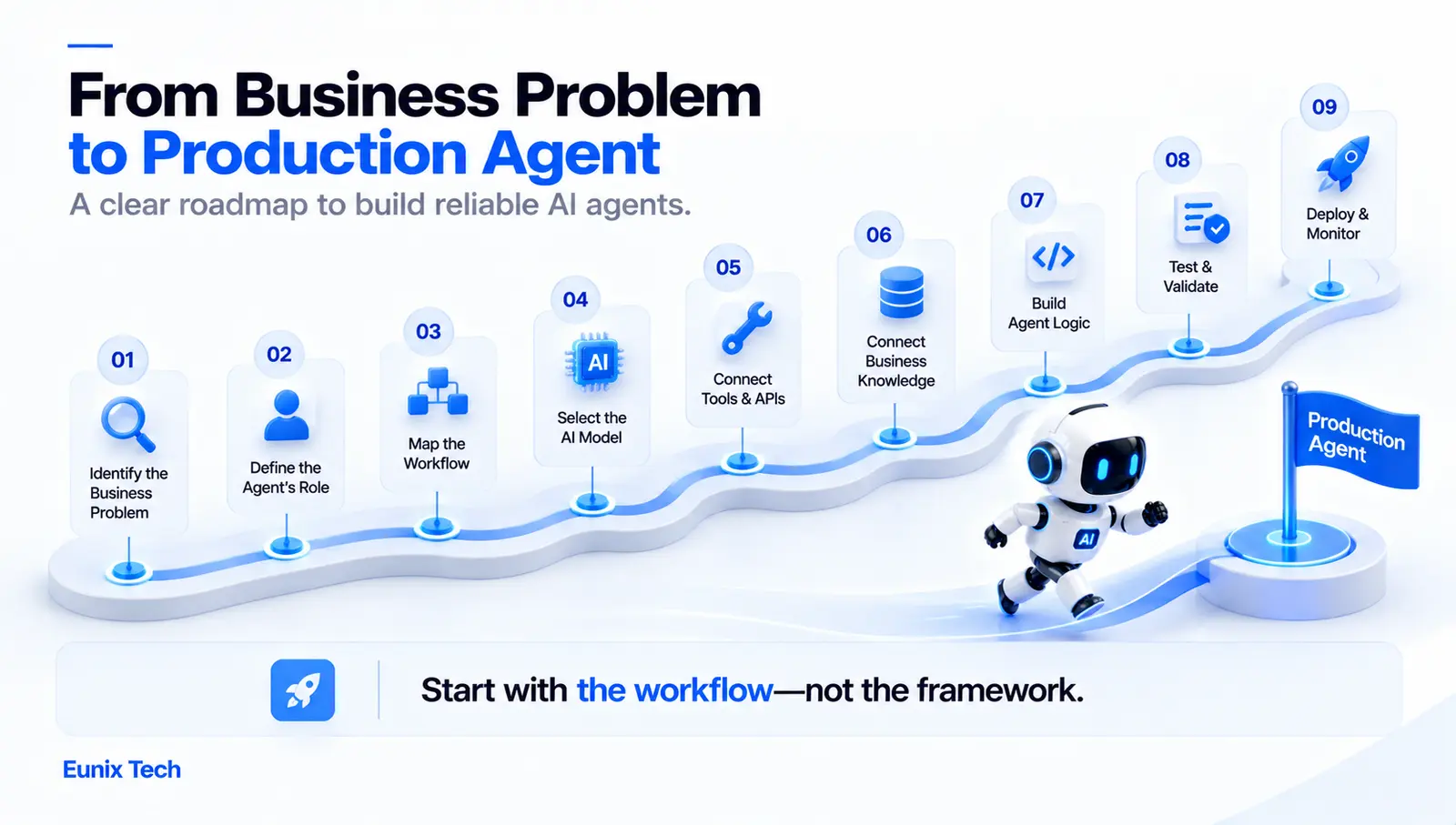
1. Identify the Business Problem
Start with the workflow. Support taking too long, staff manually processing documents, sales spending hours on lead research, reports requiring repetitive analysis, information scattered across systems - these are agent briefs.
2. Define the Agent's Role
Decide what the agent should accomplish, what it must not do, who uses it, which decisions it may make alone, and when human approval is mandatory. The negative scope is as important as the positive one and is usually the part teams skip.
3. Map the Workflow
Document the inputs, decision points, tools, data sources, actions, outputs, and escalation paths - as the process actually runs, including the exceptions people handle informally.
4. Select the AI Model
Choose between large language models, multimodal models, smaller specialised models, and custom ML models, weighing accuracy, cost, speed, context requirements, privacy, and - critically for agents - the quality of the model's tool use and instruction-following. A model that reasons beautifully but calls tools unreliably is the wrong choice here.
5. Connect Tools and APIs
REST APIs, SDKs, webhooks, databases, CRM and ERP systems, and internal applications, each with scoped credentials and its own failure handling.
6. Connect Business Knowledge
Retrieval-augmented generation, vector databases, knowledge bases, document repositories, and structured business data - the grounding that keeps answers tied to reality.
7. Build Agent Logic
Planning, reasoning, tool selection, task execution, memory, and state management. The recurring design decision is how much to leave to the model versus how much to encode: more structure means more reliability and less flexibility, and the right balance depends entirely on the cost of being wrong.
8. Test the Agent
Validate accuracy, reliability, security, tool usage, failure handling, response quality, and edge cases - including deliberate adversarial testing and what happens when a tool returns an error mid-task.
9. Deploy and Monitor
Production deployment with logging, monitoring, cost tracking, performance analysis, and continuous optimisation.
AI Agent Architecture: How the Components Work Together
User → AI Agent → Reasoning / Planning → Tools & APIs → Business Data → Action → Validation → User or System
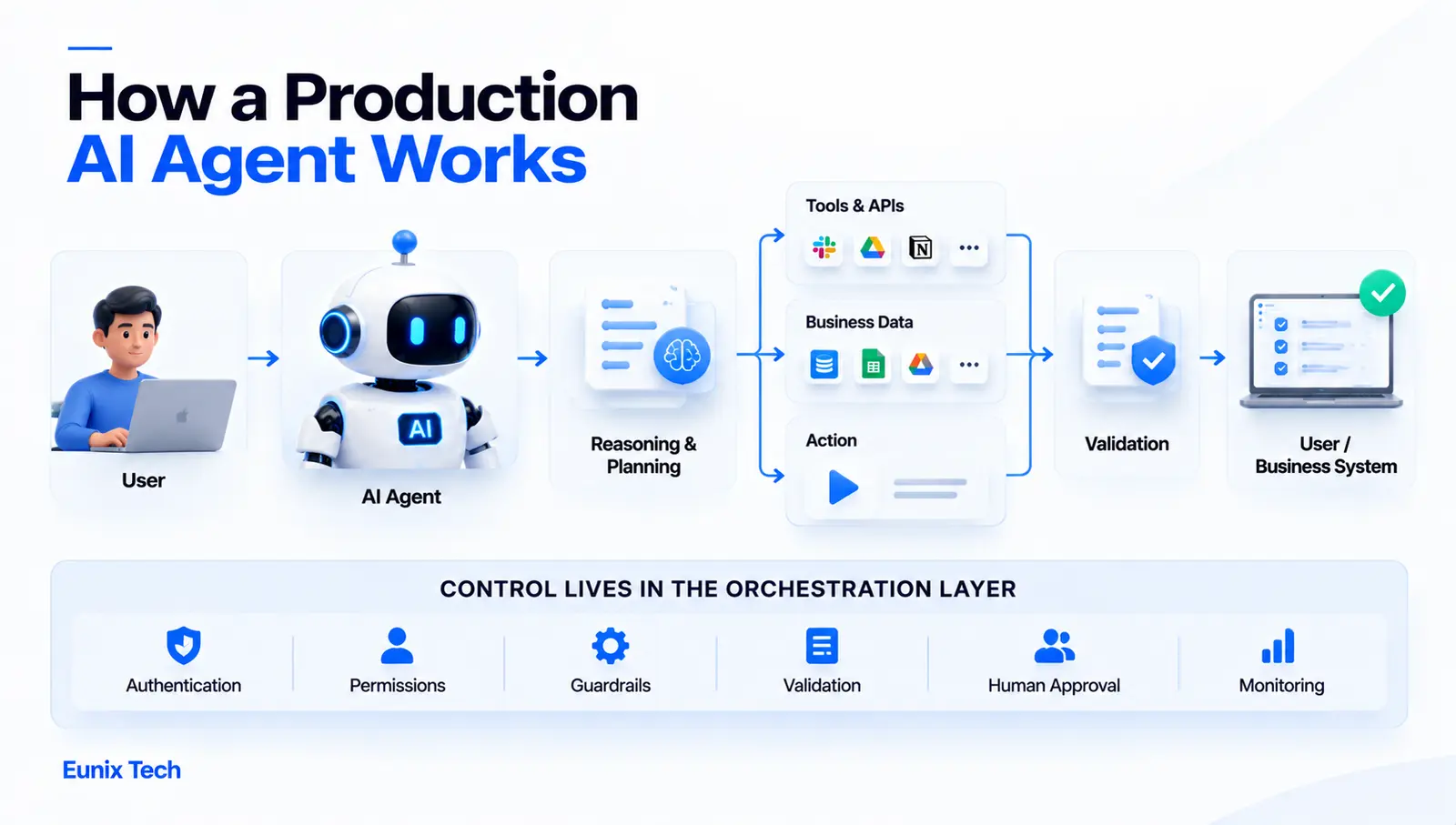
A production agent comprises a user interface, an orchestration layer that sequences steps and holds state, the AI model, a prompt and instruction layer, memory, RAG or knowledge retrieval, a tool layer, APIs, business databases, authentication, guardrails, human approval gates, and monitoring across the whole path.
The architectural principle that matters most: the orchestration layer, not the model, is where control lives. Permissions, validation, limits, and approval gates belong in code the model cannot talk its way around. OWASP advises enforcing authorisation in downstream systems rather than relying on the LLM to decide if an action is allowed. An agent whose safety depends on instructions in its prompt is one clever input away from an incident. Our guide to LLM architecture covers the surrounding patterns in depth.
Custom AI Agent Development for Business
Custom AI agent development matters when generic assistants cannot reach your workflows, your data, or your rules. Customisation typically covers business workflows, internal data, CRM and ERP systems, industry requirements, security policies, user permissions, purpose-built tools, and encoded business rules.
When Should a Business Build a Custom AI Agent?
When workflows are genuinely complex, when proprietary data is the source of the value, when several systems must be integrated, when industry-specific requirements apply, when security requirements exceed what a platform offers, or when the agent shapes a customer experience you want to own. Custom AI agent development services are worth their cost in those cases and hard to justify outside them.
Custom AI Agent vs. Off-the-Shelf AI Tool
| Factor | Custom AI Agent | Off-the-Shelf AI Tool |
|---|---|---|
| Customisation | High | Limited |
| Business integrations | Flexible | Depends on platform |
| Workflow control | High | Moderate |
| Data control | Greater | Platform-dependent |
| Development effort | Higher | Lower |
| Scalability | Highly customisable | Platform-dependent |
| Best for | Complex, specific workflows | General use cases |
If a platform covers your workflow today and will still cover it after the next two things you want, use the platform. That answer is more often correct than an agency will tell you.
AI Agent Development Services: What Do They Include?
Full AI agent development services span agent strategy, use-case discovery, architecture, custom development, model integration, RAG implementation, API integration, CRM and ERP integration, voice agent development, AI automation, testing, security implementation, deployment, monitoring, and maintenance.
The important structural point: agent work is not finished at launch. Models change, APIs deprecate, business processes shift, and users find inputs nobody imagined. An engagement covering only the initial build leaves you with a system that degrades and no one accountable for it.
Agentic AI Development Services for Complex Workflows
Multi-Agent Systems
Several specialised agents collaborating - a research agent, a data analysis agent, a customer support agent, an approval agent - each with a narrow role. Narrow roles are easier to test and debug than one agent doing everything, though coordination introduces its own failure modes and should be justified by real complexity rather than architectural enthusiasm.
Tool-Using Agents
Agents that search databases, call APIs, create records, send messages, generate reports, and execute approved actions. Every capability here is also an attack surface and a way to cause damage, so tool access should be granted deliberately, one at a time.
Autonomous vs. Human-Controlled Agents
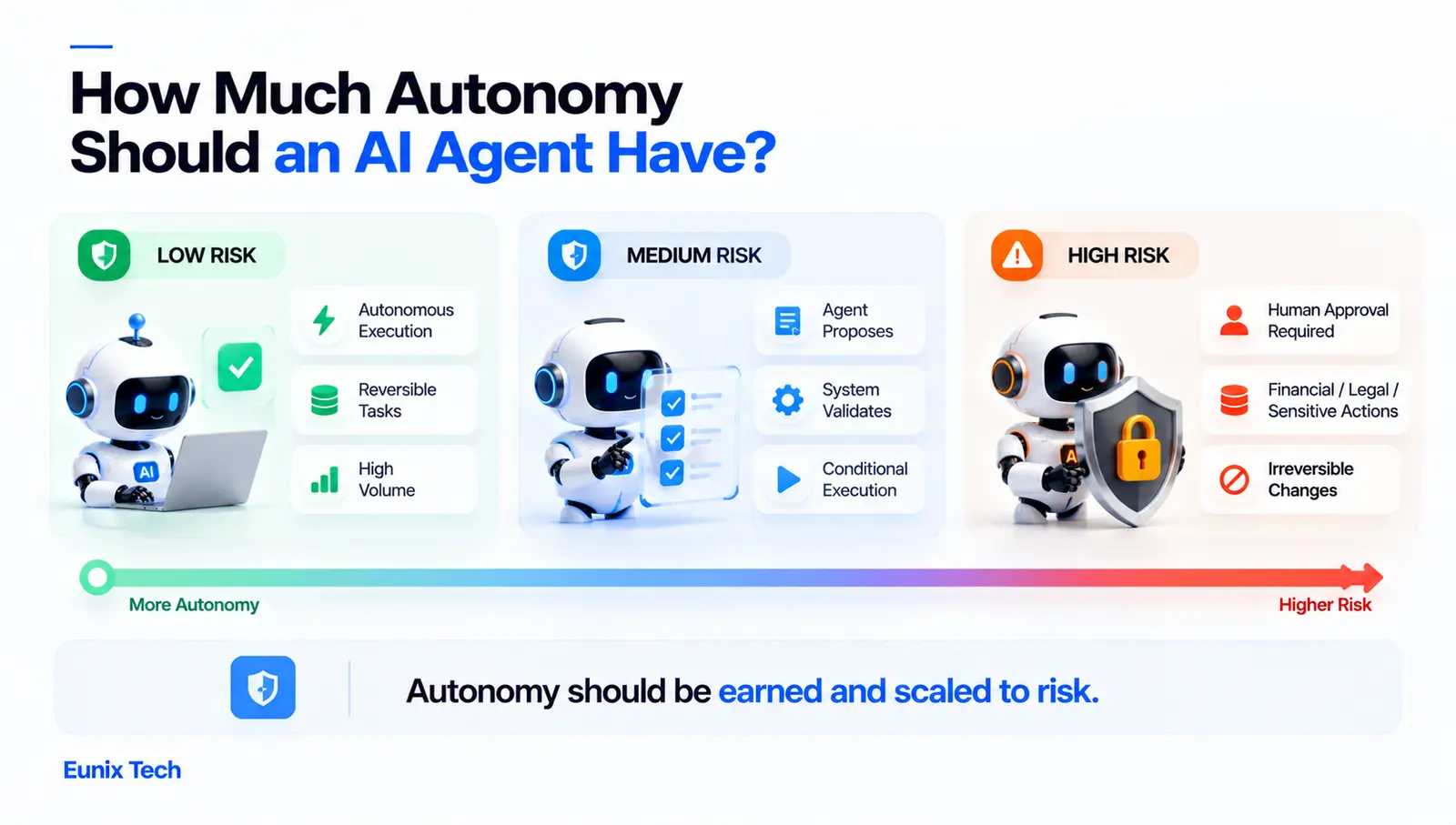
Fully autonomous workflows suit low-risk, high-volume, easily-reversible tasks. Human approval workflows suit anything consequential. Hybrid systems - autonomous by default, escalating on low confidence or high stakes - cover most real business cases.
The rule worth adopting: autonomy should be earned and scaled to risk. Start with the agent proposing and a human approving; widen the autonomy as measured accuracy justifies it. Deploying full autonomy on day one is how organisations learn about agent failure modes in the most expensive available way.
AI Agent Security and Data Privacy
Agents differ from other AI systems in one decisive respect: they act. That turns security from a data-protection question into an authorisation question.
The surface covers authentication, authorisation, role-based access, encryption, API security, data isolation between tenants and departments, handling of sensitive information, data retention, audit logs, access controls, the security posture of the model provider, and any compliance regime you operate under.
How to Prevent AI Agents From Taking Unauthorized Actions
Grant least-privilege permissions and nothing more. Restrict the tool set to what the role requires. Put approval workflows in front of consequential actions. Enforce role-based access so the agent operates with the requesting user's entitlements, never a superuser's. Validate every action against business rules before execution. Apply hard transaction and rate limits in code. Log every action with its context. And keep human oversight proportional to risk.
The framing that keeps this straight: treat an agent as a new employee with no track record and perfect confidence. You would not give that person unrestricted system access on day one, and the reasoning applies unchanged.
Common Challenges in AI Agent Development
Hallucinations and incorrect decisions. Countered with grounding, RAG, structured outputs, validation, and human review - not with better prompting alone.
Unpredictable agent behaviour. Addressed with guardrails, tighter workflow definitions, restricted tools, and systematic testing. Unpredictability usually signals too much latitude, not too little intelligence.
Poor data quality. Inaccurate business data produces inaccurate agents, reliably.
Integration complexity. Legacy systems, APIs, databases, and SaaS platforms each add failure modes, and agents touch more of them than most software does.
Security risks. Excessive permissions are the most common and most serious mistake in agent deployment.
Cost and token usage. Agents trade latency and cost for better task performance, so they are expensive per task: multiple model calls, tool calls, and retries per completed workflow. Cost per task, not cost per call, is the number to watch.
User adoption. Agents ask for more trust than other software because they act. Trust comes from visible reasoning, easy correction, reliable escalation, and being honest with users about what the agent does badly.
How Much Does AI Agent Development Cost?
There is no fixed price, because "an AI agent" covers a scoped internal knowledge assistant and a multi-system autonomous workflow. These factors determine which you are commissioning.
| Cost Factor | Potential Impact |
|---|---|
| Agent complexity | More steps and decisions require more development |
| Number of integrations | Each system adds engineering and testing |
| AI model | Model choice affects both build and running costs |
| Data volume | Large datasets increase infrastructure requirements |
| RAG implementation | Retrieval adds architecture and evaluation work |
| Custom development | Unique workflows expand scope |
| Security | Enterprise controls add meaningful effort |
| User volume | Higher usage raises infrastructure and API costs |
| Testing | Reliable agents require extensive validation |
| Maintenance | Monitoring and optimisation are recurring |
Two things distinguish agent budgets from ordinary AI projects. Testing is a larger share, because verifying a multi-step system means testing paths rather than outputs. And running cost per completed task is materially higher than a single model call, so unit economics need checking before build rather than after. A technical discovery and use-case assessment is what turns this table into a number; our guide to AI software development cost covers the wider budgeting framework.
How to Choose an AI Agent Development Company
Look for demonstrable agent development experience specifically - not general AI work - alongside custom AI development capability, LLM expertise, agentic AI experience, API integration skill, RAG experience, database integration, security knowledge, cloud architecture, testing capability, monitoring and observability practice, relevant industry exposure, post-launch support, and case studies you can question in detail.
Questions to Ask an AI Agent Development Company
- Have you built agents for businesses similar to ours, and what failed on those projects?
- Which AI model would you recommend here, and why that one?
- How will the agent access our business data, and under whose permissions?
- Which systems and APIs need integrating, and have you verified they support it?
- How will the agent's actions be constrained, and where does that enforcement live?
- How will hallucinations be reduced and detected?
- How will sensitive data be protected?
- Which actions will require human approval?
- How will performance and quality be monitored in production?
- How will ongoing AI costs be controlled as usage grows?
- What happens if an API or the AI model becomes unavailable mid-task?
Questions five and eleven are the ones that separate teams who have run agents in production from teams who have demoed them. If enforcement lives in the prompt, or there is no answer for partial failure, keep looking.
AI Agent vs. Chatbot vs. AI Assistant vs. Automation
| Capability | Chatbot | AI Assistant | Automation | AI Agent |
|---|---|---|---|---|
| Conversation | Yes | Yes | Limited | Yes |
| Understands natural language | Basic-Advanced | Advanced | Limited | Advanced |
| Multi-step tasks | Limited | Moderate | Fixed | Strong |
| Tool usage | Limited | Moderate | Predefined | Dynamic |
| Decision-making | Limited | Moderate | Rule-based | Context-aware |
| Autonomous actions | Low | Low-Moderate | Predefined | Potentially high |
| Human approval | Common | Common | Optional | Configurable |
Agents earn their extra complexity where a workflow genuinely requires reasoning, tools, decisions, and multiple steps together. Remove any one of those and something simpler will usually outperform an agent on cost, speed, and predictability.
When Should a Business Build an AI Agent?
Good candidates: employees repeatedly performing multi-step tasks; processes requiring real decisions; work spanning several systems; growing support volume; time lost searching for information; repetitive sales research; manual reporting and analysis; and existing software holding valuable data with no intelligent automation on top.
Equally important, when not to build one. If the workflow is simple and rule-based, write the rules - they will be faster, cheaper and predictable. If conventional automation is sufficient, use it. If the business problem is not clearly defined, define it first; an agent will not clarify it for you. If data quality is poor, fix the data, because an agent will amplify the problem. And if the ROI is unclear, run the numbers before building, not after.
Choosing not to build an agent is frequently the correct engineering answer, and it is the one a good partner should be willing to give you.
A Step-by-Step AI Agent Development Roadmap
Phase 1: Discovery. Identify business objectives, map workflows, identify users, audit systems, locate data sources.
Phase 2: Use-case prioritisation. Rank candidates on business value, technical feasibility, risk, cost, and complexity. The best first agent is high-value and low-risk - usually internal rather than customer-facing.
Phase 3: Proof of concept. A limited agent validating accuracy, user experience, tool usage, and business value before production investment.
Phase 4: Agent development. Agent logic, integrations, knowledge retrieval, guardrails, and interface.
Phase 5: Testing and security. Validate outputs, permissions, data security, failure scenarios, and edge cases - including mid-task tool failures.
Phase 6: Production deployment. Into real workflows, with monitoring live from the first day.
Phase 7: Monitoring and optimisation. Track accuracy, usage, errors, costs, user feedback, and task completion rates, and improve against what production reveals.
How to Measure AI Agent Performance
Answer-quality metrics alone do not describe an agent, because an agent's job is completing tasks rather than producing text. Measure task completion rate, accuracy, response time, successful tool calls, escalation rate, error rate, human intervention rate, cost per task, user satisfaction, and the business outcome the agent exists to move.
Task completion rate and cost per task are the two that matter most and are most often missing. An agent with excellent accuracy that completes 40% of tasks unaided is not yet doing its job, and one that completes 95% at an unsustainable cost per task is not either.
Business KPIs for AI Agents
Reduced support costs, faster lead response, increased sales productivity, reduced processing time, improved employee productivity, and faster decision-making. Baseline these before deployment - retrofitting a baseline afterwards turns evaluation into an argument.
Benefits of Professional AI Agent Development Services
Experienced teams deliver faster because the failure modes are already known, produce better architecture at the orchestration layer where reliability is decided, build custom integrations properly, handle security as a design input, improve reliability through testing practice adapted to multi-step systems, build infrastructure that survives scale, select models on fit rather than fashion, reduce development risk, and provide the ongoing monitoring and optimisation agents require.
The largest contribution, though, happens before code: choosing the right first use case, and ruling out the ones that should never have been agents.
Why Choose Eunix Tech for AI Agent Development?
At Eunix Tech, agent work sits where our two strengths meet - production AI engineering and full-stack software engineering. Reliable agents are mostly an orchestration, integration, permissions and error-handling problem, which means they are built by engineers who take production seriously rather than by prompt specialists.
Our work covers AI systems and workflow development, LLM and RAG engineering, API reliability, integration with existing business software, and technical audits of AI systems already live but behaving unpredictably. A significant share is stabilisation - including rescuing a failed AI chatbot project and building AI workflow automation for small and mid-sized businesses. Senior engineers do the work directly, including the discovery that decides whether an agent is the right answer at all. We are comfortable telling clients when it is not.
Build a Reliable AI Agent for Your Business
Ready to build an AI agent for your business? The right first step is not choosing a framework - it is identifying which multi-step workflow costs your team the most time and whether the systems involved can actually be reached.
An AI agent development assessment identifies high-value use cases, the limitations in your current workflows, the integrations required, the data sources involved, security requirements, a recommended architecture, model options, a development roadmap, and a realistic project scope. Talk to us about the workflow you have in mind, and if a simpler automation would serve you better, we will say so.
Conclusion
AI agent development lets businesses automate complex, multi-step work that resisted conventional automation. But a reliable agent is far more than an LLM behind a chat interface: it needs clear goals and boundaries, dependable data access, resilient tools and APIs, output validation, guardrails, human approval where stakes are high, systematic testing, and continuous monitoring.
Custom AI agent development earns its cost where workflows, data, or integrations are genuinely specific to your business, and agentic AI development services suit processes with real multi-step complexity. Security and human oversight are not optional once an agent can act on business systems - the enforcement belongs in code, not in the prompt, and autonomy should be scaled to measured performance rather than granted upfront.
Start with one clearly defined, high-value use case rather than automating everything at once. For related reading, see our guides to AI automation development and AI integration services, or get in touch for an agent development assessment.
Sources
- Building effective agents - Anthropic, 2024
- ReAct: Synergizing Reasoning and Acting in Language Models - Yao et al., 2022
- Tool use with Claude - Anthropic documentation, 2026
- LLM01:2025 Prompt Injection - OWASP Top 10 for LLM Applications, 2025
- LLM06:2025 Excessive Agency - OWASP Top 10 for LLM Applications, 2025
Frequently Asked Questions
What is AI agent development?
AI agent development is the design and engineering of AI systems that pursue a goal across multiple steps - understanding a request, reasoning about the task, planning steps, accessing business data, using tools and APIs, making decisions within defined boundaries, and requesting human approval where required. Unlike a single prompt-and-response system, an agent decides how to reach the outcome.
How are AI agents different from chatbots?
A chatbot holds a conversation, usually within scripted or narrow bounds, and its output is text. An agent is given a goal rather than a script, plans multiple steps, uses tools and APIs, and takes actions in business systems. The difference that matters operationally is that an agent acts, which makes permissions and validation central.
How does AI agent development work?
Identify the business problem, define the agent's role including what it must not do, map the real workflow, select an appropriate model, connect tools and APIs, connect business knowledge through retrieval, build the agent logic and state management, test thoroughly including failure scenarios, then deploy with monitoring and optimise continuously.
What are AI agent development services?
They typically span agent strategy, use-case discovery, architecture, custom development, model integration, RAG implementation, API and CRM/ERP integration, voice agent development, testing, security, deployment, monitoring, and maintenance. Because agents degrade as models and APIs change, an engagement covering only the initial build leaves a gap.
What is custom AI agent development?
Building an agent shaped around your specific workflows, internal data, systems, industry requirements, security policies, user permissions, and business rules, rather than configuring a generic assistant. It is worth the cost when the workflow is genuinely complex, the data is proprietary, several systems must integrate, or platform security is insufficient.
What is agentic AI development?
Building systems where multiple AI capabilities (and sometimes multiple specialised agents) work together to complete a business process involving several steps and decisions. It is more systems engineering than prompt engineering: orchestration, state management, permissions, and failure handling dominate the effort.
What types of AI agents can businesses build?
Common categories are customer service, sales, marketing, data and analytics, internal knowledge, coding and developer agents, and voice agents. Internal knowledge agents are usually the best starting point - internal audience, low blast radius, immediate feedback, and real daily value.
How much does AI agent development cost?
It depends on agent complexity, number of integrations, AI model, data volume, whether RAG is required, custom development scope, security requirements, user volume, testing depth, and ongoing maintenance. Agents differ from other AI projects in that testing is a larger share of effort and running cost per completed task is materially higher, so unit economics should be checked before building.
How long does it take to build an AI agent?
It varies with the number of integrations, the quality of the APIs involved, data readiness, the risk level of the actions the agent takes, and how much testing the use case demands. A scoped internal knowledge agent against clean data is a matter of weeks; a multi-system agent taking consequential actions under enterprise security is a matter of months.
What makes an AI agent reliable?
Clear goals and boundaries, reliable access to accurate business data, resilient tool and API handling with retries and fallbacks, output validation enforced in code, human approval on high-stakes actions, and step-level monitoring. Reliability comes from the engineering around the model, not from the model itself.
How do AI agents access business data?
Through APIs, databases, document repositories, and retrieval systems such as vector databases, mediated by an integration layer that enforces authentication and permissions. Access should be least-privilege and scoped to the requesting user's entitlements, with the enforcement in the integration layer rather than in prompt instructions.
Can AI agents integrate with CRM and ERP systems?
Yes, and these are among the most valuable integrations because they hold the business data and the records the agent needs to update. The practical constraint is API quality: modern CRMs generally integrate straightforwardly, while older ERP systems can require significantly more engineering.
How secure are AI agents?
As secure as the permissions and controls around them, which makes security a design decision rather than a property of the technology. The essentials are least-privilege access, restricted tool sets, approval workflows for consequential actions, role-based access, action validation, transaction limits enforced in code, comprehensive audit logging, and human oversight proportional to risk.
Can AI agents work with multiple APIs?
Yes - working across several systems in one task is often the main reason to build an agent. Each API needs scoped credentials, error handling, retry logic, and defined behaviour when unavailable, since every additional integration adds a way for a multi-step task to fail partway through.
What is the difference between an AI agent and an AI assistant?
An assistant answers questions, generates content and makes recommendations while the human drives every step and takes every action. An agent is given a goal, plans the steps itself, uses tools, and executes actions within defined boundaries. The assistant informs a decision; the agent carries one out.
When should a business use a custom AI agent?
When workflows are genuinely complex, proprietary data is the source of value, multiple systems must be integrated, industry-specific requirements apply, security needs exceed platform capabilities, or the agent shapes a customer experience you want to control. If an off-the-shelf platform covers your workflow now and after your next two requirements, use the platform.
What are the biggest challenges in AI agent development?
Hallucinations and incorrect decisions, unpredictable behaviour from under-specified goals, poor data quality, integration complexity, security risks from excessive permissions, cost and token usage across multi-step tasks, and user adoption. Excessive permissions and data quality cause the most serious problems in practice.
How do I choose an AI agent development company?
Prioritise demonstrable agent experience over general AI work, alongside API integration skill, RAG experience, security knowledge, testing capability, and monitoring practice. Ask where action enforcement lives - if the answer is the prompt rather than code, and what happens if an API fails mid-task. Both questions separate production experience from demo experience.
What is the role of human oversight in AI agents?
Humans should approve financial transactions, sensitive external communications, account changes, legal decisions, and anything irreversible, and should review low-confidence outputs. Oversight is not a sign of an immature agent - it is how a capable one is deployed responsibly. Autonomy should widen as measured accuracy justifies it, not be granted upfront.
Can AI agents use voice and conversational AI?
Yes - voice agents handle customer service, appointment scheduling, lead qualification, and phone support. Voice adds constraints text does not have: latency budgets in the hundreds of milliseconds, interruption handling, transcription errors compounding into misunderstanding, and no visual fallback when something goes wrong. The cost profile differs meaningfully too.
