
LLM Architecture: How to Design Reliable AI Applications for Production
Learn how LLM architecture works and how to design reliable AI applications for production. Explore components, architecture patterns, deployment, security, and scaling.
Calling an LLM API is easy. Building an LLM application that stays reliable, fast, secure, and affordable with real users is not. That gap is what LLM architecture is about - the design of everything around the model that turns a clever demo into a dependable product. Because here is the truth most teams learn the hard way: a working prototype is a long way from LLM application development that survives production.
An LLM by itself is just a text-in, text-out model. A real product needs application logic, prompt and context management, data and retrieval, tool integrations, validation, security, and monitoring - all working together. That whole system is your LLM application architecture, and the decisions you make in it determine whether your AI feature is trustworthy or a liability.
In this guide you'll learn what LLM architecture means, the components a production LLM system needs, the common architecture patterns and when to use each, how to design for reliability, security, scale, and cost, and how to choose the right approach for your business.
What Is LLM Architecture?
LLM architecture is the structure of a complete AI application built around one or more language models - how the model connects to your data, your business logic, your users, and the outside world. It is the difference between "we call OpenAI" and "we built a system that reliably does a job."
It helps to separate three things people often blur together. The LLM model is the foundation model itself (GPT, Claude, Llama) - a general reasoning engine. The LLM application is the product users actually interact with. The LLM architecture is how every part of that application is arranged: APIs, databases, retrieval systems, tools, and application logic working as one system.
At small scale, architecture barely matters - you can hardcode a prompt and ship. But as an application grows, handles more users, touches sensitive data, and takes on higher-stakes tasks, architecture becomes the thing that decides reliability, cost, and how fast you can improve. Good LLM architecture design is what lets a system scale without falling over.
What Does a Production LLM Application Need?
A production-ready LLM system is built from several layers, each solving a problem the raw model cannot.
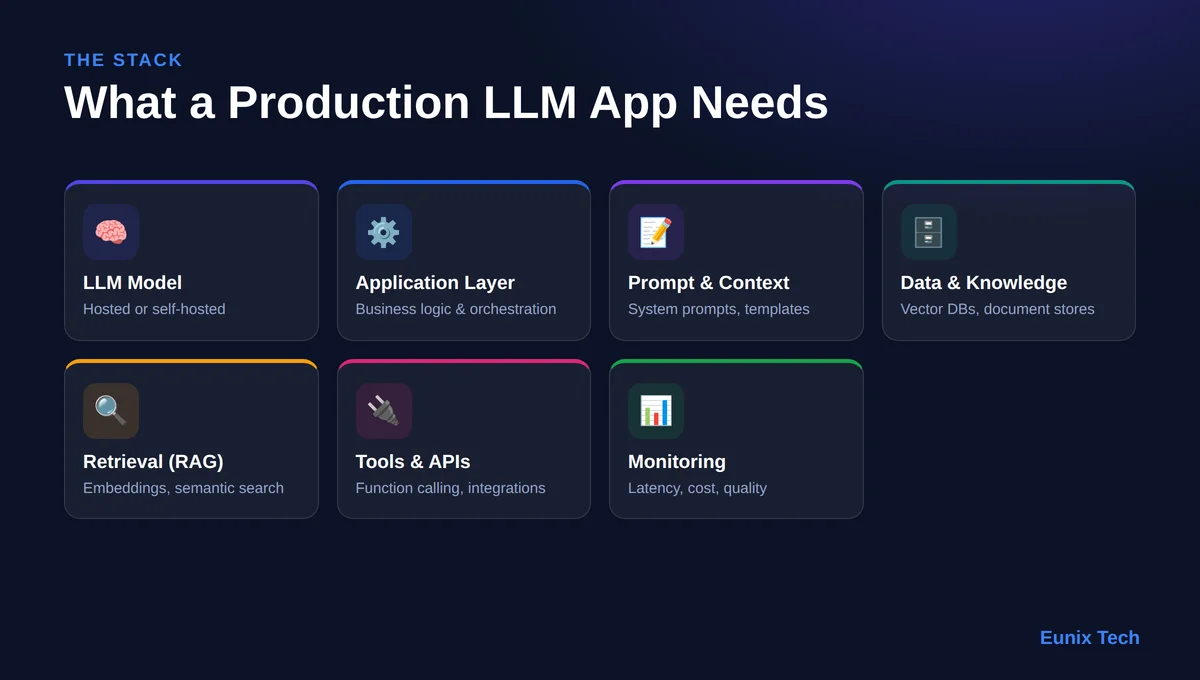
LLM Model
The foundation model at the core. The main choice is hosted (OpenAI, Anthropic, Google - fast to start, no infrastructure) versus self-hosted open models (more control, privacy, and cost predictability, but more to run). Model selection should follow the use case, not the hype: the newest, largest model is rarely the right default.
Application Layer
The code that runs your product - handling user requests, applying business logic, orchestrating prompts, and processing responses. This is ordinary software engineering, and it is where most of the real work lives.
Prompt and Context Management
How the system builds what it sends to the model: system prompts, prompt templates, and the context assembled for each request. Because context windows are finite and every token costs money, deciding what context to include, and what to leave out - is an architectural decision, not an afterthought.
Data and Knowledge Layer
Your databases, document stores, and knowledge bases - plus vector databases that store embeddings for semantic search. This layer is what grounds the model in your information rather than only its training data.
Retrieval Layer
The retrieval-augmented generation (RAG) pipeline: turning content into embeddings, running semantic search, and feeding the most relevant results into the prompt. Good retrieval is the single biggest lever for accuracy in knowledge-based applications.
Tools and API Integrations
Function calling and integrations that let the model do more than talk - query a live system, call an external API, trigger a workflow, or read from an internal tool. This is how an LLM app takes action in the real world.
Monitoring and Observability
Tracking latency, token usage, cost, errors, and response quality. You cannot manage what you cannot see, and LLM systems fail in quiet ways - a slow drift in answer quality - that only observability catches.
LLM Application Architecture: Key Components and Data Flow
Put the layers together and a request flows through the system like this:
User → Application → Prompt/Context Layer → Retrieval/Tools → LLM → Validation → Response → Monitoring
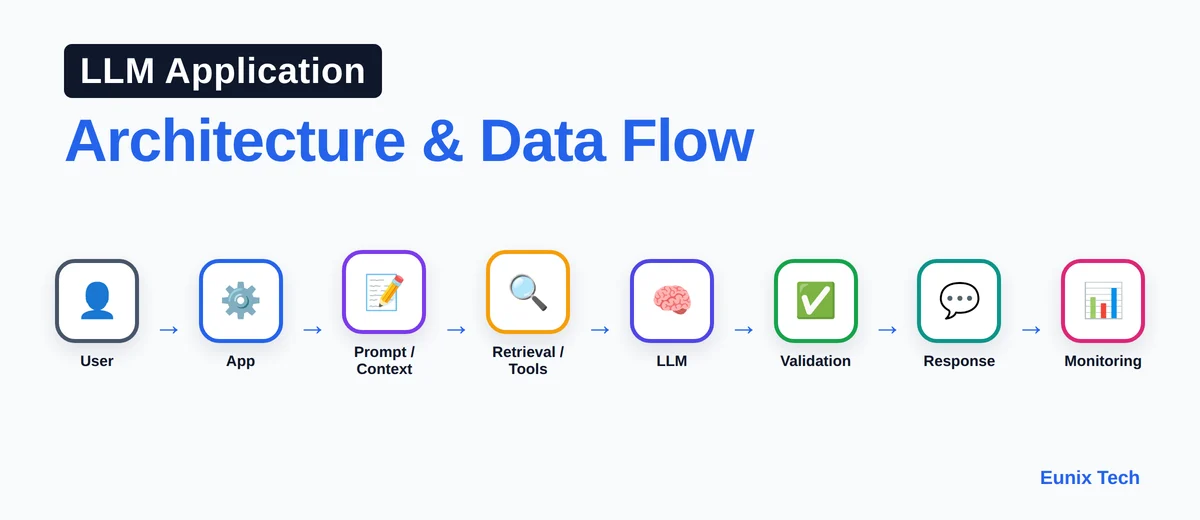
A user request enters through the application layer, which applies business rules and authentication. The prompt and context layer assembles the right instructions and pulls relevant knowledge from the retrieval layer; if the task needs live data or an action, tools and APIs are called. The assembled prompt goes to the LLM, which generates a response, and crucially, that response passes through a validation step before it ever reaches the user, checking format, safety, and business rules. The validated response is returned, and monitoring captures the latency, cost, and quality of the whole exchange. That validation and monitoring loop is what separates a production system from a demo that pipes model output straight to the screen.
Common LLM Architecture Patterns
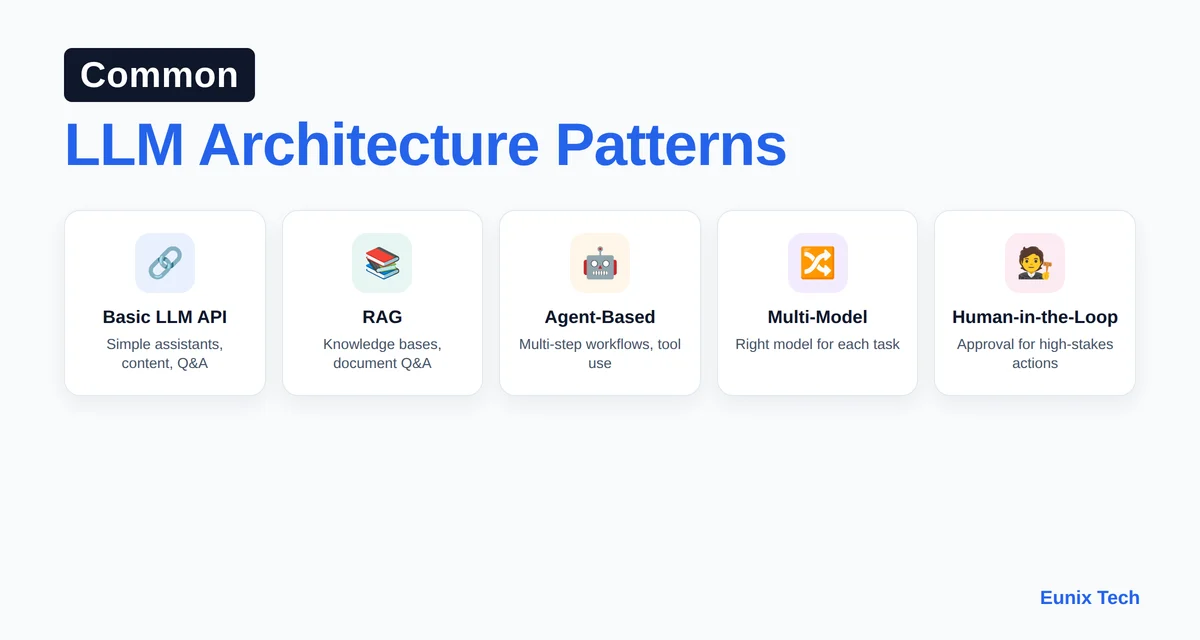
There is no single architecture that fits every application. These are the main patterns, from simplest to most capable.
Basic LLM API Architecture
The application sends a prompt to a model and returns the response. Best for simple AI assistants, content generation, and basic question-answering where the model's own knowledge is enough.
RAG Architecture
Adds a retrieval layer so the model answers from your documents and data, not just its training. Best for enterprise knowledge bases, document Q&A, and internal knowledge assistants - anywhere answers must be grounded in your own, current information.
Agent-Based Architecture
The model plans and executes multi-step tasks, calling tools along the way. Best for complex workflows, tool use, and business process automation, but it is also the hardest to make reliable, which is why it needs strong guardrails.
Multi-Model Architecture
Different models for different jobs: a powerful model for complex reasoning, a small fast one for classification or summarization. This routing keeps quality high where it matters and cost low everywhere else.
Human-in-the-Loop Architecture
A person reviews or approves the model's output before a high-stakes action completes. Essential anywhere a wrong answer has real consequences - payments, legal, healthcare, irreversible changes.
LLM App Development: From Prototype to Production
Turning an idea into a reliable LLM app follows a clear lifecycle. Skipping steps is why so many AI prototypes stall on the way to production.
It starts by defining the business use case - the problem and the measurable outcome - then selecting the right model for that job. From there you design the LLM architecture (which pattern, which layers), build the application layer, and integrate your data and external tools. The step teams most often skip is next: test and evaluate the system, measuring accuracy and failure rates across many real cases, not just a few happy-path demos. Only then do you deploy to production, and finally monitor and continuously improve using real usage data. This is the same disciplined arc we describe in our guide to AI product development - architecture is where it becomes concrete.
LLM Deployment Architecture: Moving AI Applications Into Production
LLM deployment architecture is everything that makes the system run reliably in the real world: cloud infrastructure, API gateways, containers, load balancing, databases, caching, authentication, monitoring, logging, model APIs, and CI/CD pipelines. These are familiar tools to any engineering team - the difference is that an LLM app adds model endpoints, token cost, and response-quality monitoring to the usual concerns.
Just as important is a proper path from development → staging → production. Prototypes that skip staging tend to "test in production", which, with a non-deterministic model touching real users and real data, is exactly where you do not want surprises. Separate environments let you evaluate changes safely before they reach customers.
How to Design Reliable LLM Applications
Reliability is in the title of this article for a reason: it is the hardest and most important property of a production LLM system. It comes from architecture, not luck.
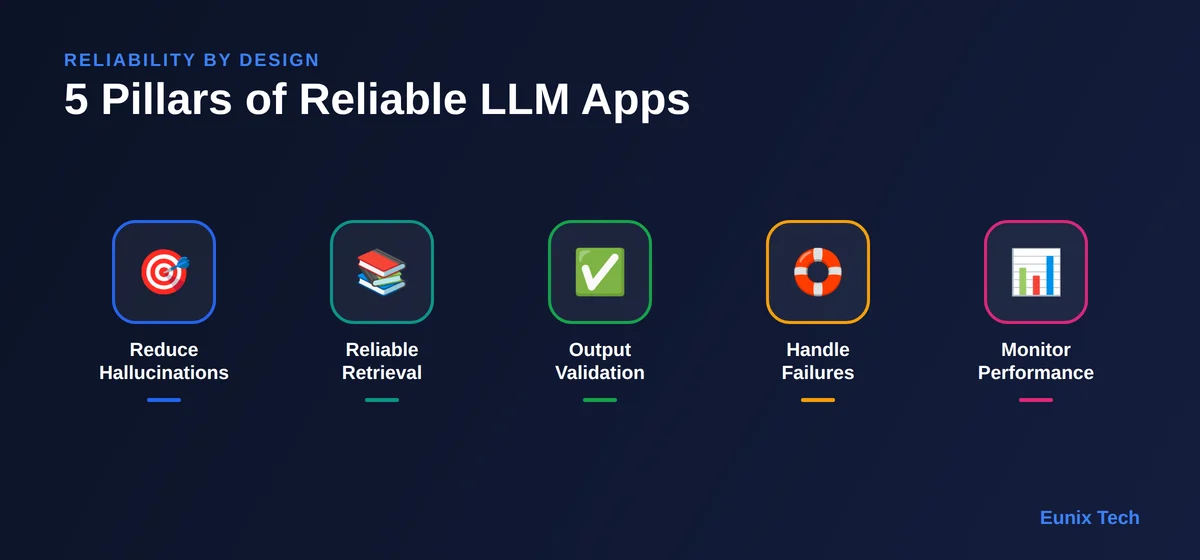
Reduce hallucinations. Ground the model in real data with RAG, write clearer prompts, and validate outputs. A model that cites your documents invents far less than one answering from memory.
Build reliable retrieval. Most RAG quality problems are retrieval problems. Thoughtful chunking, good embeddings, useful metadata, and re-ranking of results matter more than which model you use - if the model is fed the wrong context, no amount of prompting saves the answer.
Add output validation. Never pipe raw model output straight to users or systems. Enforce structured outputs, validate against a schema, apply guardrails, and check business rules before acting on a response.
Handle model failures. APIs time out, rate-limit, and occasionally return nonsense. Design for it with timeouts, retries, fallback models, error handling, and graceful degradation so one bad call doesn't take down the feature.
Monitor AI performance. Track accuracy, latency, token consumption, error rate, cost, and user feedback continuously. LLM quality drifts quietly; monitoring is how you notice before your users do. Many of the failed AI projects we rescue had no observability at all.
Security Considerations for LLM Architecture
LLM applications introduce security risks that traditional software does not, and they must be designed in from the start - not bolted on afterward. The essentials: strong authentication and authorization, careful handling of data privacy and sensitive information, and defenses against prompt injection, where malicious input tries to hijack the model's instructions. Beyond that, guard against data leakage in responses, protect API keys, enforce access control, keep secure logs that don't capture sensitive data, and vet how third-party AI providers use anything you send them. Because an LLM can be manipulated through ordinary text, security here is an architectural concern, not just an infrastructure one.
How to Make LLM Architecture Scalable
An architecture that works for a hundred requests can collapse at a hundred thousand. Scalability comes from horizontal scaling, load balancing, caching frequent results, asynchronous and queue-based processing for slow model calls, a scalable database layer, sensible model selection, and managing provider rate limits through good API management. The key shift as you grow: expensive, synchronous, one-at-a-time model calls have to give way to cached, batched, and asynchronous patterns - otherwise cost and latency grow faster than your user base.
How to Control LLM Application Costs
Token usage is a real, recurring bill, and architecture is where you control it. The levers: optimize tokens and trim unnecessary context, choose the right model per task, refine prompts, cache responses, use smaller models for simple work, batch process where possible, and monitor token consumption closely. The guiding principle is simple - the most powerful model isn't always the most cost-effective model. Routing easy tasks to a cheaper model and reserving the expensive one for genuinely hard reasoning can cut costs dramatically without hurting quality.
Common LLM Architecture Mistakes
The recurring mistakes are worth naming so you can design around them: building around the model instead of the business use case, using one model for everything, ignoring retrieval quality, skipping evaluation, shipping with no observability, poor error handling, ignoring security, building a prototype with no production plan, and - at the other extreme - over-engineering an architecture far beyond what the problem needs. Almost every unreliable LLM app we see is explained by two or three of these.
LLM Architecture vs Traditional Software Architecture
LLM applications need an approach that blends software engineering with AI engineering. Here's how they differ:
| Factor | Traditional Software | LLM Application |
|---|---|---|
| Core logic | Deterministic code | Code + probabilistic model |
| Data | Structured databases | Databases + unstructured knowledge |
| Testing | Functional testing | Functional + AI evaluation |
| Output | Generally predictable | Can vary |
| Monitoring | Application performance | Performance + model quality |
| Cost | Compute / infrastructure | Compute + model / token usage |
| Failure types | Software errors | Software + model errors |
The pattern is clear: everything you already do in software still applies, and the model adds a second, probabilistic dimension on top. That is why teams that treat an LLM app as "just an API call" struggle - it is a software system and an AI system at once.
How to Choose the Right LLM Architecture for Your Business
The right architecture follows your requirements: the business use case, data and security requirements, expected traffic, response latency, accuracy needs, budget, integrations, scalability, and any regulatory constraints. A simple decision framework:
- Simple AI assistant → Basic LLM API architecture
- Private company knowledge → RAG architecture
- Complex automated workflows → Agent architecture
- High-volume application → Scalable multi-service (and often multi-model) architecture
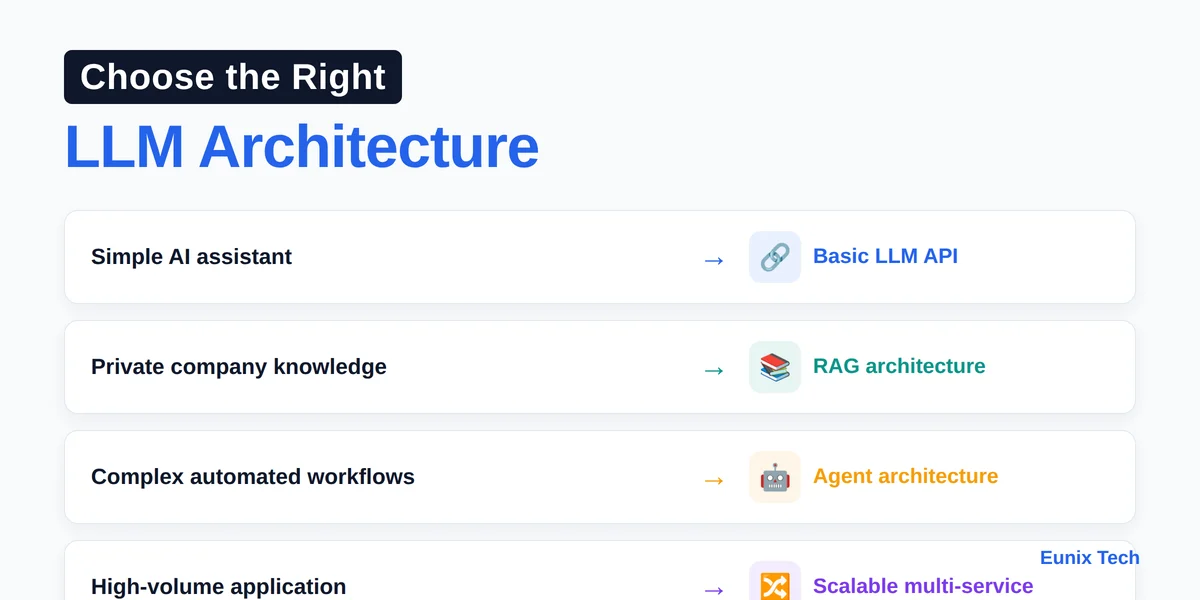
Most real products combine these - for example, RAG plus a multi-model setup plus human-in-the-loop for the risky actions.
When Should You Work With an LLM Application Development Company?
Plenty of teams can wire up a basic assistant themselves. Professional LLM application development services earn their keep when the stakes and complexity rise: complex integrations, enterprise data, real production deployment, high user volume, strict security requirements, an existing AI system that has become unreliable, a need for serious RAG or agent work, legacy application integration, or ongoing optimization that an internal team can't spare time for. The common thread is that these are software and AI engineering problems at once, and getting the architecture wrong early is expensive to undo.
This is exactly where Eunix Tech's LLM architecture and AI systems work focuses: designing and building production-grade LLM applications, and just as often, stabilizing ones that were rushed into production and broke.
Why Choose Eunix Tech for LLM Architecture and Development?
At Eunix Tech, we build LLM applications for production, not for the demo. Our work spans LLM architecture design, AI application development, OpenAI and modern model integration, RAG and agent systems, and full-stack engineering - with senior engineers involved directly, the same people who scope your system building it. We also do a lot of production hardening and AI rescue: taking AI prototypes and failing LLM applications and turning them into reliable, secure, cost-controlled systems. If your product has outgrown a proof of concept, that experience is the difference between shipping and stalling.
CTA: Build an LLM Application That Works in Production
Ready to build a production-ready LLM application? Whether you're starting from an idea, have a prototype that needs hardening, or are wrestling with an existing AI system that isn't reliable, talk to us. Tell us your use case and current architecture, and we'll give you a clear, honest plan to get it into production.
Conclusion
LLM architecture is far more than choosing an AI model. Reliable applications require application logic, data, retrieval, integrations, security, monitoring, and evaluation - all designed to work together. The right architecture depends on your business use case and technical requirements, and production LLM systems have to be designed deliberately for reliability, scalability, security, and cost.
The mindset that separates the teams that succeed: treat AI architecture as a software engineering problem and an AI problem. Do that, and you get an LLM application people can actually depend on. To go deeper on the model and data side, see our guide to custom AI software development.
Frequently Asked Questions
What is LLM architecture?
LLM architecture is the design of a complete AI application built around one or more language models - how the model connects to your application logic, data, retrieval systems, tools, security, and monitoring. It's the difference between simply calling a model API and building a system that reliably performs a job in production.
What are the main components of LLM architecture?
The core components are the LLM model, the application layer (business logic and orchestration), prompt and context management, a data and knowledge layer (including vector databases), a retrieval layer for RAG, tools and API integrations, and monitoring and observability. Each solves a problem the raw model cannot handle on its own.
What is LLM application architecture?
LLM application architecture describes how a request flows through the system: a user request enters the application, relevant context is retrieved, tools are called if needed, the LLM generates a response, that output is validated, the response is returned, and monitoring captures performance. The validation and monitoring steps are what make it production-grade.
How do you build a production-ready LLM application?
Define the business use case, select the right model, design the architecture, build the application layer, integrate data and tools, then rigorously test and evaluate the system across many real cases. Deploy through proper development, staging, and production environments, and monitor and improve continuously. Skipping evaluation and monitoring is the most common reason prototypes never make it to reliable production.
What is LLM deployment architecture?
LLM deployment architecture is the infrastructure that runs the application reliably: cloud infrastructure, API gateways, containers, load balancing, databases, caching, authentication, logging, model APIs, CI/CD pipelines, and monitoring - plus separate development, staging, and production environments. It adds model endpoints, token cost, and response-quality monitoring to standard deployment concerns.
What is the difference between RAG and a basic LLM architecture?
A basic LLM architecture sends a prompt to the model and returns its answer, relying on the model's own training knowledge. RAG (retrieval-augmented generation) adds a retrieval layer that pulls relevant information from your own documents and data into the prompt, so the model answers from current, company-specific knowledge. RAG dramatically reduces hallucinations for knowledge-based use cases.
How do you make an LLM application reliable?
Ground responses with RAG, invest in retrieval quality (chunking, embeddings, re-ranking), validate every output against schemas and business rules, handle model failures with timeouts, retries, and fallbacks, and monitor accuracy, latency, cost, and quality continuously. Reliability is an architectural property - it comes from the system around the model, not the model alone.
How much does LLM application development cost?
It depends on complexity - the architecture pattern, data and integration work, security and scale requirements, and whether you're using hosted or self-hosted models. Beyond build cost, there's ongoing token/inference cost, which good architecture (caching, model routing, prompt optimization) controls. The most powerful model isn't always the most cost-effective, so cost planning is part of architecture design.
How do you scale an LLM application?
Scale with horizontal scaling, load balancing, caching, asynchronous and queue-based processing for slow model calls, a scalable database layer, appropriate model selection, and careful management of provider rate limits. The key shift is moving from synchronous, one-at-a-time model calls to cached, batched, and asynchronous patterns so cost and latency don't grow faster than your traffic.
When should a business hire an LLM application development company?
When complexity or stakes are high: enterprise data, complex integrations, real production deployment, high user volume, strict security, a need for RAG or agents, legacy integration, ongoing optimization, or an existing AI system that has become unreliable. These are simultaneously software and AI engineering problems, and getting the architecture right early saves expensive rework later.
