
LLM Evaluation: How to Measure the Accuracy and Reliability of AI Apps
Learn how LLM evaluation measures AI accuracy, reliability, and performance. Explore evaluation metrics, testing frameworks, benchmarking, observability, and tools.
Every team that ships an AI feature eventually asks the same uncomfortable question: is this thing actually any good? The demo impressed everyone, the pilot users were polite, but nobody can say with numbers whether the application answers correctly, how often it invents things, or whether last week's prompt change made it better or quietly worse. LLM evaluation is the discipline that replaces that guesswork with evidence - a repeatable way to measure the quality, accuracy, and safety of an AI application before and after real users touch it.
Evaluating an LLM application is not the same as testing ordinary software, and that trips up good engineering teams. Traditional tests compare an output to an expected value. Language models produce different wording every time, several answers can be equally correct, and a response can be fluent, confident, well-formatted, and completely wrong. That is why LLM reliability has to be measured across several dimensions rather than a single pass/fail, and why choosing the right LLM evaluation metrics matters far more than reporting one accuracy percentage.
Gartner's much-quoted prediction that 30% of generative AI projects would be abandoned after proof of concept points at exactly this gap. Most were not abandoned because the model was incapable, but because nobody could prove the system was good enough to trust, and without proof, no business sponsor signs off on production.
What Is LLM Evaluation?
LLM evaluation is the process of systematically measuring an AI application's outputs against defined criteria. Instead of asking "does it feel right?", you run the application over a curated set of inputs, score the responses on the dimensions you care about, and track those scores as prompts, models, and data change.
One distinction is worth making early. Model evaluation asks how a foundation model performs in general - the kind of thing public leaderboards measure. Application evaluation asks how your system performs on your task with your data, prompts, and retrieval. A model that tops a general leaderboard can still perform badly inside your product, and it is application evaluation that decides whether you ship.
Evaluation also happens at two moments. Pre-production evaluation runs against a fixed test dataset in development and CI, telling you whether a change is safe to release. Production evaluation runs against real traffic, telling you what users actually experience and surfacing the queries you never thought to test. Teams that only do the first are permanently surprised by the second.
Both human and automated evaluation have a place - human review is the most accurate signal and the slowest, while automated evaluation (including AI model evaluation techniques where one model scores another) runs on every commit. None of it can be a one-time exercise, because outputs shift when a provider updates a model version, when a prompt is edited, when your knowledge base changes, and when users start asking new kinds of questions. Generative AI evaluation is a continuous measurement, not a launch checklist item.
Why Is LLM Evaluation Important?
Because an AI application can be technically working and commercially failing at the same time. The API returns 200, the response is grammatical, and the customer has just been told about a refund policy your company does not have.
Evaluation catches the failures that never throw an error. Accuracy and relevance: the answer has to be correct and address the question asked, since plenty of AI answers are true statements about the wrong topic. Consistency: a system that is excellent on Monday and erratic on Tuesday is unusable in a business process even if its average looks fine. Hallucinations: the most damaging failure mode, because users cannot distinguish confident invention from fact. Safety and bias: harmful or unfair outputs create legal and brand exposure that dwarfs the cost of the feature. Latency and cost: a response that is 2% better but takes eight seconds and costs five times more is a bad trade you can only see by measuring all three together.
The core insight is that an LLM application can produce technically valid responses while failing every business requirement you had. Evaluation makes that visible before your customers do.
LLM Evaluation vs Traditional Software Testing
| Traditional Software Testing | LLM Evaluation |
|---|---|
| Mostly deterministic outputs | Probabilistic outputs |
| Expected output is predefined | Multiple valid answers may exist |
| Unit and integration testing | Automated + human + model-based evaluation |
| Functional correctness | Quality, relevance, accuracy and safety |
| Bugs are generally reproducible | AI failures may vary between runs |
| Performance testing | Performance + model behaviour |
Traditional testing does not go away. Your API contracts, database queries, authentication, and error handling still need unit and integration tests exactly as before. LLM evaluation is an additional layer on top: the deterministic parts of the system are tested, and the probabilistic part is evaluated. Teams that try to force model quality into a pass/fail unit test end up with a suite that is either permanently red or meaninglessly loose.
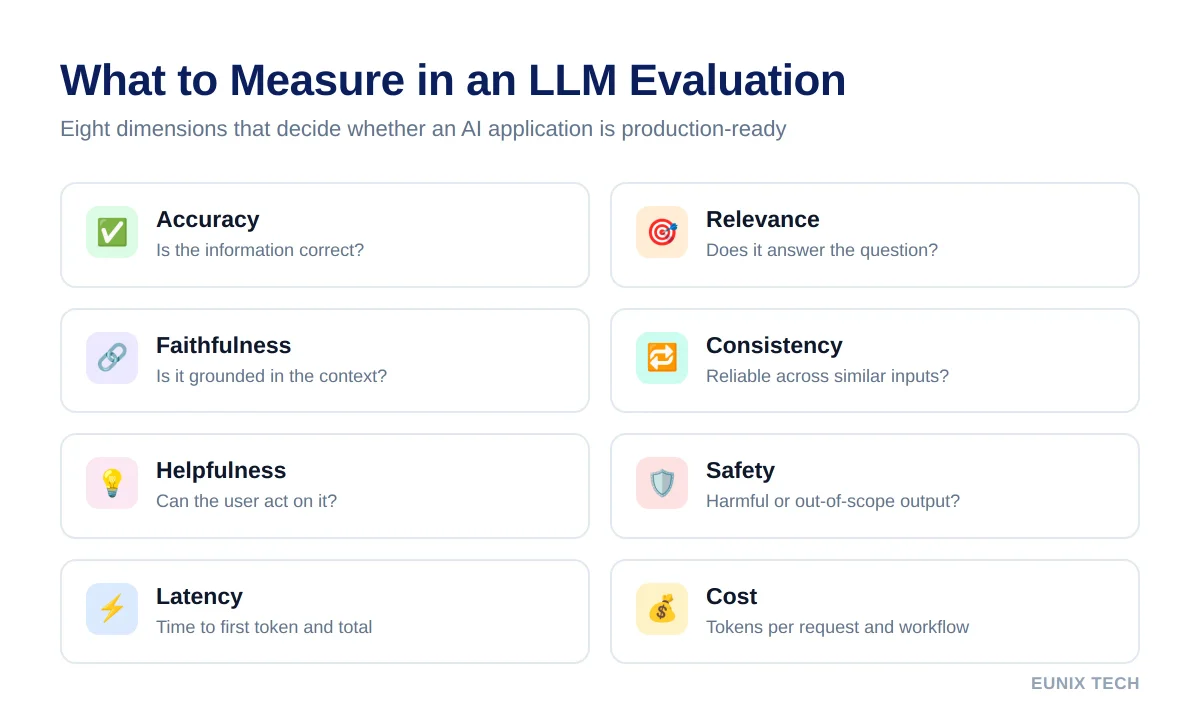
What Should You Measure in an LLM Evaluation?
Before choosing tools, decide what "good" means for your application.
Accuracy
Does the response contain correct information? "Correct" needs a definition - matching a known answer, being consistent with source documents, or satisfying a business rule.
Relevance
Does the response answer the user's actual question? A technically accurate answer to a question nobody asked is still a failure.
Faithfulness
Is the answer supported by the context provided to the model? For anything that retrieves documents, answers must trace to source material rather than to the model's imagination.
Consistency
Does the application respond reliably across similar inputs and repeated runs? High variance signals that your prompt or context is under-specified.
Helpfulness
Does the response give the user something they can act on? Hedged, generic answers score well on safety and poorly on usefulness.
Safety
Does the application avoid harmful, inappropriate, or out-of-scope responses, including under adversarial prompting?
Latency
How quickly does it respond? For interactive products, time to first token often matters more than total completion time.
Cost
What does each request or workflow cost? At scale, cost per successful outcome is a product metric, not just an infrastructure one.
LLM Evaluation Metrics You Should Track
Categories become useful when they turn into numbers you track release over release. These are the LLM evaluation metrics that earn a place on most production dashboards.
Correctness scores whether the response is factually or task-wise right, against reference answers or a judge model with explicit criteria. Relevance scores how directly the output addresses the request, independent of correctness. Faithfulness (or groundedness) scores whether every claim is supported by the retrieved context - the highest-value metric in RAG applications and the most reliable early warning for hallucinations.
Context relevance measures whether the context you retrieved was actually useful. Low context relevance alongside a good answer usually means the model is answering from its own knowledge, which fails as soon as questions get specific. Hallucination rate tracks unsupported or fabricated information; even a small percentage matters when output is customer-facing or triggers a downstream action. Response completeness measures whether multi-part requests are fully answered - a common and under-measured failure.
Latency covers time to first token and total response time, tracked at p50 and p95 rather than as an average, because the tail is what users complain about. Token usage and cost makes quality-versus-cost decisions concrete instead of theoretical.
No single number tells you a system is healthy. A useful scorecard combines a quality metric, a grounding metric, a safety metric, and a performance metric, and you watch the shape of all four.
LLM Evaluation Framework: How to Build an Evaluation System
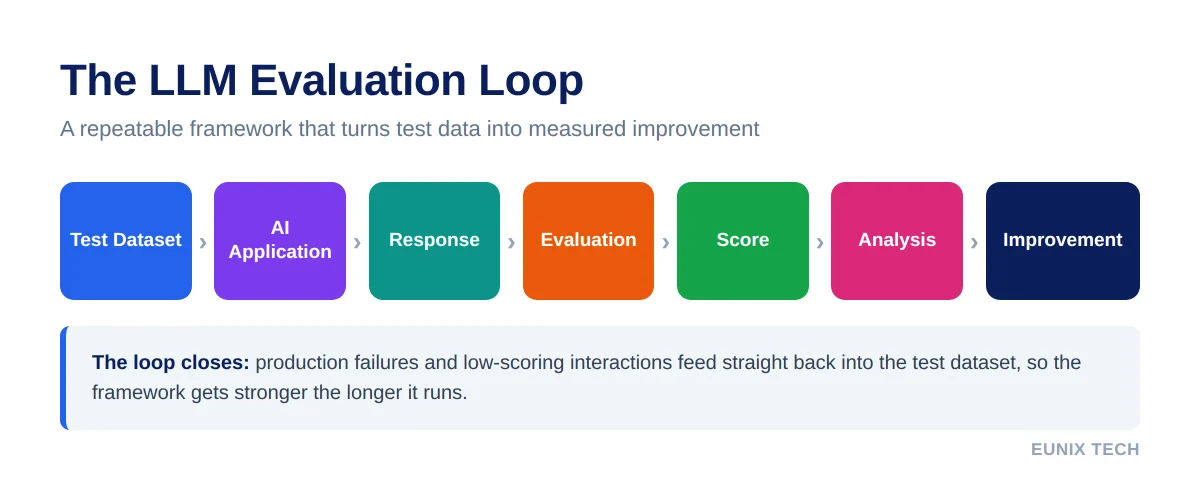
An LLM evaluation framework is the repeatable loop that produces those numbers:
Test Dataset → AI Application → Generated Response → Evaluation → Score → Analysis → Improvement
Start by defining evaluation objectives tied to business outcomes rather than generic AI virtues. Then build a representative test dataset - the step that determines everything downstream. It should reflect real user queries, including the awkward, ambiguous, and adversarial ones. Fifty genuinely representative cases beat five hundred easy ones.
From there, establish evaluation criteria specific enough that two reviewers would agree, select evaluation methods suited to each criterion, run automated evaluations on every meaningful change, add human review on a sample to confirm the automated scores track expert judgement, analyse results by clustering failures into patterns instead of reading them one at a time, and continuously improve against what those patterns reveal.
The framework only pays off if it runs automatically. An evaluation suite someone has to remember to run will not be run.
LLM Evaluation Methods
Different criteria call for different LLM evaluation methods, each with a real trade-off between cost, scale, and trustworthiness.
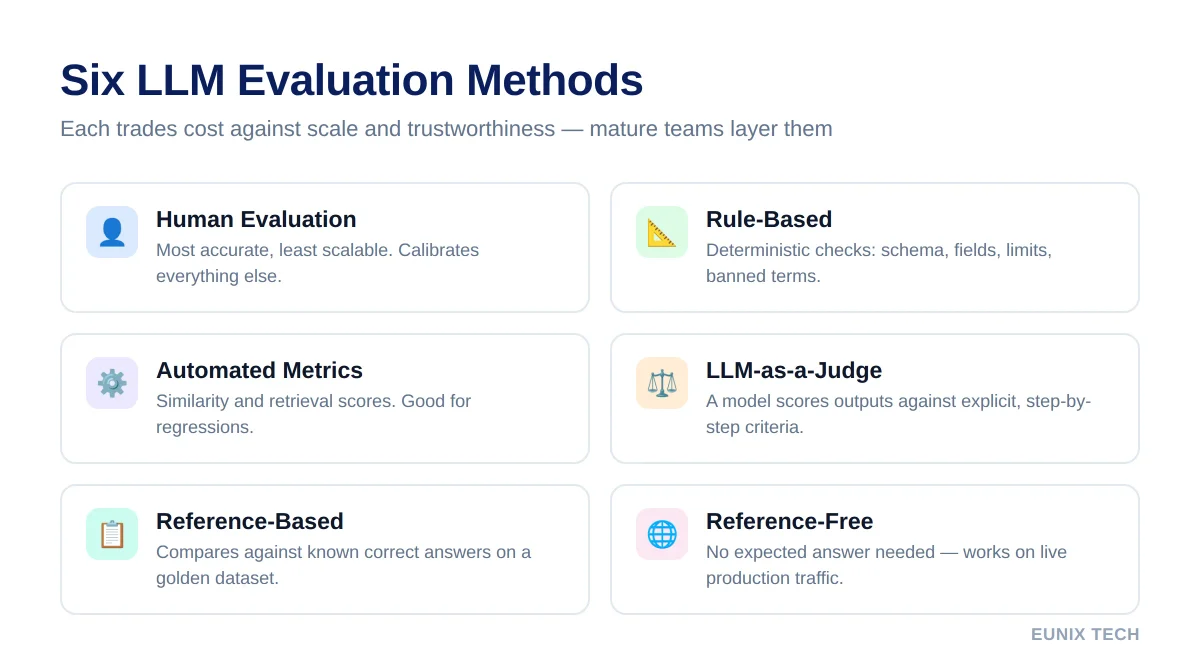
Human Evaluation
Expert reviewers score responses directly. The gold standard for nuanced quality and domain correctness, and the only way to calibrate every other method, but slow, expensive, and impossible to run on every commit.
Rule-Based Evaluation
Deterministic checks: valid JSON, required fields present, length limits, banned terms. Cheap, fast, and completely reliable within its narrow scope. Use it for everything it can cover, because it never disagrees with itself.
Automated Evaluation
Software-computed metrics such as semantic similarity, retrieval scores, or overlap with reference answers. Scales well and is useful for regression detection, though similarity scores are blunt instruments for quality.
LLM-as-a-Judge
Another model scores the response against explicit criteria. This is now the workhorse of production evaluation because it handles semantic quality that string matching cannot. It works far better with explicit, step-by-step criteria than with vague instructions, and it needs periodic validation against human annotations - a judge is a model too, and it can be confidently wrong in its own ways.
Reference-Based Evaluation
Compares outputs against known correct answers. Precise where you have ground truth, which means a curated dataset you maintain.
Reference-Free Evaluation
Scores a response using only the input, context, and output. This is what makes evaluation possible on live production traffic, where ground truth does not exist.
Mature setups layer these: rules for hard constraints, reference-based scoring on a golden dataset, reference-free judging on production traces.
LLM Benchmarking: How to Compare Models and Applications
LLM benchmarking is comparison under controlled conditions - same test dataset, same metrics, one variable changed. That variable might be a different model, a rewritten prompt, an alternative RAG configuration (chunk size, embedding model, re-ranking), or a new version of a model you already use.
Two things make it valuable in practice. It is the only honest way to answer "should we switch models?", measuring cost, latency, and quality together, because the best-quality option is frequently not the best value. And it protects you when a provider ships a new model version - re-running your benchmark tells you in an afternoon whether the upgrade helps or hurts your specific use case.
Which raises the important caveat: do not choose a model because it leads a public benchmark. General benchmarks measure general capability on academic tasks. Your application has a narrow job, your own data, and a specific definition of a good answer. A mid-tier model with strong retrieval and a well-tuned prompt routinely beats a frontier model dropped in without either.
LLM Testing: How to Test AI Applications Before Production
LLM testing covers the checks that run before a change reaches users, and a production system needs several kinds.
Functional testing verifies the application does its job end to end. Prompt testing confirms prompt changes behave as intended across varied inputs, since a small edit can shift behaviour surprisingly. Retrieval testing checks the retrieval layer on its own: are the right documents coming back, regardless of what the model does with them?
Hallucination testing deliberately asks questions the system should not be able to answer, checking that it declines rather than invents. Safety and adversarial testing probe the boundaries - harmful requests, prompt injection, jailbreaks, malformed input. Performance testing measures latency and throughput under realistic concurrency, including when the provider is slow or rate-limiting. Regression testing re-runs your golden dataset on every change to catch quality that silently degrades - the most damaging failure mode, because nothing alerts.
The mistake to avoid is treating this as a pre-launch phase. Testing belongs in the development lifecycle from the first week, running in CI alongside your unit tests, exactly as we describe in our guide to LLM architecture for production. Applications tested only before launch get tested only once.
LLM Observability: Monitoring AI Applications in Production
If evaluation asks does the AI perform well?, LLM observability asks what is actually happening inside this application right now? One measures quality; the other gives visibility into behaviour. Production systems need both, and observability is what makes evaluation continuous instead of episodic.
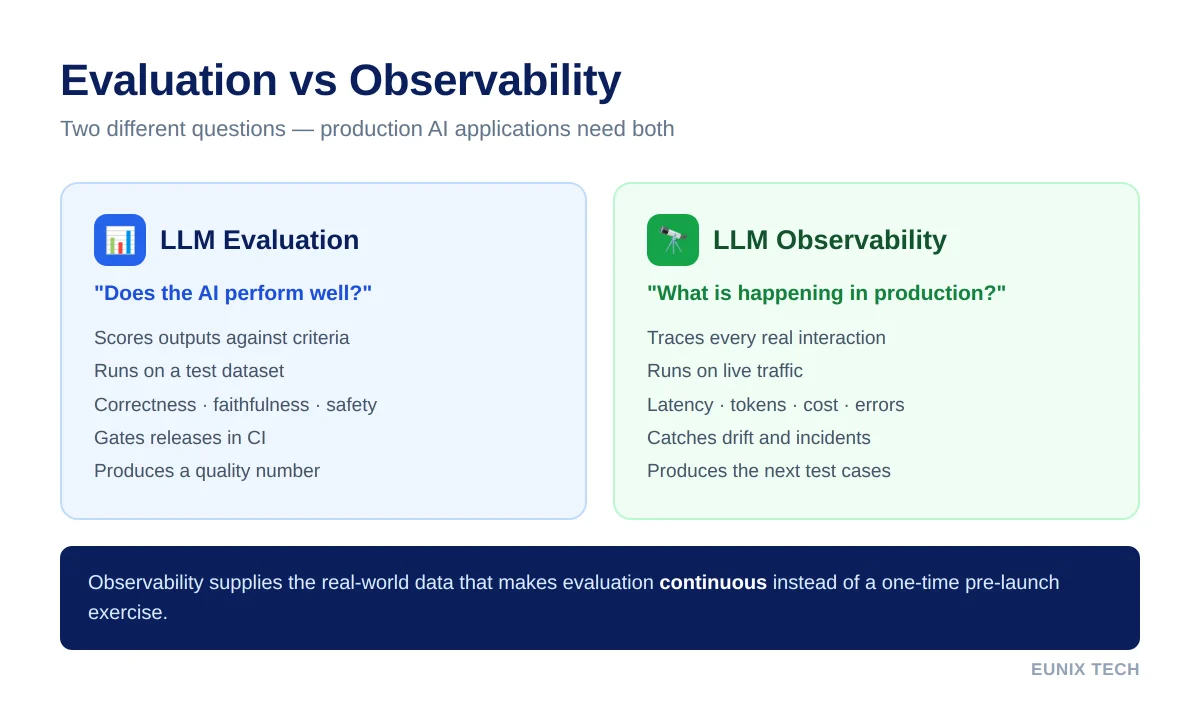
In practice that means capturing and tracing every interaction: the request and its full context, the response, latency at each stage, token usage and cost, errors and retries, retrieval quality, model and prompt version, user feedback, and interactions that failed outright. Tracing matters especially for multi-step systems - when an agent takes six steps and produces a bad answer, you need to see which step went wrong, not just the final output.
This is where the feedback loop closes. Production traces reveal the queries real users ask, invariably a wider and stranger distribution than any test set. Failed and low-scoring interactions become new test cases, and reference-free evaluation on a sample of live traffic gives you a quality trend line rather than a single pre-launch snapshot. When a provider quietly changes a model or your knowledge base drifts, monitoring tells you - usually well before a customer does.
LLM Evaluation Tools
The LLM evaluation tools market has settled into a few clear categories, and most teams use two or three rather than one. Evaluation frameworks provide the metrics and test harness, running your dataset through the application and scoring outputs. Experiment tracking tools record what changed between runs so results stay comparable. Observability and tracing platforms capture production traffic, cost, and latency, and increasingly run evaluations on live traces. Prompt testing tools support fast iteration across prompt variants, benchmarking tools handle structured model-versus-model comparison, and human evaluation platforms manage annotation workflows and labelled datasets.
Choosing between them comes down to application type (a simple assistant and a multi-step agent need different tracing depth), whether you run RAG and therefore need retrieval metrics, scale, integration and self-hosting requirements, budget, and how much evaluation engineering your team can maintain. One practical warning: tooling matters far less than the test dataset and the criteria. A basic framework with an excellent dataset outperforms a sophisticated platform pointed at fifteen sample questions.
How to Evaluate a RAG Application
RAG systems deserve separate treatment because they fail in two independent places - retrieval or generation, and a single end-to-end score cannot tell you which. Evaluate both layers.
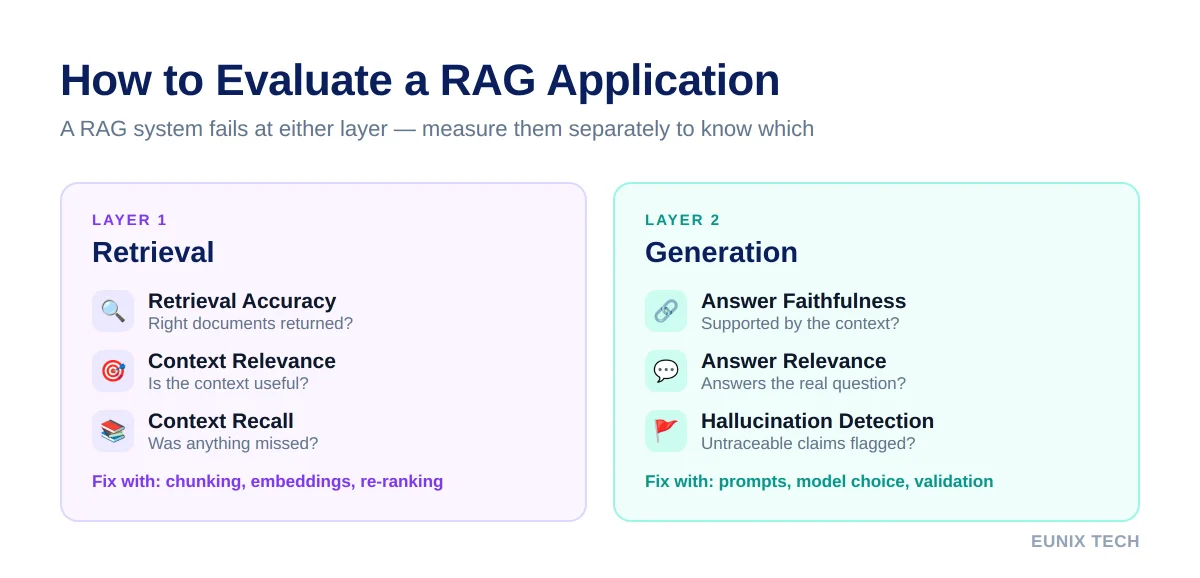
Retrieval Accuracy
Are the documents retrieved the ones that actually contain the answer? Measured against queries with known correct sources.
Context Relevance
Of the context retrieved, how much is genuinely useful? Padding the prompt with marginally related chunks raises cost and dilutes the model's attention.
Context Recall
Did retrieval find all the information needed to answer completely? Good precision with poor recall produces confident, partial answers.
Answer Faithfulness
Is every claim in the answer supported by the retrieved context? This catches the model going beyond its sources.
Answer Relevance
Does the final response address the user's actual question, given that retrieval worked?
Hallucination Detection
Flagging statements that cannot be traced to a source, including subtle cases where the model blends real context with plausible invention.
The diagnostic value comes from reading these together. Poor retrieval with good generation means fixing chunking, embeddings, or re-ranking. Good retrieval with poor faithfulness means fixing the prompt, the model, or output validation. Teams that measure only the final answer spend weeks tuning the wrong layer.
How to Build an LLM Evaluation Pipeline
A practical rollout, in the order that works: 1. Define business requirements - what the application must do, and what failure costs. 2. Create a test dataset from real queries, including edge cases. 3. Define evaluation metrics matching those requirements, with explicit thresholds. 4. Establish a baseline by scoring the current system. 5. Run automated evaluation in CI on every prompt, model, or retrieval change. 6. Perform human review on a sample to validate the automated scores. 7. Analyse failures by grouping them into patterns rather than fixing them individually. 8. Improve the application, largest pattern first. 9. Run regression tests to confirm the fix broke nothing that previously worked. 10. Monitor in production, feeding real failures back into the dataset so the pipeline strengthens the longer it runs.
Step 4 is the one teams skip and later regret. Without a baseline you cannot prove a change was an improvement - you can only assert it.
Common LLM Evaluation Mistakes
Measuring only accuracy says nothing about grounding, safety, latency, or cost - a system can be accurate and unusable. Testing with too few examples produces numbers with no statistical meaning and creates false confidence. Ignoring real-world user queries means your test set reflects what the team expects rather than how users actually type. Not testing for hallucinations guarantees you never discover that the system fails to refuse. Ignoring retrieval quality hides the fact that in RAG applications, most "model" failures are retrieval failures in disguise.
Skipping human evaluation lets automated scores drift away from real quality. Not tracking production performance means measuring a system that no longer exists once models, data, and behaviour change. Failing to run regression tests turns every improvement into a chance of a silent degradation elsewhere. And optimising for benchmarks instead of business outcomes produces a rising score that never moves resolution rate, deflection rate, or hours saved.
How to Improve LLM Reliability After Evaluation
Evaluation is only worth the effort if it drives change, and the useful thing about a good setup is that failure patterns map to specific fixes.
Low relevance or inconsistent formatting usually points to the prompt - clearer instructions, explicit constraints, better examples. Low context relevance or recall points to retrieval - chunking, embedding model, re-ranking, metadata filtering, or simply better source data. Persistent reasoning failures across a whole task category may justify changing models, or fine-tuning where you have substantial task-specific data and stable requirements.
Structural failures call for structural fixes: output validation against schemas and business rules, guardrails for safety and scope, better context management so the model is not drowning in irrelevant tokens, and fallback models or retries when a provider degrades. Where the system is right most of the time but being wrong is expensive, the answer is human approval in the loop for those specific high-risk actions - not more prompt tuning. Underpinning all of it, data quality, because no amount of prompt engineering rescues a knowledge base full of outdated documents.
LLM Evaluation for Production AI Applications
In production, evaluation stops being a project and becomes an operating practice measuring five things continuously: quality, reliability, safety, performance, and cost. That means keeping a baseline you can always compare against, monitoring live traffic rather than only test data, and running regression tests on every change, because in an LLM application "every change" is broader than it sounds. Model versions change under you, prompts get edited, knowledge bases get updated, and user behaviour shifts as people learn what the system can do. Each can move quality without a single line of application code changing, which is precisely why continuous evaluation is a production requirement rather than an engineering nicety.
Teams that operate AI well close the loop deliberately: user feedback and production incidents feed the test dataset, the dataset drives the next round of improvements, and evaluation scores get reviewed as regularly as uptime. It is the same production-grade discipline we apply when building LLM architecture for real systems - architecture and evaluation are two halves of one reliability problem.
When Should Businesses Invest in Professional LLM Evaluation?
Not every AI feature needs a formal evaluation programme; an internal drafting assistant used by five people can be judged informally. The calculus changes when stakes or scale do.
Professional LLM evaluation services earn their cost in enterprise AI applications, customer-facing chatbots where wrong answers reach customers directly, RAG systems built on proprietary knowledge, AI agents that take actions rather than just generate text, high-volume systems where a small error rate becomes a large absolute number, applications touching sensitive or regulated data, and mission-critical workflows.
Two other signals are clear. If your application hallucinates often enough that users have started double-checking it, evaluation tells you why and where. And if you have an AI system that performs inconsistently - better some weeks than others, with nobody able to explain it - you almost certainly have an evaluation and observability gap rather than a model problem. Diagnosing that is one of the most common reasons teams bring in outside AI application development services.
Why Choose Eunix Tech for AI Application Evaluation?
At Eunix Tech, we build and stabilise AI applications for production. Evaluation is not a service we bolt on - it is how we know the systems we ship actually work. Our work spans LLM architecture and system design, production AI engineering, RAG and agent development, application reliability and technical audits, AI workflow automation, full-stack engineering, and ongoing production monitoring.
A large share of what we do is AI rescue: taking applications that were rushed into production and are now unreliable, instrumenting them so their real failure modes become visible, and fixing the architecture and retrieval issues that evaluation exposes. Senior engineers do the work directly - the same people who scope your system build it. If you are designing an application from scratch, our companion guide to LLM architecture: how to design reliable AI applications for production covers the structural half of this problem. Evaluation is how you prove that architecture is doing its job.
CTA: Make Your AI Application More Reliable
Is your AI application ready for production? If you cannot answer that with numbers - accuracy, hallucination rate, latency, cost per request - that is the gap worth closing first. Talk to us about your application's accuracy, reliability, architecture, and evaluation setup. Tell us what it does and where it is inconsistent, and we will give you an honest assessment of what it would take to make it dependable.
Conclusion
LLM evaluation is what turns an AI prototype into an application a business can rely on. Accuracy is only one part of it: relevance, faithfulness, consistency, safety, latency, and cost all determine whether users trust the system enough to keep using it.
A strong LLM evaluation framework combines automated testing on a representative dataset, human review to keep those scores honest, benchmarking to make model decisions on evidence, and production observability to catch what test data never will. Because models, prompts, data, and user behaviour all keep changing, that framework has to run continuously rather than once before launch.
Production-ready AI needs both halves - deliberate architecture and continuous evaluation. To go deeper on the build side, see our guides to AI product development and custom AI software development, or get in touch to talk through your own application.
Frequently Asked Questions
What is LLM evaluation?
LLM evaluation is the process of systematically measuring an LLM application's outputs against defined criteria such as accuracy, relevance, faithfulness, safety, latency, and cost. Instead of judging AI quality by impression, you run the application over a representative test dataset, score the responses, and track those scores as prompts, models, and data change.
Why is LLM evaluation important?
Because LLM applications fail without throwing errors - a response can be fluent, well-formatted, and confidently wrong. Evaluation makes hallucinations, irrelevant answers, safety issues, and quality regressions visible before customers find them, and gives stakeholders the evidence they need to approve a production launch.
What are the most important LLM evaluation metrics?
Correctness, relevance, faithfulness (groundedness), context relevance, hallucination rate, response completeness, latency, and token cost. No single metric is sufficient - a useful scorecard combines a quality metric, a grounding metric, a safety metric, and a performance metric.
How do you evaluate an LLM application?
Define what good means for your use case, build a test dataset from real user queries, choose matching metrics, establish a baseline, run automated evaluations on every change, validate them with human review on a sample, analyse failures by pattern, fix the biggest pattern first, and monitor production traffic to feed new failures back into the dataset.
What is an LLM evaluation framework?
The repeatable system that produces evaluation scores: test dataset → application → generated response → evaluation → score → analysis → improvement. In practice the term also covers the tooling that runs this loop, providing built-in metrics, custom judge criteria, and CI integration.
What is LLM benchmarking?
Comparing options under controlled conditions - the same dataset and metrics, one variable changed - across models, prompts, RAG configurations, and model versions, measuring quality, cost, and latency together. Benchmark on your own task and data rather than choosing a model because it leads a public leaderboard.
What is the difference between LLM evaluation and LLM observability?
Evaluation answers "does the AI perform well?" by scoring outputs against criteria. Observability answers "what is happening inside the application in production?" by capturing requests, responses, traces, latency, cost, errors, retrieval quality, and user feedback. Observability supplies the real-world data that makes evaluation continuous.
How do you test an LLM application?
Combine functional testing of the workflow, prompt testing across varied inputs, retrieval testing of the RAG layer alone, hallucination testing with questions the system should decline, safety and adversarial testing, performance testing under load, and regression testing on a golden dataset. Run it in CI throughout development, not only before launch.
What tools can be used for LLM evaluation?
Tools fall into categories: evaluation frameworks, experiment tracking, observability and tracing platforms, prompt testing tools, benchmarking tools, and human annotation platforms. Choose based on application type, RAG requirements, scale, integration needs, and budget - the quality of your test dataset matters far more than which tool you pick.
How do you evaluate a RAG application?
Evaluate retrieval and generation separately, because a RAG system can fail at either layer. Measure retrieval accuracy, context relevance, and context recall on the retrieval side; answer faithfulness, answer relevance, and hallucination rate on the generation side. Together they tell you whether to fix chunking and embeddings or the prompt and validation.
How can businesses improve LLM reliability?
Map failure patterns to fixes: prompts for relevance and formatting issues, retrieval for grounding issues, a different or fine-tuned model for persistent reasoning failures, and output validation, guardrails, context management, and fallback models for structural failures. Where being wrong is costly, add human approval for those high-risk actions, and keep source data current, because no prompt engineering rescues an outdated knowledge base.
