
AI Product Development: Complete Guide for Businesses in 2026
Learn the complete AI product development process, idea validation, fairness in AI, generative AI, product strategy, and best practices for successful AI products.
Building an AI model is the easy part now. Building an AI product - one that real users trust, that keeps working after launch, and that earns more than it costs - is where most companies get stuck. That gap is what AI product development is about: turning a promising model into a dependable product through strategy, validation, quality data, responsible design, and continuous improvement.
The demand is everywhere. McKinsey's 2025 State of AI survey found that 88% of organizations now use AI regularly in at least one business function, up from 78% a year earlier, and 62% are already experimenting with AI agents. Yet the same research shows only 39% report any measurable impact on profit, and Gartner predicted that at least 30% of generative AI projects would be abandoned after the proof-of-concept stage, mostly because of poor data quality, escalating costs, and unclear business value.
The lesson is not "AI does not work." It is that great technology does not automatically become a great product. A working demo built in a weekend is not a system that can handle a thousand paying users, protect their data, and improve every month. The teams that succeed treat AI as a product to be engineered, not a science experiment to be admired.
In this guide you will learn what AI product development actually involves, the full AI product lifecycle step by step, how generative AI is changing the way teams build, the challenges that sink most projects, and the best practices that separate AI products that ship from the ones that stall.
What Is AI Product Development?
AI product development is the end-to-end process of planning, building, testing, launching, and improving a software product whose core value comes from artificial intelligence. It combines three disciplines: product thinking (what problem are we solving, for whom, and why), data science (what model can solve it), and software engineering (how do we make it reliable, secure, and usable at scale).
The difference between ordinary software development and AI product development comes down to certainty. Traditional software is deterministic - given the same input, it always returns the same output, so you can test it exhaustively. AI systems are probabilistic. The same question can produce different answers, quality depends on data the team may not fully control, and the model can quietly get worse over time as the real world drifts away from its training data.
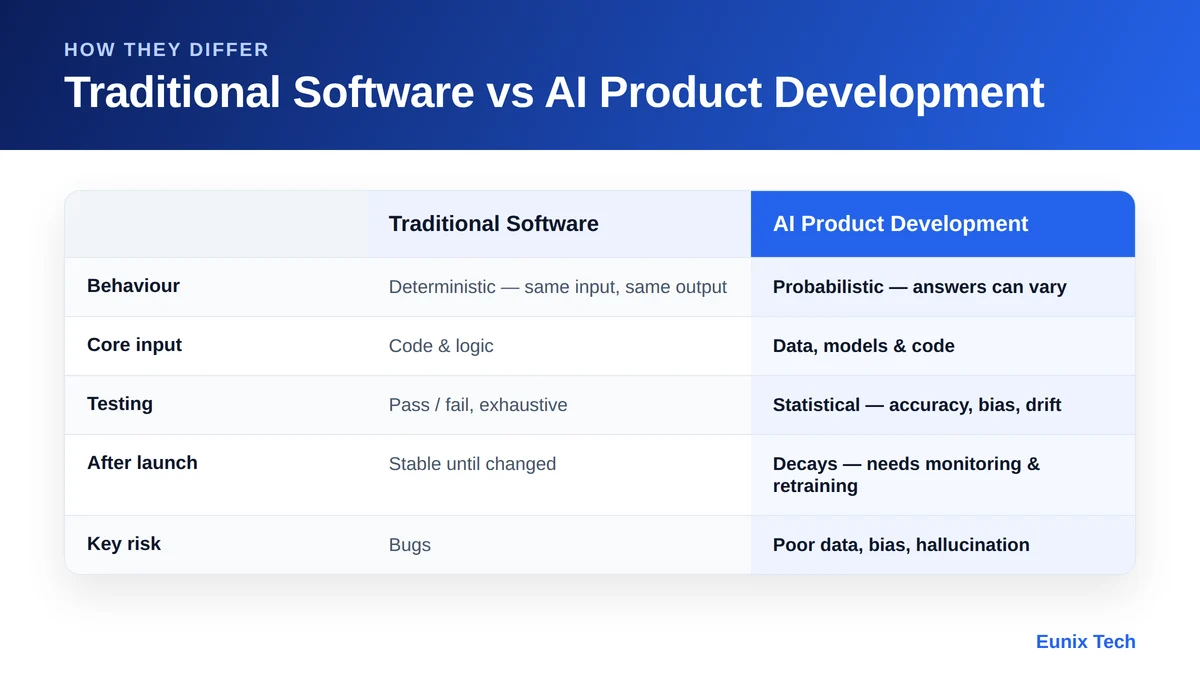
That difference changes everything about the process:
- Data is a first-class ingredient. No amount of clever engineering fixes a model trained on the wrong or dirty data.
- Testing is statistical, not binary. You measure accuracy, bias, and failure rates across many cases instead of asking "did it pass or fail?"
- The product is never finished. Models decay. Continuous monitoring and retraining are part of the product, not an optional add-on.
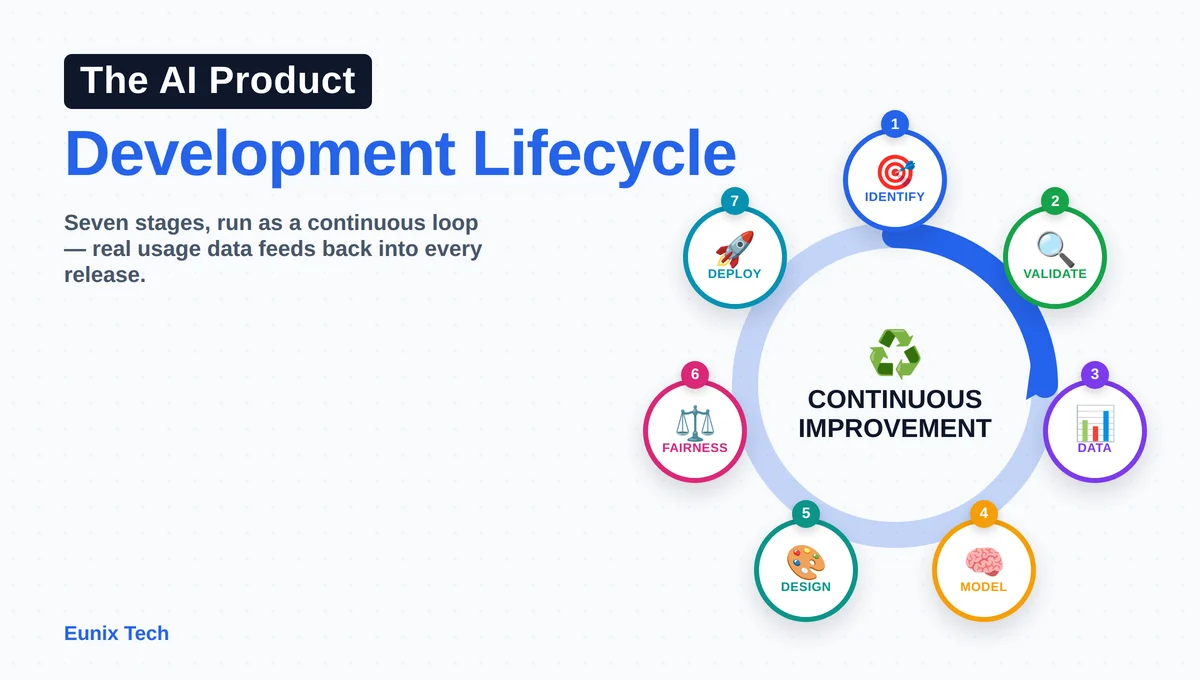
Because of this, the AI product development process follows its own lifecycle - one that loops back on itself rather than running in a straight line from idea to launch.
The AI Product Development Process: Step-by-Step
A reliable AI product moves through seven stages. Skipping any of them is the most common reason AI products fail after launch.
Stage 1 - Identify the Business Problem
Every successful AI product starts with a business problem, not a model. Before anyone writes a prompt or picks a framework, define the goal in plain language: reduce support ticket volume, speed up invoice processing, increase conversion, cut fraud losses.
Three questions matter most here. What is the measurable business outcome we want? What customer pain point are we removing? And - the question most teams skip - is AI actually the right tool? Plenty of problems are solved better and cheaper by a simple rule, a database query, or a better form. AI earns its place only when the problem involves language, images, prediction, or patterns that ordinary code cannot handle well.
Stage 2 - Validate AI Product Ideas Before Full Development
Knowing how to validate AI product ideas before full development is what protects your budget. The goal of this stage is to be proven wrong cheaply, before you have spent six months building the wrong thing.
Validation combines market and user evidence with a small technical test:
- Market research and competitor analysis - is anyone already solving this, and where is the gap?
- Customer interviews - talk to real users about the problem, not your solution. This kills bad assumptions for the price of a few conversations.
- A focused MVP - build the smallest version that tests whether the AI can actually deliver the core value. (Our guide on MVP development cost covers how to budget this, and AI MVP development explains why so many AI MVPs break after launch.)
- Assumption testing - list your riskiest assumptions ("the model will be accurate enough," "users will trust it") and design the cheapest experiment that proves or disproves each one.
Stage 3 - Data Collection & Preparation
Data quality decides AI product quality. Most of the real work in an AI project happens here, and it is rarely glamorous.
Good data preparation covers where the data comes from (internal systems, public datasets, user-generated content, or synthetic data), how clean and representative it is, and how it is labeled. It also means taking privacy seriously from the start: knowing what personal data you hold, minimizing what you collect, and complying with regulations like GDPR before the product ships, not after a complaint. Weak, biased, or poorly labeled data is the single most common root cause of AI products that disappoint in production.
Stage 4 - AI Model Selection & Development
Only now does model work begin. The right choice depends entirely on the problem defined in Stage 1.
- Classical machine learning still wins for structured, numeric problems like forecasting, scoring, and fraud detection.
- Large language models (LLMs) handle text, conversation, summarization, and reasoning tasks.
- Generative AI creates new content - text, images, code, audio.
- Fine-tuning adapts a general model to your specific domain and tone when you have enough quality examples.
- Retrieval-augmented generation (RAG) grounds an LLM in your own documents and data, dramatically reducing hallucinations without the cost of training a model from scratch.
For most business products today, a smart combination of an existing foundation model plus RAG delivers the best value - far faster and cheaper than training a custom model, and accurate enough when engineered well. Our overview of custom AI software development goes deeper on when to build versus buy.
Stage 5 - Product Design & User Experience
An accurate model wrapped in a confusing experience is still a failed product. Designing for AI has its own principles because users interact with something that is powerful but imperfect.
Good AI UX sets honest expectations, shows the model's confidence, and always leaves the user in control. Human-in-the-loop design keeps a person in charge of high-stakes decisions rather than letting the model act alone. Explainability - showing why the AI suggested something - turns a black box into a tool people trust. And graceful handling of wrong answers, with easy correction and feedback, matters more than squeezing out the last percent of accuracy. Trust, not raw performance, is what drives adoption.
Stage 6 - Testing, Fairness & Compliance
AI testing goes far beyond "does it work?" It asks "does it work fairly, safely, and within the law for everyone who uses it?"
What Purpose Do Fairness Measures Serve in AI Product Development?
Fairness measures exist to make sure an AI product treats different groups of people equitably, and to protect your business from the legal, financial, and reputational damage that biased AI causes. A model trained on historical data will happily learn historical discrimination in hiring, lending, or pricing unless you actively detect and correct it.
In practice, fairness and responsible AI work includes several linked activities:
- Bias detection - testing whether outcomes differ unfairly across gender, race, age, or other protected attributes.
- Ethical and responsible AI design - deciding what the system should not do, and building in guardrails.
- Explainable AI - being able to justify a decision, which is increasingly a regulatory requirement, not a nice-to-have.
- Regulatory compliance - meeting rules such as the EU AI Act, GDPR, and sector-specific standards.
- Rigorous model evaluation - measuring accuracy, safety, and bias against clear thresholds before release, and re-checking after every significant change.
Fairness is not a box you tick once. It is a continuous commitment that protects both your users and your company.
Stage 7 - Deployment, Monitoring & Continuous Improvement
Launch is the middle of the story, not the end. AI products need more monitoring than ordinary software because they can degrade silently.
Deployment means shipping the model into production safely, with staged rollouts and the ability to roll back fast. Monitoring then watches not just uptime and cost, but model behavior: accuracy, response quality, and model drift - the slow decline that happens as real-world data moves away from what the model learned. Feedback loops capture user corrections and route them back into the next round of training, so the product gets smarter with use. Continuous improvement, driven by this real usage data, is what keeps an AI product competitive long after launch.
When Generative AI Meets Product Development
Generative AI has not just added a new feature category - it has changed how products themselves get built. When generative AI meets product development, two things happen at once: teams can build faster, and they can build kinds of products that were impossible before.
On the product side, generative AI powers assistants, content creation, code generation, document intelligence, and personalized experiences that adapt to each user. On the process side, it compresses timelines: prototypes that took weeks now take days, first-draft copy and designs appear in minutes, and engineers ship faster with AI pair programmers.
The limitations are just as real, and pretending otherwise is how projects fail. Generative models hallucinate confident nonsense, carry the biases of their training data, raise thorny questions about intellectual property, and cost real money per call at scale. The teams that win treat generative AI as a powerful but fallible collaborator - one whose output is always checked, grounded in trusted data, and kept on a budget.
How Can Generative AI Tools Benefit a Product Development Team?
Beyond the product itself, the everyday work of building improves too. So how can generative AI tools benefit a product development team? By removing friction from nearly every stage of the process:
- Faster research and discovery - summarizing market reports, user interviews, and competitor analysis in minutes.
- Documentation and specs - turning rough notes into clear PRDs, tickets, and technical docs.
- UI and prototype generation - producing first-draft interfaces and mockups to react to.
- Code assistance - writing boilerplate, suggesting fixes, and explaining unfamiliar code.
- Testing - generating test cases, edge cases, and sample data.
- Customer insight - clustering support tickets and reviews into themes the roadmap can act on.
- Sprint planning and brainstorming - drafting user stories and stress-testing ideas as a thinking partner.
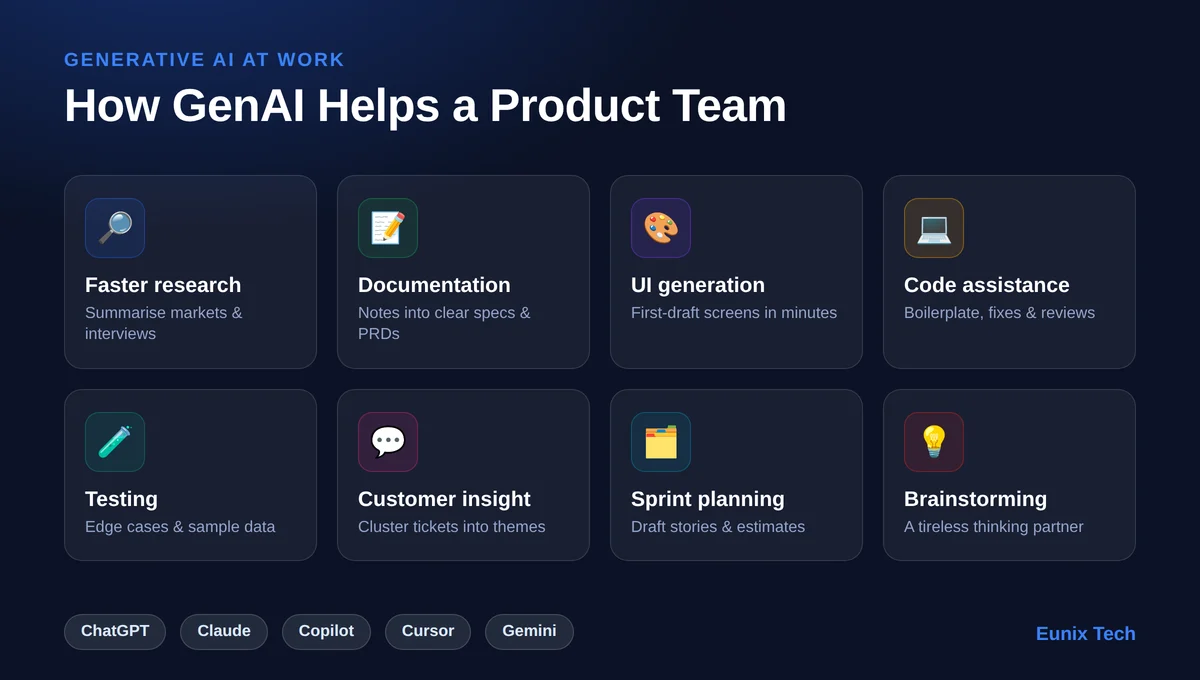
The practical toolkit most teams now reach for includes ChatGPT and Claude for research, writing, and reasoning; GitHub Copilot and Cursor for coding; and Gemini for multimodal and search-grounded tasks. Used well, these tools do not replace the team - they remove the busywork so the team spends its time on judgment, design, and the decisions that actually need a human.
Common Challenges in AI Product Development
Knowing where AI products break lets you design around the failure before it happens.
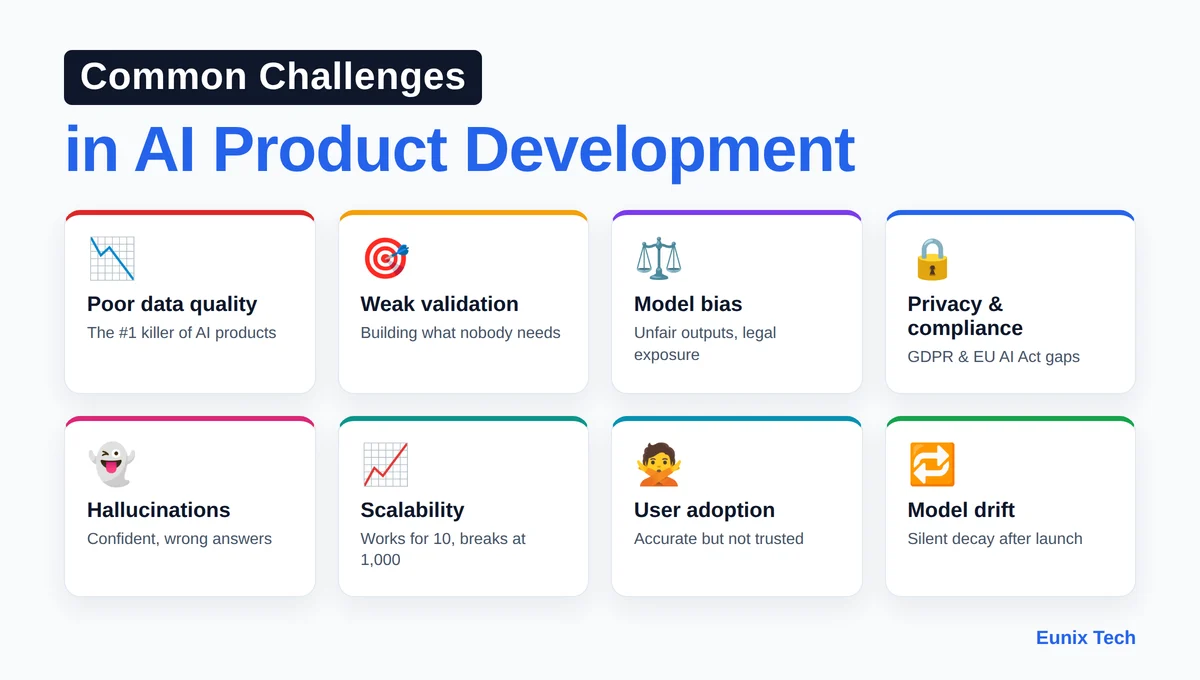
Poor data quality
The number-one killer. Incomplete, biased, or badly labeled data produces an unreliable product no engineering can rescue.
Lack of business validation
Building something technically impressive that no customer actually needs. Skipping Stage 2 is expensive.
Bias in AI models
Unfair or discriminatory outputs that create legal exposure and destroy user trust the moment they surface.
Privacy & compliance
Mishandling personal data, or ignoring regulations like GDPR and the EU AI Act, turns an AI product into a liability.
Model hallucinations
Generative models stating false information with total confidence - dangerous in any product where users act on the answer.
Scalability issues
A prototype that works for ten users but buckles - in speed and cost - when a thousand arrive.
User adoption
Even accurate AI fails if people do not understand or trust it. Poor AI UX quietly kills otherwise strong products.
Best Practices for Successful AI Product Development
The teams that ship durable AI products tend to follow the same disciplines:
- Start with a real business problem. Let a measurable outcome, not the technology, lead.
- Validate ideas early. Test your riskiest assumptions before full build, not after.
- Use high-quality data. Invest in collection, cleaning, and labeling - it pays back more than any model tweak.
- Design responsible AI systems. Build in fairness, explainability, and human oversight from day one.
- Measure business KPIs. Track the outcome that justified the project, not just model accuracy.
- Continuously retrain models. Plan for drift; a model is a perishable asset.
- Monitor AI performance in production. Watch quality, cost, and behavior, not only uptime.
- Improve with customer feedback. Wire user corrections directly into the next iteration.
None of this is exotic. It is ordinary product and engineering discipline applied honestly to a technology that punishes shortcuts harder than most.
Future Trends in AI Product Development
The direction of travel is clear, even if the pace surprises everyone. AI agents and autonomous workflows are moving from experiments to production, taking on multi-step tasks with less human prompting. Multimodal AI that fluently combines text, images, audio, and video is becoming the default rather than the exception. At the same time, smaller domain-specific models are proving that bigger is not always better - a focused, cheaper model often beats a giant general one for a narrow job.
Underneath it all, two themes will define the winners: enterprise-grade AI that is secure, governed, and integrated with real business systems, and responsible AI that is trustworthy by design as regulation catches up. AI copilots embedded inside every product category will keep raising the baseline of what users expect. The companies that build for this future - governed, grounded, and continuously improving - are the ones whose AI products will still be standing in three years.
Conclusion
AI product development is much more than building an AI model. It is a full lifecycle - problem definition, validation, data, modeling, design, fairness testing, deployment, and continuous improvement - where the model is only one moving part among many.
Successful AI products require strategy, honest validation, high-quality data, responsible design, and a commitment to keep improving with real customer feedback. Businesses that follow a structured AI product development process reduce their risk, launch faster, and build AI solutions that actually scale - instead of joining the large share of AI projects quietly abandoned after the demo.
If you are planning an AI product, the highest-leverage decision you can make is to get the process right before you write the first line of code. At Eunix Tech, we help startups and growing businesses do exactly that - from validating the idea and preparing the data to building, deploying, and continuously improving responsible AI products. Many clients come to us after a rushed build failed elsewhere; our rescue work taught us precisely which corners must never be cut. If you want a clear, honest plan for your AI product, talk to us - we will give you a scope and estimate you can compare against any other proposal.
Frequently Asked Questions (FAQ)
What is AI product development?
AI product development is the end-to-end process of planning, building, testing, launching, and continuously improving a software product whose core value comes from artificial intelligence. It combines product strategy, data science, and software engineering, and - unlike ordinary software - treats data quality, fairness testing, and ongoing model monitoring as core parts of the work rather than afterthoughts.
How do you validate AI product ideas before development?
Validate cheaply before you build fully. Combine market research and competitor analysis with real customer interviews about the problem, then build a small MVP that tests whether the AI can actually deliver the core value. List your riskiest assumptions - accuracy, trust, cost, and design the cheapest experiment that proves or disproves each one. The goal is to be proven wrong for the price of a prototype, not a full product.
What purpose do fairness measures serve in AI product development?
Fairness measures ensure an AI product treats different groups of people equitably and protect the business from the legal, financial, and reputational harm that biased AI causes. They include bias detection across protected attributes, explainable AI, responsible design guardrails, regulatory compliance (such as the EU AI Act and GDPR), and rigorous model evaluation against clear thresholds - applied continuously, not just once before launch.
When does generative AI improve product development?
Generative AI improves product development when it is used as a powerful but checked collaborator. It shines at faster prototyping, drafting content and documentation, generating code and UI, and clustering customer feedback. It improves outcomes only when its output is verified, grounded in trusted data (often via RAG), and kept within a cost budget, because it can also hallucinate, carry bias, and become expensive at scale.
How can generative AI tools benefit a product development team?
They remove friction across the workflow: faster research, automatic documentation and specs, UI and prototype generation, code assistance, test-case creation, customer-insight analysis, and support for sprint planning and brainstorming. Tools like ChatGPT, Claude, GitHub Copilot, Cursor, and Gemini let a team spend less time on busywork and more on judgment, design, and the decisions that genuinely need a human.
What is the AI product development lifecycle?
The AI product lifecycle has seven stages: identify the business problem, validate the idea, collect and prepare data, select and develop the model, design the product experience, test for fairness and compliance, and deploy with ongoing monitoring and continuous improvement. Crucially, it is a loop - real usage data feeds back into retraining and new features, so the product keeps getting better after launch.
How long does AI product development take?
It depends on complexity, data readiness, and scope. A validated AI MVP can often be built in 6-12 weeks, while a full production-grade product with custom data pipelines, fairness testing, and integrations typically takes several months. The biggest variable is data: teams with clean, well-labeled data move far faster than teams that discover their data problems mid-build.
What is the difference between AI software development and AI product development?
AI software development usually means building an AI system to a given specification - training a model or shipping a feature. AI product development is broader: it owns the whole product outcome, from validating that the idea is worth building through design, fairness, deployment, and continuous improvement. Software development asks "did we build the model right?" Product development also asks "did we build the right product, and will it still be right next year?"
