
MVP Development Services for Startups: Building, Launching, and Validating Your Product
Explore MVP development services for startups, from product strategy and UX design to development, testing, launch, and post-launch iteration.
Every startup begins with an idea and a limited budget to test it. A minimum viable product (MVP) is how you turn that idea into a real, working product with just the core features needed to reach real users, collect feedback, and validate your assumptions - before you spend a fortune building the full version. Done right, an MVP answers the only question that matters early on: does anyone actually want this?
That is where professional MVP development services for startups come in. The right partner does far more than write code. They help you decide what to build and what to leave out, design an experience users understand, engineer it properly, launch it, and then improve it based on what real usage reveals. The difference between a founder who ships and learns in three months and one who burns a year building the wrong thing is usually the process behind the product.
In this guide, we'll explore what MVP development services include, how the process works, why startups need them, what they cost, and how to choose the right MVP development partner.
MVP Development Services for Startups
MVP development services help early-stage companies build the first real version of their product - the version designed to learn from, not to be the finished article.
How an MVP differs from a full-fledged product
A full product tries to serve every user and cover every feature. An MVP does the opposite: it solves one core problem for one core user, extremely well, and skips everything else for now. The goal is not to impress with breadth but to prove that the central idea works and that people will use it.
Why MVPs focus on learning and validation
An MVP is a learning tool. Every feature you ship is really a question to the market: will users sign up, will they come back, will they pay? The faster you can ask those questions with a real product, the faster you learn, and the less money you risk on guesses. A good MVP is engineered to produce answers, through analytics and user feedback, not just to exist.
Why an MVP should be functional and usable - not simply a low-quality product
"Minimum" is the most misread word in "MVP." It does not mean cheap or broken. A confusing, buggy MVP teaches you nothing useful, because users abandon it for reasons that have nothing to do with your idea. The right standard is minimum scope, production quality: few features, but the ones you ship should work reliably and feel simple to use.
Why Startups Need MVP Development Services
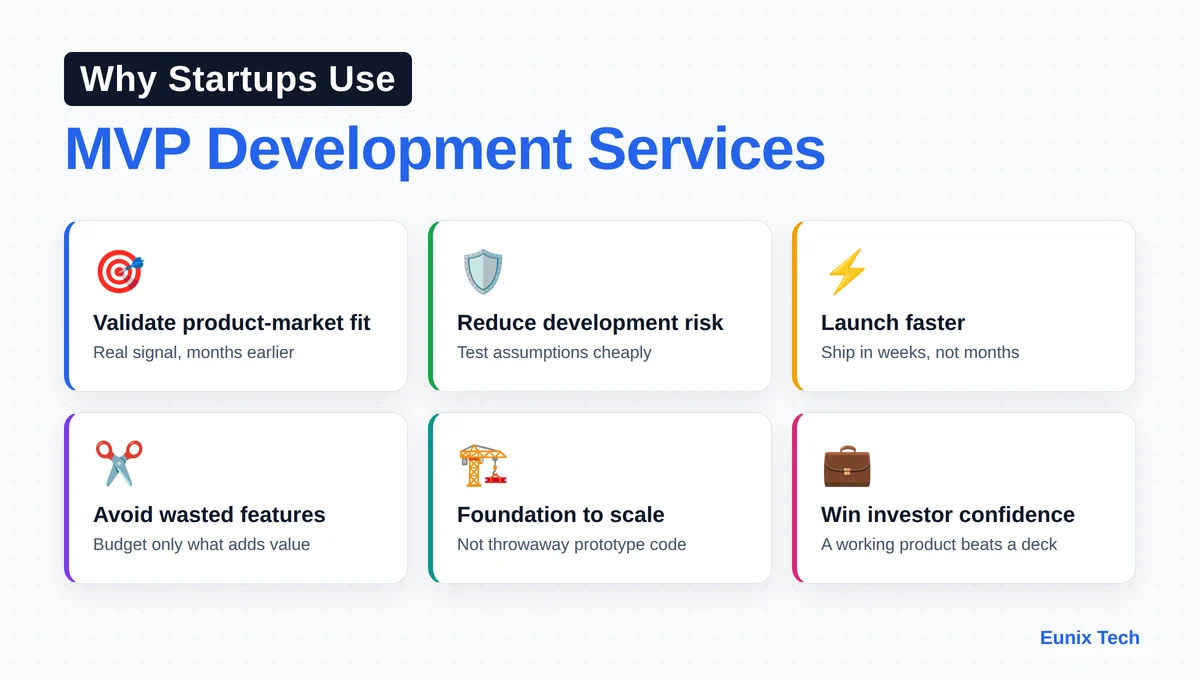
Validate Product-Market Fit Earlier
An MVP puts a real product in front of real users months before a full build would. That early signal - do people use it, do they return - is the single most valuable thing a startup can buy.
Reduce Product Development Risk
By testing the riskiest assumptions first with a small investment, you avoid the most expensive mistake in startups: building a complete, polished product that nobody needs.
Launch Faster and Gather Real User Feedback
Speed is a startup's main advantage. Shipping a focused MVP in weeks means you start collecting real feedback while competitors are still writing specs.
Avoid Spending on Unnecessary Features
Most features in a founder's original vision go unused. An MVP process forces ruthless prioritization, so your budget goes only to what creates value.
Build a Foundation for Future Growth
A well-engineered MVP is not throwaway code. Built properly, it becomes the architectural foundation you extend as you grow - instead of a prototype you have to rebuild the moment it succeeds.
Create a Working Product for Investors and Stakeholders
A live product with early traction is a far stronger pitch than a slide deck. An MVP gives investors something real to evaluate and gives you leverage in the raise.
What Do MVP Development Services for Startups Include?
Full-service MVP development covers the whole journey from idea to a live, improving product.
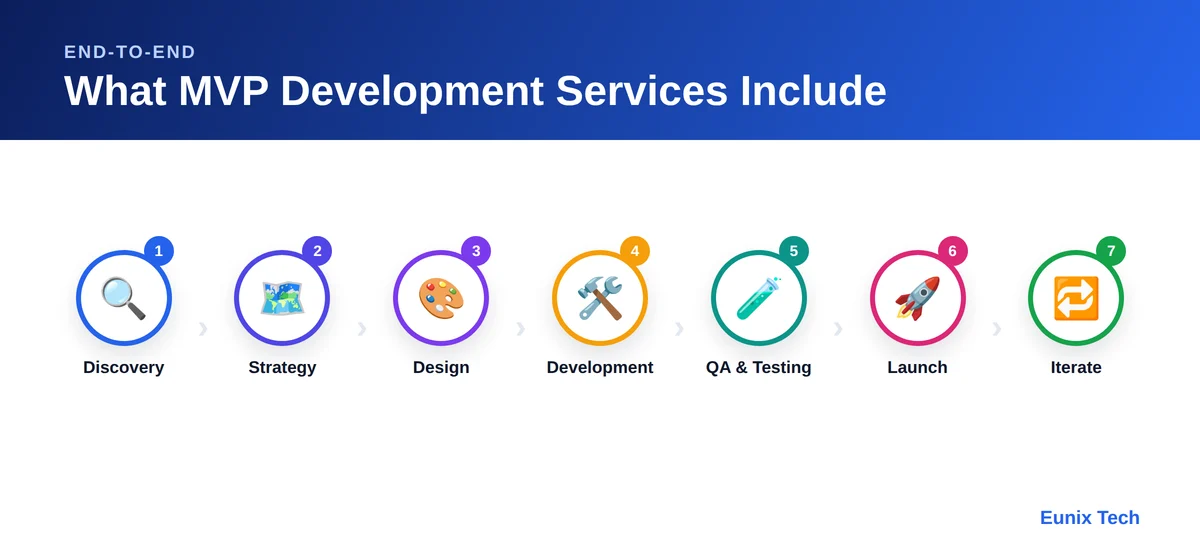
Product discovery and idea validation comes first - market research, competitor analysis, and user conversations to confirm the problem is real and worth solving. From there, MVP strategy and feature prioritization defines the smallest feature set that tests the core idea, so you build the right thing next rather than everything at once.
Product design and user experience turns that scope into clear, usable interfaces and clickable prototypes, tested before expensive development starts. MVP software development then builds it in short iterations - frontend, backend, APIs, and any AI integration - with working software shipped every week or two. Quality assurance and testing runs in parallel, catching bugs before users do, while deployment and MVP launch gets the product safely into the real world with staged releases and monitoring. Finally, post-launch support and iteration turns real usage data into a steady stream of improvements, because the launch is the start of learning, not the end of the project.
If you are budgeting this journey, our detailed guide on MVP development cost breaks down what each phase typically involves.
Types of MVP Solutions for Startups
Different products call for different kinds of MVP. These are the common MVP solutions for startups:
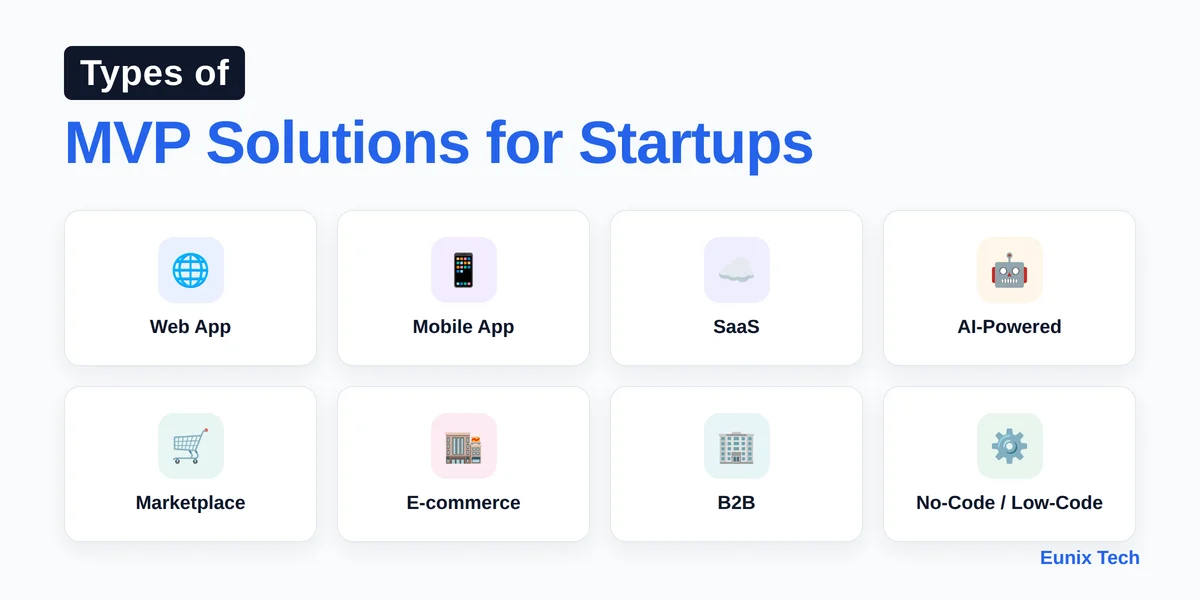
- Web App MVP - browser-based products, dashboards, and platforms, usually the fastest route to real users.
- Mobile App MVP - iOS and Android products, native or cross-platform with React Native or Flutter.
- SaaS MVP - subscription software with accounts, billing, and multi-tenant foundations built in early.
- AI-Powered MVP - products where AI is the core value, from assistants to document intelligence. Our guide on AI MVP development covers what makes these different.
- Marketplace MVP - two-sided platforms connecting buyers and sellers, where the hard part is seeding both sides.
- E-commerce MVP - a focused storefront to validate demand before investing in a full commerce platform.
- B2B MVP - tools for business users, where integration and reliability matter more than flash.
- No-Code or Low-Code MVP - the quickest, cheapest way to test an idea, ideal before committing to custom code.
Bespoke MVP Development Services: When Should Startups Choose Custom Development?
No-code tools are perfect for validating simple ideas. But some products outgrow templates quickly, and forcing them onto a no-code platform creates a ceiling you hit right when you start succeeding. Bespoke MVP development services make sense when your product has unique requirements that off-the-shelf tools cannot handle: complex workflows that do not fit a standard template, AI or machine-learning integrations, custom APIs connecting to other systems, advanced security or compliance needs, real scalability demands, or industry-specific rules. In these cases, custom development is not over-engineering - it is the only path that will not need to be torn down and rebuilt in six months.
MVP Development Services for Tech Startups: What Should You Look For?
Tech startups have a specific need: an MVP that is fast to build and built on foundations that will not collapse under growth. That means looking for a partner who delivers a strong technical architecture, rapid development cycles, scalable foundations, API-first thinking, AI integration where it adds value, the ability to iterate quickly, and security treated as a default rather than an afterthought.
Why Technical Flexibility Matters for Early-Stage Startups
Your first idea will change. The whole point of an MVP is to learn, and learning means pivoting. An architecture that makes change cheap lets you respond to what users tell you; a rigid one turns every new insight into an expensive rewrite.
Build for Today Without Overengineering for Tomorrow
The balance every good MVP partner strikes: build clean, sound foundations that can scale, without gold-plating features and infrastructure for a scale you have not reached yet. You want a product that can grow - not one that spent its budget preparing for millions of users it does not have.
How Much Do Services for MVP Development for Startups Cost?
There is no single price, because cost is driven by scope. The main factors are product complexity, the number of platforms (web, iOS, Android), the number of core features, how demanding the UX/UI is, third-party integrations, any AI or advanced technology requirements, the development team's location and seniority, and the level of post-launch support you need.
A simple single-platform MVP costs a fraction of a multi-platform product with AI and complex integrations. The honest way to budget is to define the smallest valuable scope first, then price that - rather than pricing a wish list. For a full breakdown of pricing models and estimates, see our MVP development cost guide.
Common MVP Development Mistakes Startups Should Avoid
The failures repeat across startups, and nearly all are avoidable: building too many features instead of the core few, skipping product validation and assuming demand, ignoring user experience, choosing technology before defining the problem, building without a clear target user, treating the MVP as the final product, ignoring analytics and user feedback, over-engineering for scale you do not have, and choosing a development partner on price alone. That last one is expensive - a cheap build that has to be rescued and rebuilt costs far more than doing it right the first time, as our work on fixing failed projects repeatedly shows.
End-to-End MVP Development Services for Startups: From Idea to Launch and Beyond
The full lifecycle of a well-run MVP looks like this:
Idea → Discovery → Validation → Strategy → UX/UI → Development → Testing → Launch → Measurement → Iteration
The advantage of an end-to-end partner who owns every step is continuity. When the same team handles product strategy, design, and engineering, no knowledge is lost in handoffs between vendors, no phase gets skipped because it was "someone else's job," and the product that launches is coherent from strategy through to code. Managing one accountable partner is also simply less work than stitching together freelancers and agencies - time a founder should be spending on customers, not coordination. This is the same full-lifecycle thinking behind product engineering services.
Conclusion
For a startup, MVP development is the disciplined way to turn an idea into evidence. It lets you launch faster, spend less, and learn what your users actually want before you commit to the full product - turning risky guesses into informed decisions.
But successful MVP development takes more than writing code. It takes the right combination of product strategy, design, and engineering working together, and a partner honest enough to tell you what not to build. Get that combination right, and your MVP becomes the first solid step toward a product that scales - not a prototype you have to throw away.
If you are planning an MVP, talk to us. We'll help you define the smallest version worth building, give you an honest estimate, and build it on foundations you can grow.
Frequently Asked Questions (FAQ)
How does MVP development for a startup work?
It starts with discovery and validation to confirm the problem is real, then strategy to define the smallest feature set that tests your core idea. Design turns that into usable interfaces, development builds it in short iterations, and testing keeps quality high. After a staged launch, real usage data and user feedback drive continuous improvement. The whole point is to learn fast and cheaply before committing to a full build.
What are the best MVP solutions for startups?
It depends on your product. Web app MVPs are usually the fastest to real users; mobile MVPs suit products that live on a phone; SaaS MVPs need billing and multi-tenant foundations early; AI-powered MVPs add model and data work on top; and no-code MVPs are the cheapest way to test a simple idea. The best solution is the smallest one that genuinely validates your core assumption.
How much do MVP development services for startups cost?
Cost is driven by scope - product complexity, number of platforms and core features, UX demands, integrations, AI requirements, and team seniority. A simple single-platform MVP costs far less than a multi-platform product with AI and complex integrations. The best approach is to price the smallest valuable scope rather than a full wish list. Our MVP development cost guide covers this in detail.
How long does it take to build an MVP for a startup?
A focused MVP typically takes 6-12 weeks, depending on complexity and how ready your requirements and data are. No-code MVPs can be faster; MVPs with AI, multiple platforms, or heavy integrations take longer. Breaking the work into phases with weekly demos means you see progress, and can validate assumptions - early rather than waiting months for a big reveal.
Do MVP development services include product design and user experience?
Yes - good ones do. Design is not optional polish; a confusing MVP fails for reasons unrelated to your idea and teaches you nothing. Full-service MVP development includes UX research, UI design, and clickable prototypes tested with users before development, so the product you build is one people can actually understand and use.
Which companies offer end-to-end MVP development services for startups?
Look for a partner that owns the whole lifecycle - discovery, strategy, design, development, testing, launch, and iteration - rather than just coding to a spec. End-to-end partners keep strategy, design, and engineering aligned and spare you the overhead of managing multiple vendors. Eunix Tech works exactly this way, as a senior, hands-on team for startups and growing businesses.
Are MVP development services suitable for seed-stage startups?
They're especially valuable at seed stage, when capital is tight and validation matters most. An MVP lets a seed-stage startup test product-market fit, gather real feedback, and produce a working product for investors - all without the cost and risk of building the full product first. It's the most efficient way to turn limited funding into maximum learning.
