
Product Engineering Services: What They Include
What do product engineering services include? Discovery, design, build, QA, deployment and ongoing support. See the process, benefits, and how to choose a partner.
Ten years ago, most companies needed "a website" or "an app." Today they need digital products - products that make money, keep users coming back, and improve every month. That change is why product engineering has become critical.
The demand comes from every direction. Established companies are going through digital transformation and need software that works like a product, not like an internal tool. Startups need to launch fast and scale without rebuilding. And every industry - retail, healthcare, construction, finance - now competes on the quality of its digital experience.
Traditional software development is no longer enough for this. Writing code to a specification answers the question "did we build it right?" But nobody in that model owns the harder question: "did we build the right thing, and will it still be the right thing next year?" Product engineering services exist to own both questions.
In this guide, you will learn what product engineering services are, how the end-to-end lifecycle works, the main types of services, how product engineering can benefit your organization, and how to choose the right product engineering company for your business.
What Are Product Engineering Services?
Product engineering services cover the complete journey of a digital product: discovery, strategy, design, development, testing, deployment, and continuous improvement after launch. One team owns the product across its whole lifecycle - not just the coding phase.
If you are asking "what is product engineering services in simple words" - it is the difference between hiring builders and hiring a team that designs the house, builds it, and keeps improving it while you live in it.
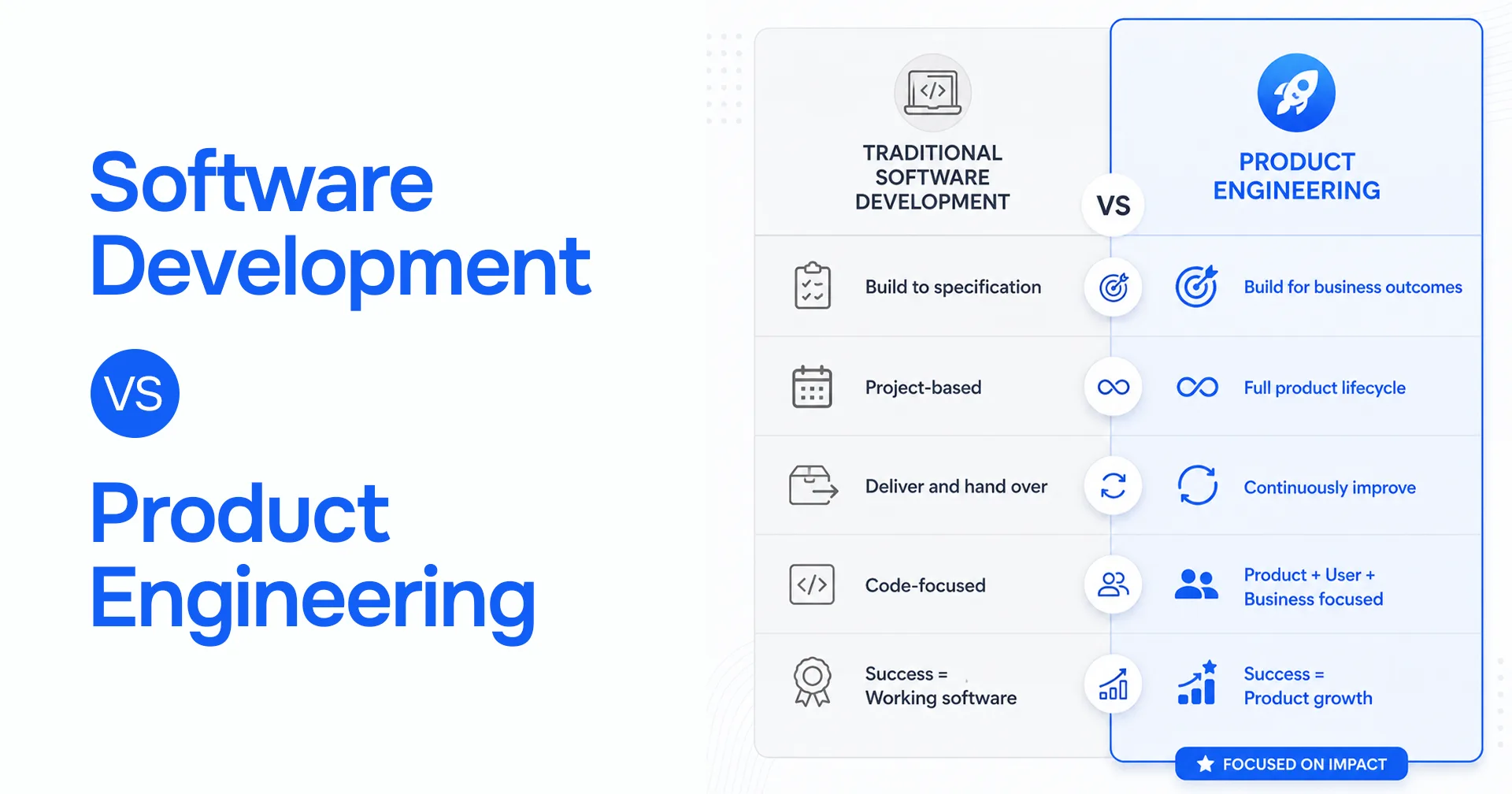
The difference between software development and product engineering is ownership:
| Traditional Software Development | Product Engineering | |
|---|---|---|
| Goal | Deliver what the specification says | Deliver business outcomes |
| Scope | Build and hand over | Full product lifecycle |
| Success metric | Code works, project closed | Users retained, revenue grown |
| After launch | Support contract, maybe | Continuous improvement, always |
| Mindset | "You decide, we build" | "We advise, we build, we measure" |
Three ideas define the approach:
- Product lifecycle ownership. The team is responsible from the first user interview to version 5.0. Decisions are made for the long life of the product, not for the end of a contract.
- Continuous innovation. A digital product is never finished. Real usage data drives a constant cycle of measuring, learning, and shipping improvements.
- Engineering-first approach. Architecture, automation, testing, and scalability are treated as product features, because in the long run they decide how fast the product can evolve.
End to End Product Engineering Services Lifecycle
End to end product engineering services follow a clear lifecycle. Here is what each phase includes and why it matters.
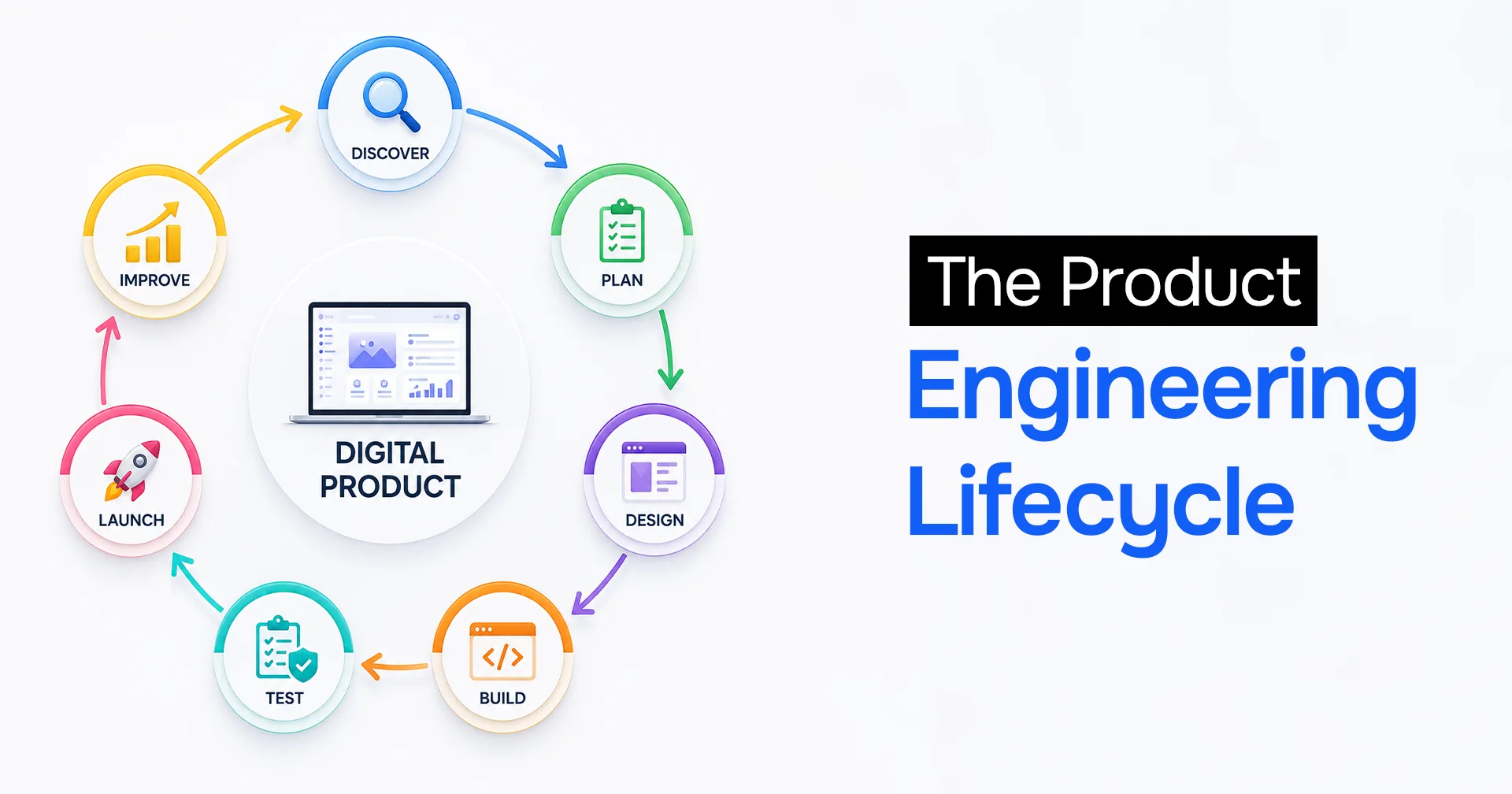
Product Discovery
Every good product starts with understanding, not code.
- Market research - who are the competitors, what do they charge, and where is the gap your product can fill?
- User interviews - talking to real potential users to learn what problem is worth solving. This step kills bad assumptions cheaply.
- Business goals - defining what success means: revenue, retention, cost savings, or market entry. The goal shapes every technical decision that follows.
Product Strategy & Roadmap
Discovery produces knowledge; strategy turns it into a plan.
- MVP planning - defining the smallest version that tests the core idea with real users. (We wrote a full guide on MVP development cost if you are budgeting this phase.)
- Prioritization - ranking features by value and effort, so the team always builds the most important thing next.
- Feature roadmap - a realistic sequence of releases for the next several months, updated as the market answers back.
Product Design Engineering Services
Product design engineering services connect user experience with technical reality - designers and engineers working as one team, so nothing beautiful is impossible to build and nothing buildable is ugly.
- UX Research - understanding how users think and where they struggle.
- UI Design - clear, consistent interfaces that make the product feel simple.
- Design Systems - a shared library of components, so every new screen is faster to design and build than the last one.
- Prototyping - clickable prototypes tested with users before expensive development starts.
Product Development
This is where the product gets built - in short iterations, with working software shipped every one or two weeks.
- Frontend - the web and mobile interfaces users touch, built with frameworks like React, Next.js, or Flutter.
- Backend - the business logic, data models, and services behind the product.
- APIs - clean interfaces that connect your product to mobile apps, partners, and third-party services.
- Cloud - infrastructure on AWS, Azure, or Google Cloud that grows with your user base instead of being rebuilt for it.
- AI integration - adding intelligence where it creates real value: recommendations, automation, chat, document processing, or predictions.
QA & Testing
Quality is engineered in parallel with development, not inspected at the end.
- Automation - automated test suites that check every release in minutes, so bugs are caught before users see them.
- Performance - load testing to make sure the product stays fast when traffic grows.
- Security - vulnerability scanning, dependency checks, and secure coding practices from day one.
Deployment
- DevOps - treating infrastructure as code, so environments are reproducible and reliable.
- CI/CD - pipelines that build, test, and release automatically. Shipping becomes a routine, not an event.
- Kubernetes - container orchestration for products that need high availability and elastic scaling.
- Cloud - deployment strategies (staging, canary releases, rollbacks) that make releases safe.
Product Maintenance & Continuous Improvement
The launch is the middle of the story, not the end.
- Feature enhancements - a steady stream of improvements driven by user feedback.
- Monitoring - error tracking and uptime alerts, so the team knows about problems before users complain.
- Analytics - usage data that shows which features create value and which ones nobody touches.
- Scaling - evolving the architecture as the product grows from hundreds to millions of users.
Types of Product Engineering Services
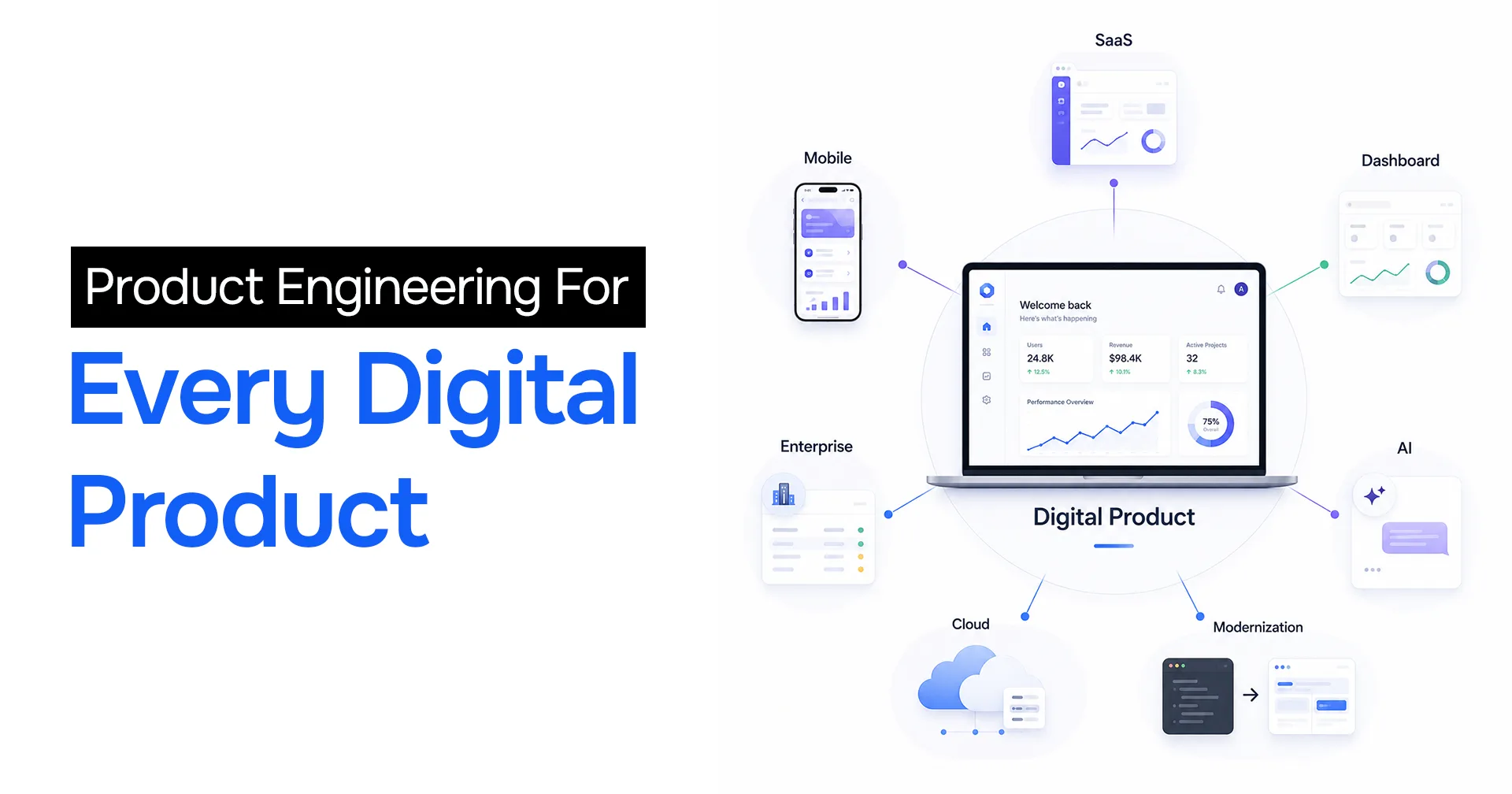
Different products need different engineering focus. These are the main types of product engineering services companies offer:
Digital Product Engineering Services
The broad category: building revenue-generating digital products - platforms, portals, marketplaces, and apps - with full lifecycle ownership. This is what most companies mean when they look for a digital product engineering services provider.
Enterprise Product Engineering Services
Products for large organizations: integration with existing systems (ERP, CRM, SSO), strict security and compliance requirements, and support for thousands of internal users. Enterprise product engineering is less about flashy features and more about reliability at scale.
SaaS Product Engineering
Subscription software needs specific engineering: multi-tenant architecture, billing and plan management, usage metering, onboarding flows, and an API customers can build on. Getting these foundations right early saves painful rework later.
Mobile Product Engineering
iOS and Android products - native or cross-platform with React Native or Flutter - including offline support, push notifications, app store releases, and mobile analytics.
AI Product Engineering
Products where AI is the core value: LLM-powered assistants, document intelligence, prediction engines, and automation agents. This adds model selection, prompt engineering, evaluation pipelines, and cost control on top of normal product work.
Cloud Product Engineering
Cloud-native architecture, migration from on-premise systems, serverless designs, and cost optimization - making sure the infrastructure bill grows slower than the user count.
Legacy Product Modernization
Rebuilding or gradually replacing older products that still earn money but resist change: outdated frameworks, monolithic codebases, and systems only one retired developer understands.
Custom Product Engineering Services
When your product does not fit a standard template - special hardware integrations, unusual industries, complex regulations - custom product engineering services shape the process around your exact situation instead of forcing you into someone else's.
How Can Product Engineering Services Benefit Your Organization
So how can product engineering services benefit your organization in practice? These are the benefits our clients actually measure:
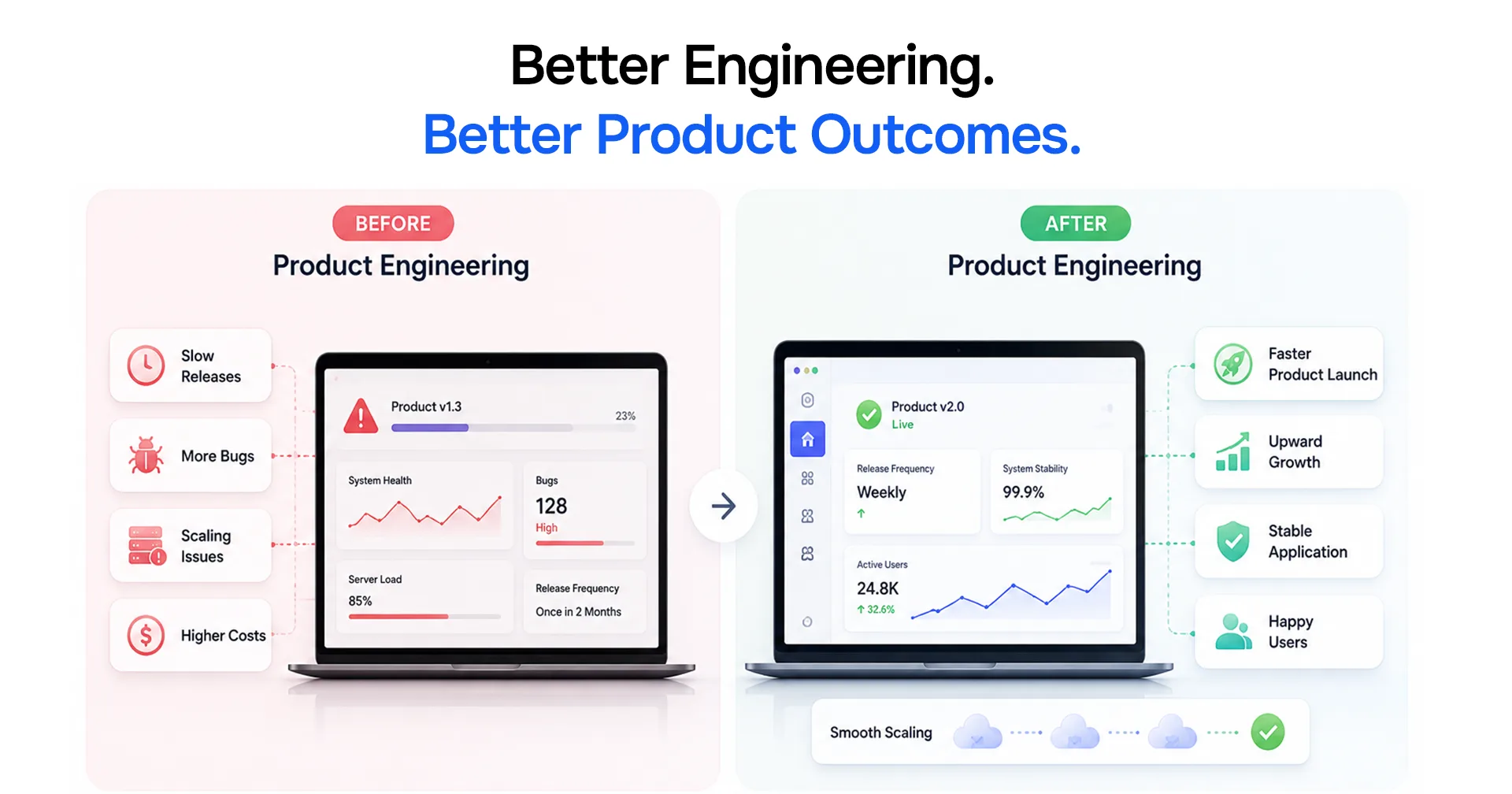
Faster time-to-market
An experienced team with a proven process ships in weeks what an ad-hoc team ships in months. Speed comes from skipping the mistakes, not from skipping the steps.
Reduced development costs
You pay for a working product, not for hiring, training, and management overhead. And because architecture and testing are done right the first time, you avoid the most expensive project of all: the rebuild.
Better product quality
Automated testing, code reviews, and engineering discipline produce software that works on Monday morning, and keeps working after every release.
Higher customer satisfaction
Products built on real user research, improved continuously from real usage data, simply fit their users better. Retention follows quality.
Continuous innovation
A dedicated product team ships improvements every sprint. Your product evolves at the speed of the market instead of freezing at version 1.0.
Scalability
Products engineered for growth handle their success. When marketing works and traffic triples, the product speeds up the business instead of becoming the bottleneck.
Security
Security practices built into the process - secure coding, dependency scanning, access control, compliance awareness - cost little upfront and prevent disasters later.
Better ROI
This is the sum of everything above: faster launch, lower total cost, higher quality, and a product that keeps earning. Product engineering is an investment model, not an expense model.
Best Product Engineering Services Company
Honest answer first: there is no single "best product engineering services company" for everyone. Big consultancies are strong for enterprise programs with huge budgets. Freelance teams are cheap for small experiments. The best partner for you depends on your product stage, budget, and how much strategic help you need.
What you should look for in any product engineering services firm:
- Full lifecycle capability - discovery and design through deployment and maintenance, not just coding.
- A portfolio of shipped products - live products with real users, not just completed contracts.
- Engineering discipline - ask how they test, deploy, and monitor. Vague answers predict vague quality.
- Honest scoping - a good partner tells you what not to build. Beware of teams that agree with everything.
- Communication - weekly demos, clear progress, and bad news delivered early.
- Fair engagement models - pricing that fits your stage, from a small discovery project to a dedicated team.
At Eunix Tech, this is exactly how we work. We provide end-to-end product engineering services - discovery, design, development, AI integration, and long-term product improvement - for startups and growing businesses. We are a senior, hands-on team: the people who scope your product are the people who build it. Clients come to us to launch new products, and many come after a cheap build failed elsewhere - our rescue work taught us precisely which engineering corners must never be cut.
If you are evaluating product engineering partners, talk to us. We will give you a clear scope, an honest estimate, and a plan you can compare against any other proposal.
Conclusion
Product engineering drives innovation beyond software development. It replaces "build to specification and hand over" with a model where one team owns the product's success across its whole life.
End-to-end engineering helps businesses launch, scale, and modernize products: discovery reduces the risk of building the wrong thing, disciplined development and QA keep quality high, and continuous improvement keeps the product competitive after launch.
And choosing the right engineering partner is the highest-leverage decision in the whole process - it reduces risk, accelerates time-to-market, and improves long-term product success more than any single technology choice.
Frequently Asked Questions (FAQ)
What is product engineering services and how does it differ from software development?
Product engineering services cover the full lifecycle of a digital product - discovery, design, development, testing, deployment, and continuous improvement. Software development typically means building to a given specification and handing over the result. Product engineering adds ownership of outcomes: the team is measured on whether the product succeeds, not just whether the code works.
How can product engineering services benefit your organization?
The main benefits are faster time-to-market, lower total development cost, better product quality, higher customer satisfaction, continuous innovation, easier scaling, stronger security, and better ROI. In short: you get a product that launches sooner, works better, and keeps improving.
What are end-to-end product engineering services?
End-to-end means one partner handles every phase: product discovery, strategy and roadmap, UX/UI design, frontend and backend development, QA, deployment, and post-launch maintenance. The advantage is continuity - no knowledge is lost between phases, and no phase is skipped because it was "someone else's job."
What should you look for in a product engineering services firm?
Look for full lifecycle capability, a portfolio of shipped products with real users, visible engineering discipline (testing, CI/CD, monitoring), honest scoping that pushes back on unnecessary features, and clear weekly communication. Ask to speak with past clients whose products are still running.
How product engineering services support digital product launches?
They de-risk the launch step by step: discovery validates demand before heavy investment, MVP planning keeps the first version small and testable, automated testing and staged deployments make release day boring (which is what you want), and monitoring plus analytics show immediately how real users respond so the team can react fast.
What industries benefit the most from enterprise product engineering services?
Industries with complex workflows and legacy systems see the biggest gains: finance, healthcare, construction, logistics, manufacturing, and retail. Anywhere software directly drives revenue or operations, enterprise product engineering pays for itself through reliability and integration quality.
How do digital product engineering services help businesses innovate faster?
They shorten the loop between idea and shipped feature: modern architecture makes changes cheap, CI/CD makes releases frequent, and analytics show what users actually do. When shipping an improvement takes days instead of months, a business can test ten ideas in the time competitors test one.
How to connect customer service data to product engineering?
Route support insights into the product backlog systematically: tag support tickets by theme, review the top recurring issues in each sprint planning, connect helpdesk tools to the product analytics stack, and measure whether releases reduce related tickets. Support data is the cheapest user research you own - most companies just never wire it into engineering decisions.
What are red flags when choosing a product engineering services firm?
Beyond the basics (portfolio, process, communication), watch for warning signs: a quote without a discovery conversation, no questions about your business goals, "yes" to every feature request, and no plan for what happens after launch. A firm that only talks about building, and never about measuring - is selling software development, not product engineering.
Which IT services firm offers the best product engineering service?
Large firms like Accenture, EPAM, or GlobalLogic lead for enterprise-scale programs, but they are built for big budgets and long procurement cycles. For startups and mid-sized businesses, specialized product engineering companies usually deliver better speed and value: senior engineers, direct communication, and startup-friendly pricing. Eunix Tech competes in exactly this space.
Which is the best digital product engineering services provider?
The best provider is the one that fits your product stage, industry, and budget, and can prove it with shipped products. Shortlist two or three firms, give each the same brief, and compare how they scope it: the provider that asks the best questions and challenges your assumptions is usually the one that will build the best product. If you want that conversation with us, Eunix Tech is here.
