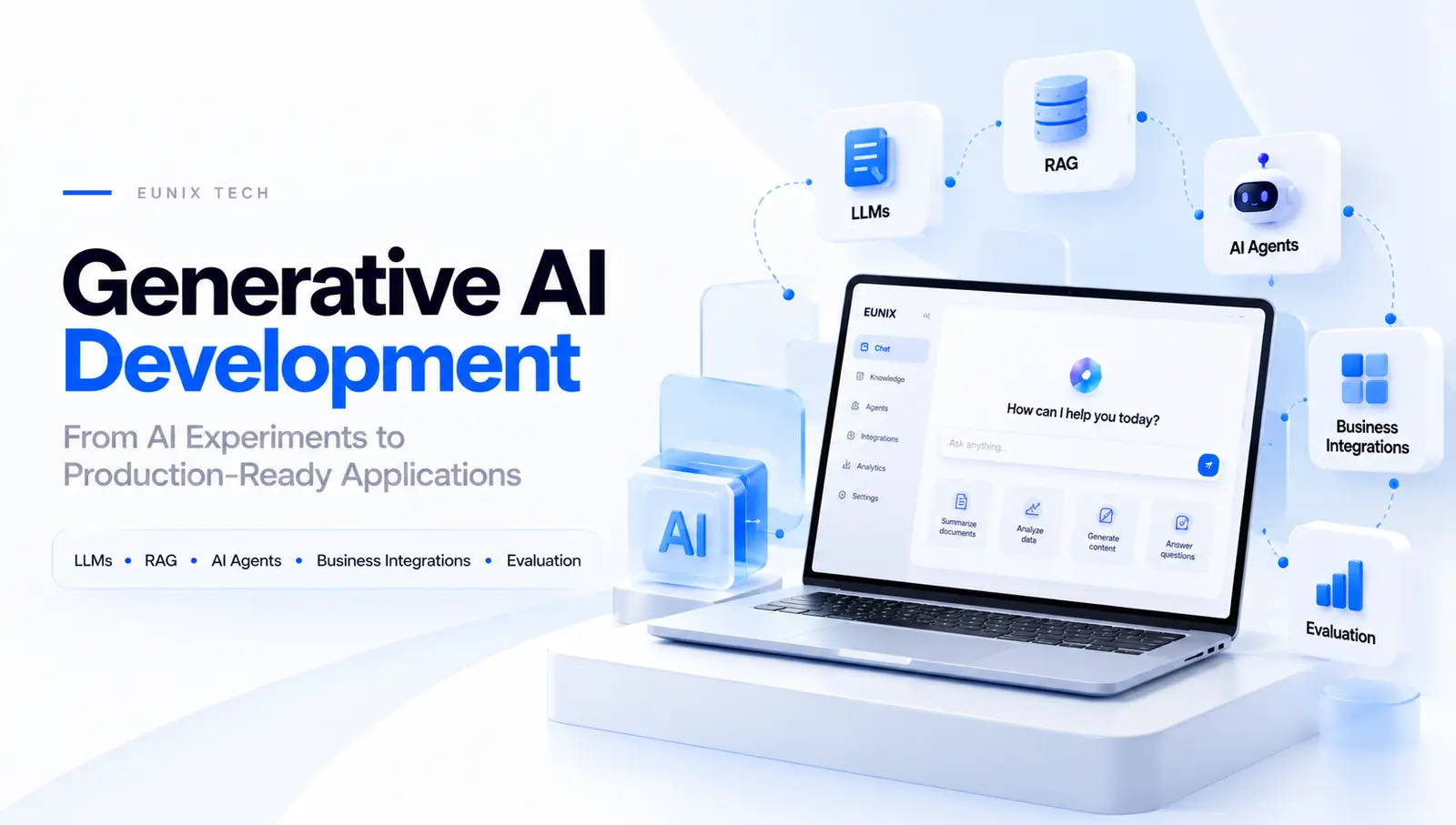
The experimentation phase is over for most businesses. The pilots ran, the demos impressed, and now the question has changed from can this work? to why is it still not in production? Generative AI development is the discipline that answers the second question - turning a model that produces good output into an application people depend on daily.
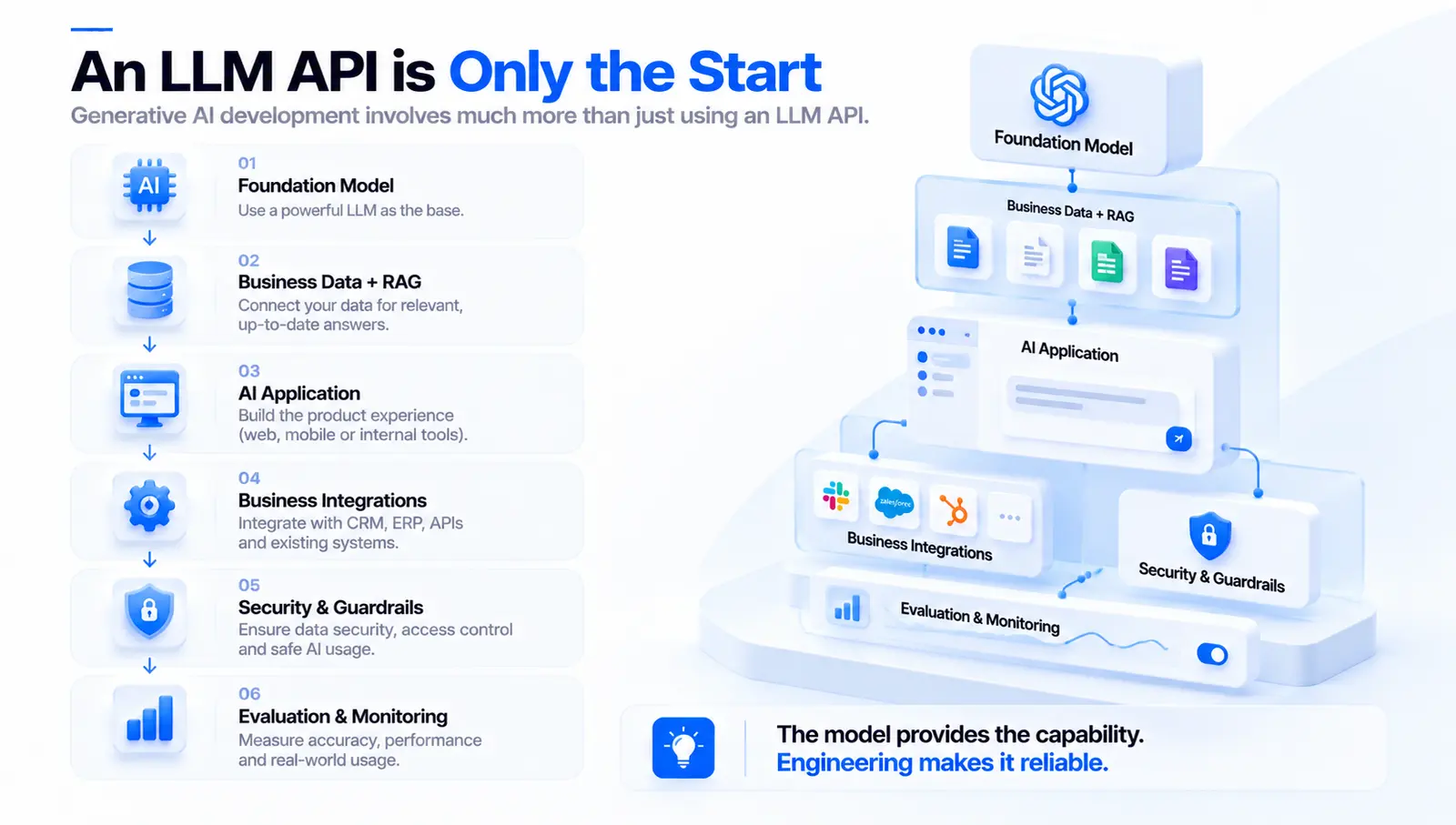
The gap is wider than it looks, because connecting an LLM API is genuinely easy and everything after it is not. A production GenAI application needs its own data grounding it, an architecture that survives real traffic, integrations with the systems the work actually lives in, security that holds when the model meets sensitive information, and evaluation that proves quality rather than assuming it. Those are the parts that take the time, and skipping them is why so many promising pilots never graduate.
This guide covers what GenAI development involves, what businesses realistically build with it, the development process end to end, the technology choices that matter, the RAG-versus-fine-tuning decision, what drives cost, and how to evaluate generative AI development services.
What Is Generative AI Development?
Generative AI development is the engineering of complete applications built around models that produce content - text, code, structured data, images - rather than only classifying or predicting. The model supplies a capability; the development work turns that capability into something that reliably does a job.
GenAI applications differ from traditional software in one decisive way: the core component is probabilistic. The same input can produce different output, several answers can be equally valid, and correctness is a judgement rather than an assertion. Everything unusual about building them follows from that.
The building blocks are worth naming plainly. Foundation models accessed through APIs supply the raw capability. RAG (retrieval-augmented generation) feeds the model your own information at query time, so answers reflect your data rather than the model's training. Fine-tuning adapts a model's behaviour or style using your examples. AI agents let the model plan and execute multi-step tasks with tools. Multimodal models extend all of this beyond text to images, audio and documents.
A useful progression to hold in mind: traditional AI → generative AI → AI applications → AI agents. Traditional AI predicts and classifies. Generative AI produces. AI applications wrap that production in software people can use. Agents let that software act. Each step adds capability and, proportionally, engineering responsibility.
What Can Businesses Build With Generative AI?
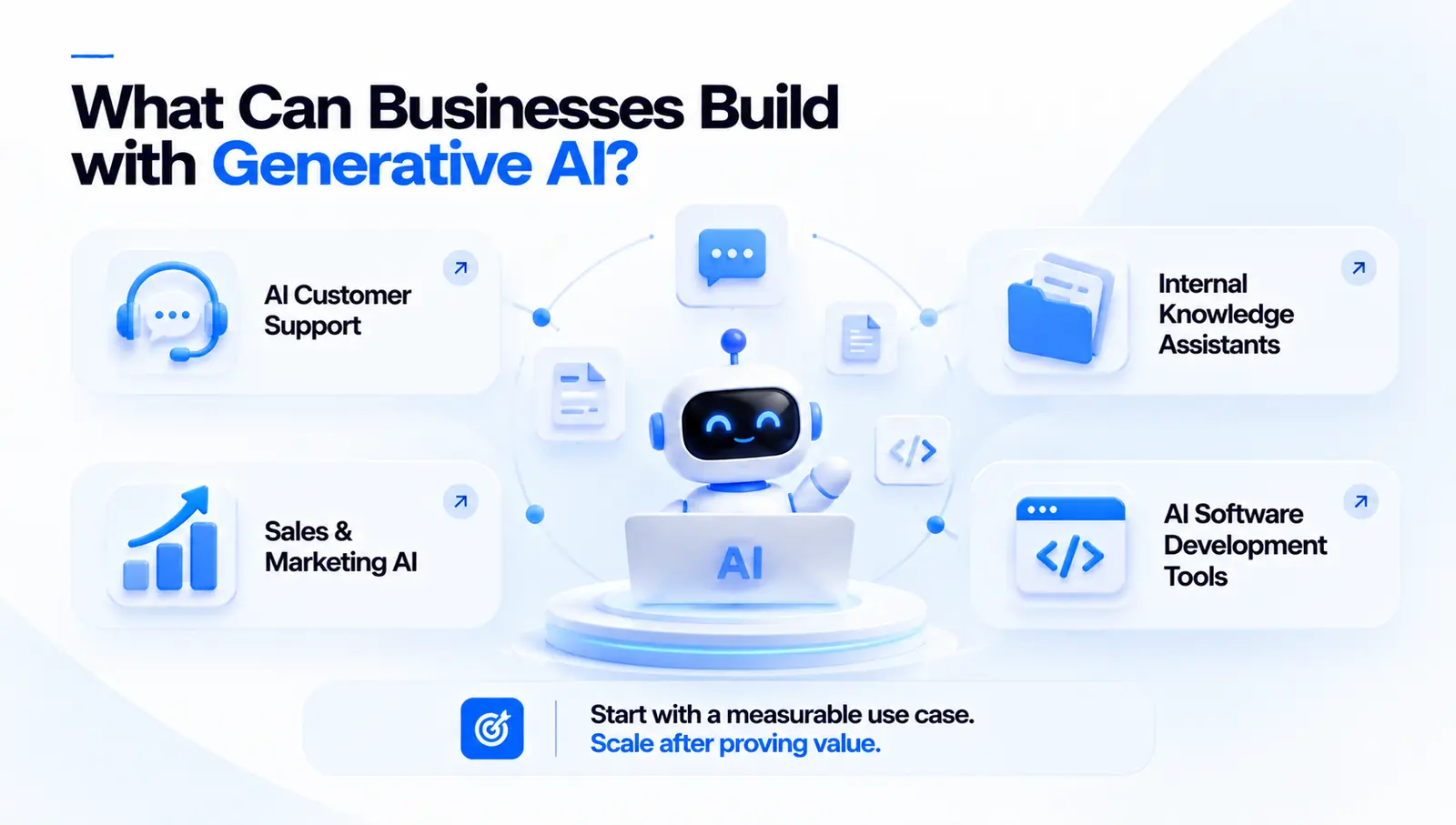
AI Customer Support Applications
Answering customer questions from your documentation, retrieving from a knowledge base, classifying tickets, drafting responses, and escalating cleanly when confidence is low. The escalation path matters more than raw answer quality - a system that knows its limits earns trust faster than one that is marginally more accurate but never defers.
Internal AI Knowledge Assistants
Natural-language search across company documents, SOPs, policies and internal knowledge. This is usually the best first GenAI project: the audience is internal, mistakes are cheap, feedback is immediate, and almost every organisation has knowledge nobody can find.
AI Sales and Marketing Applications
Lead research and scoring, personalised outreach, content generation, market research, and campaign analysis. The pattern that works is AI handling the reading and drafting while people keep the judgement - AI-assisted lead scoring and demand generation across sales, marketing and business development is most effective when it prioritises a rep's attention rather than replacing their decision.
AI Software Development Tools
Code generation, review, documentation, testing, debugging, and developer assistants - the category with the fastest adoption, largely because developers can evaluate the output themselves.
The Generative AI Development Process
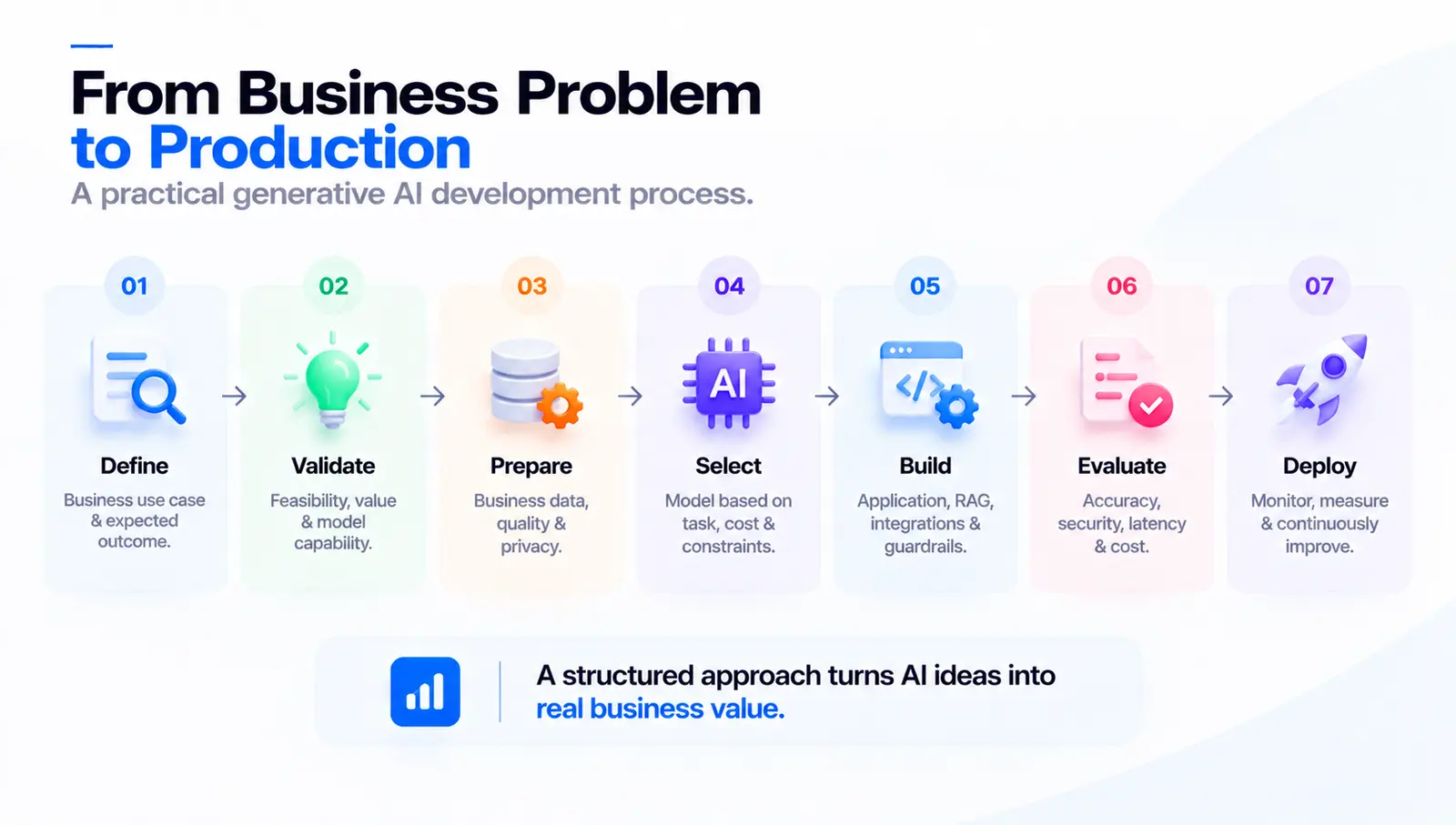
1. Define the Business Use Case
Start with business problem → expected outcome → AI opportunity, in that order. Choosing a model first is the most common and most expensive mistake, because it quietly converts an open question about value into a closed question about implementation.
2. Validate the GenAI Use Case
Before building, check the assumptions: what users actually do today, how the existing workflow runs, whether competitors have solved it, whether a proof of concept can be built cheaply, whether the task is within current model capability, and what the return looks like if it works. Some use cases fail this stage, and finding out here is the cheapest possible outcome.
3. Prepare Business Data
Documents, databases, APIs, structured and unstructured data - assessed for quality, completeness and privacy. This step is routinely underestimated and routinely responsible for disappointing results. A GenAI application is only as good as what it can retrieve.
4. Select the Right AI Model
Compare large models, smaller specialised models, multimodal models, open-source and API-based options against accuracy on your task, cost at your volume, speed, context window, privacy requirements, tool-calling quality, and deployment constraints. The largest model is rarely the right default; a smaller model with strong retrieval usually beats a frontier model without it.
5. Build the GenAI Application
Backend, frontend, the prompt and instruction layer, model API integration, RAG, database, business integrations, authentication, and guardrails. Most of this is ordinary software engineering, which surprises teams who expected the model to be the hard part.
6. Test and Evaluate
Accuracy, hallucination rate, response quality, security, latency, cost and edge cases - measured against a representative dataset rather than judged by impression. This is a discipline with its own methods, covered in our guide to LLM evaluation.
7. Deploy and Monitor
Cloud deployment with logging, monitoring, AI cost tracking, user feedback capture, model performance measurement, and a continuous improvement loop. GenAI applications drift as providers update models and data ages, so monitoring is not optional.
When Generative AI Meets Product Development
GenAI changes product development in both directions: it changes how products are built, and it changes what products can be.
On the building side, prototyping is dramatically faster, engineering is AI-assisted, and the distance from idea to demonstrable concept has collapsed. On the product side, natural-language interfaces, personalised experiences, embedded copilots and automated workflows are now features users expect rather than differentiators.
The strategic distinction worth being explicit about: GenAI can be a feature inside a product or the core technology behind the product. A feature can be added incrementally and removed if it disappoints. A core technology sets your architecture, your cost structure and your competitive position, and demands far more engineering rigour. Confusing the two - building a feature with core-level investment, or a core capability with feature-level care - is a common and expensive error. Our guide to AI product development covers the product side in depth.
How Developers Use Generative AI in Software Development
Code Generation
Producing boilerplate, functions, and components - most valuable on well-specified, repetitive work.
Code Refactoring
Restructuring existing code, applying patterns consistently, and modernising older implementations.
Debugging
Interpreting stack traces, suggesting causes, and narrowing the search space on unfamiliar code.
Test Generation
Drafting unit and integration tests, though generated tests need review - a test that asserts current behaviour rather than correct behaviour locks in bugs.
Documentation
Producing and maintaining documentation that otherwise goes stale.
Codebase Understanding
Explaining unfamiliar code and answering questions about a repository - often the highest-value use in a large or inherited codebase.
The important caveat concerns accountability. The responsibility of developers using generative AI does not shrink because the code was generated: accuracy, security, performance, licensing, architectural fit and production reliability all remain the engineer's to verify. AI shifts where effort goes - less typing, more reviewing - rather than removing it. Teams that treat generated code as reviewed code accumulate problems faster than they accumulate features, which is why optimising AI-generated codebases has become its own category of work.
What Technologies Are Used in Generative AI Development?
Foundation Models and LLMs
Commercial models from OpenAI, Google and Anthropic, or open-source models where privacy or cost predictability matters. The choice is a trade between capability, control and running cost.
RAG and Vector Databases
How businesses connect GenAI to proprietary information - embeddings, semantic search, and retrieval that grounds answers in your own content. This is the single biggest lever on accuracy for knowledge-based applications, and the subject of our guide to RAG development.
AI APIs and Integrations
REST APIs, SDKs and webhooks connecting to CRM, ERP and internal applications. The integration layer is where most engineering effort actually goes.
Cloud Infrastructure
AWS, Azure or Google Cloud, with containers and orchestration where scale justifies them.
The point is not the list. Each layer exists because production GenAI needs something the model alone cannot provide: your data, your systems, and infrastructure that survives real usage.
RAG vs Fine-Tuning: Which Approach Should Businesses Use?
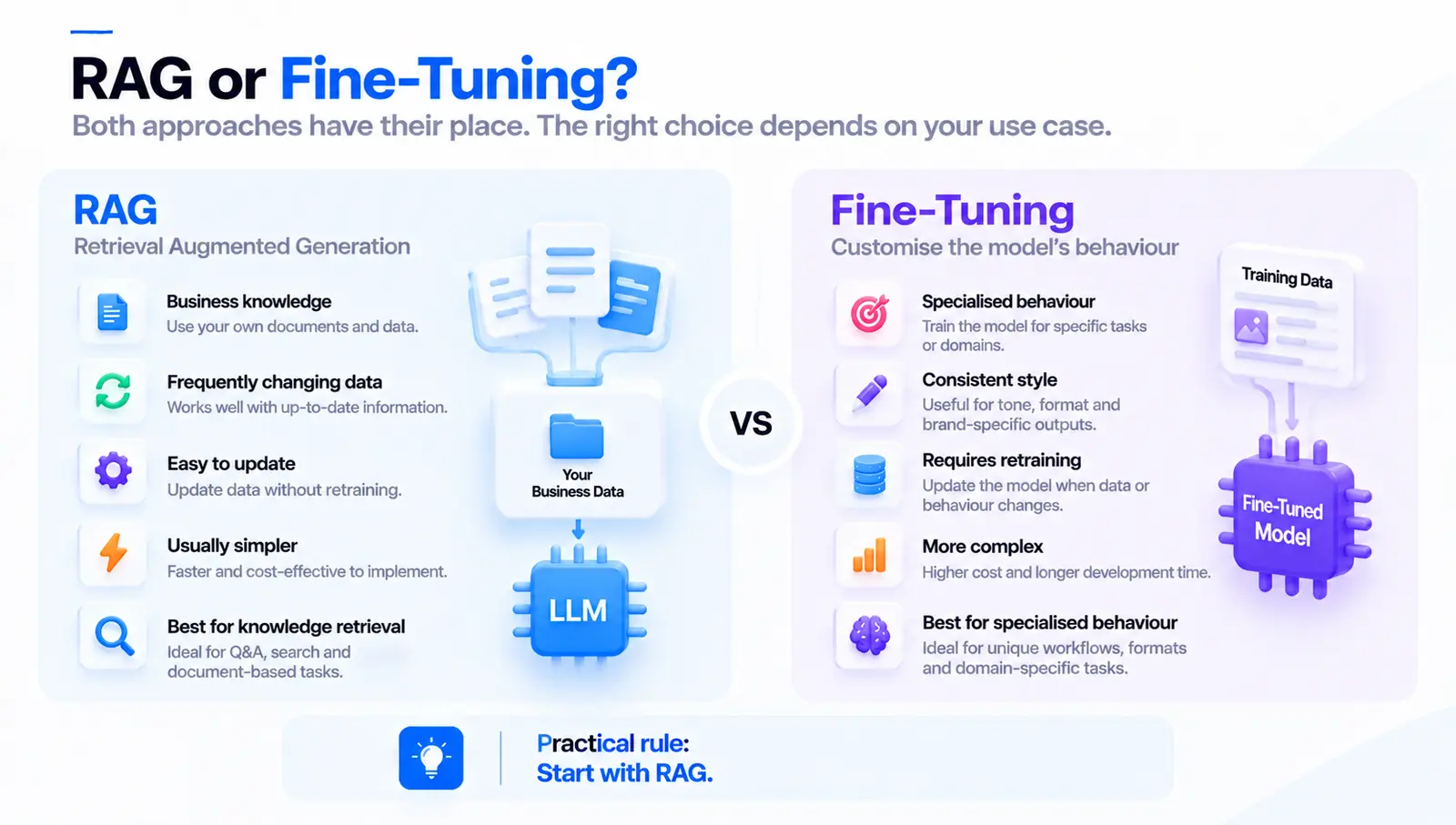
| Factor | RAG | Fine-Tuning |
|---|---|---|
| Business knowledge | Excellent | Possible |
| Frequently changing data | Strong | Weak |
| Updating information | Easy - reindex | Requires retraining |
| Behaviour and style | Moderate | Strong |
| Implementation | Usually simpler | More complex |
| Best for | Knowledge retrieval | Specialised behaviour |
The practical rule: start with RAG. Most business use cases are knowledge problems - the model needs to know your information, not to behave differently. RAG solves that with a pipeline you can update in minutes, while fine-tuning solves it with a training run you must repeat every time the data changes.
Fine-tuning earns its complexity when you need consistent specialised behaviour, a particular output format the model resists, or domain language it handles poorly, and it works alongside RAG rather than instead of it. Our fine-tuning versus prompt engineering framework covers the decision in more detail.
Challenges in Generative AI Development
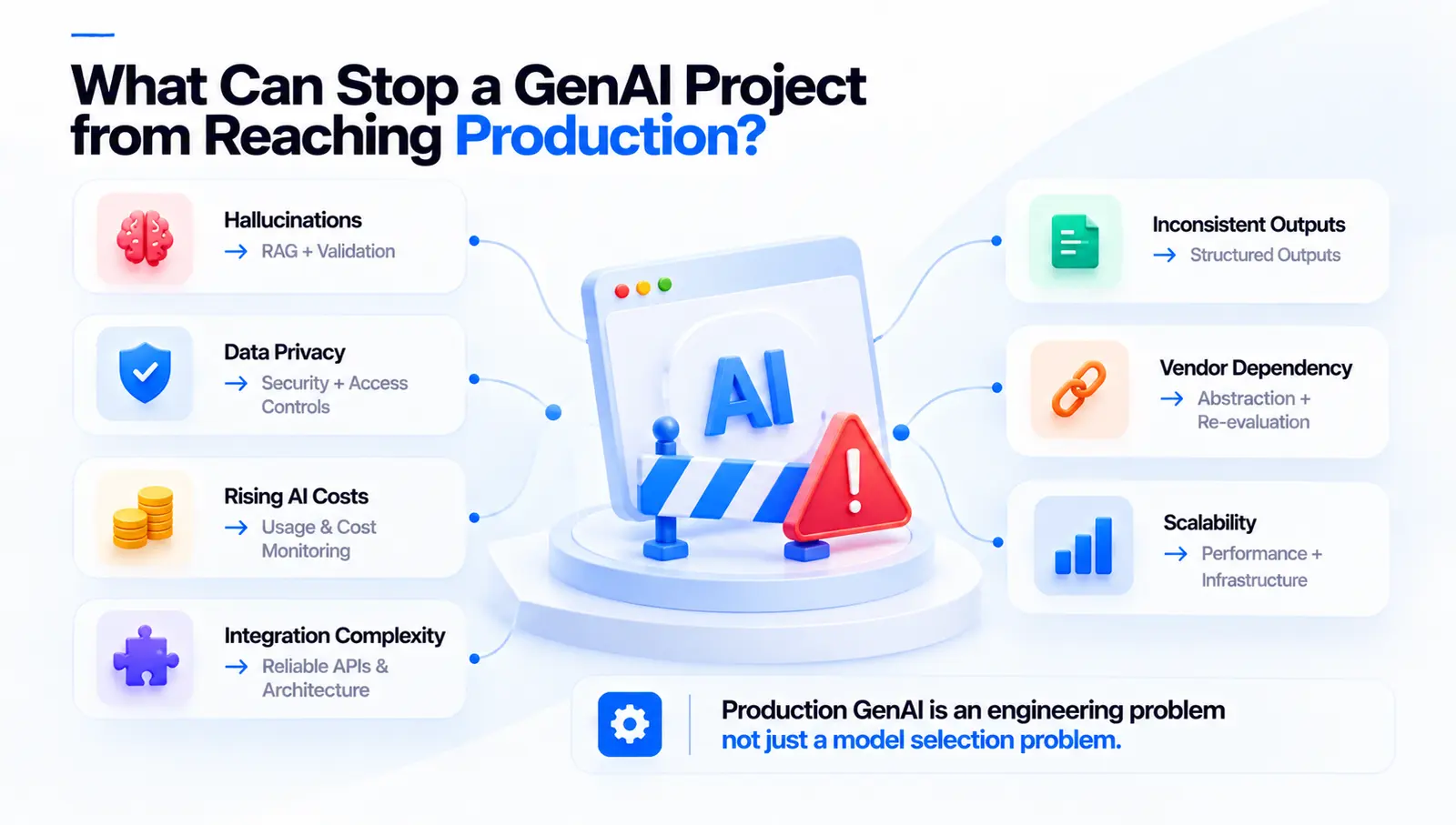
Hallucinations - confident, fluent, invented output, countered by grounding in retrieved data, structured outputs and validation rather than better prompting alone.
Data privacy and security - what leaves your environment, what the provider retains, and which users may see which data.
AI model costs - usage-based and scaling with adoption, so successful pilots become expensive quietly.
Integration complexity - usually the largest single portion of the engineering effort.
Inconsistent outputs - the same question producing differently-shaped answers, addressed with structured output formats and explicit constraints.
Model and vendor dependency - providers deprecate versions and change behaviour underneath you, which argues for an abstraction layer and periodic re-evaluation.
Scalability - concurrency, latency and cost per request all move together as usage grows.
None of these are solved by choosing a better model. They are solved with testing, structured outputs, RAG, guardrails and monitoring - engineering, not procurement.
How Much Does Generative AI Development Cost?
Cost is driven by application complexity, the number of integrations, model and API usage, data requirements, whether RAG is needed, the extent of custom development, security requirements, infrastructure, testing depth, and ongoing maintenance.
A useful mental model for scale:
Simple GenAI feature < AI-powered application < enterprise GenAI platform
Each step up multiplies integration work, security requirements and testing rather than adding to them linearly. The two items most often missing from early estimates are data preparation and integration effort. For the full budgeting framework, see our guide to AI software development cost.
How to Choose a Generative AI Development Company
Look for demonstrable GenAI development experience, LLM expertise, RAG experience specifically, API integration capability, a real AI evaluation methodology, security knowledge, cloud architecture skill, production deployment history rather than prototypes alone, case studies you can question, and post-launch support.
Questions to Ask a GenAI Development Company
- Have you built production GenAI applications, and what happened after launch?
- Which AI models would you recommend here, and why those?
- Should we use RAG or fine-tuning, and what makes you say so?
- How will you evaluate AI response quality?
- How will our business data be protected, and what leaves our environment?
- How will AI costs be controlled as usage grows?
- How will the application integrate with our existing systems?
- How will the system be monitored after launch?
Questions three and four are the most diagnostic. A partner who reaches for fine-tuning before understanding your data, or who cannot describe a concrete evaluation method, has probably not run one of these in production.
Generative AI Development Services: What Do They Include?
Full generative AI development services span GenAI strategy, use-case discovery, AI architecture, LLM integration, RAG development, custom GenAI applications, chatbot development, agent development, API integration, AI evaluation, security, deployment, monitoring and maintenance.
The framing that matters is lifecycle rather than menu. A GenAI application is not finished at launch - models change, data ages, and usage reveals inputs nobody designed for. An engagement that ends at deployment leaves you owning a system that degrades with no one accountable for it.
Why Choose Eunix Tech for Generative AI Development?
At Eunix Tech, we build GenAI applications for production rather than for demos. Our work spans LLM architecture and system design, RAG engineering, AI agent development, integration with existing business software, evaluation and observability, and full-stack product engineering - with senior engineers involved from discovery through release.
A significant share of what we do is stabilising GenAI applications that were built quickly and became unreliable, including rescuing a failed AI chatbot project. That experience shapes how we build new ones.
Conclusion
Generative AI development is considerably more than integrating an LLM API. Successful applications require business validation before building, quality data, an appropriate model chosen for the task rather than the headline, sound architecture, and continuous evaluation.
RAG, APIs, agents and model integration are what turn a foundation model into something a business can rely on, and starting with a measurable use case, then scaling after proving value, is what separates the applications that reach production from the pilots that stall. The right development partner combines AI expertise with production software engineering, because a GenAI application is both at once.
If you are weighing a GenAI application or modernising one that isn't performing, talk to us, or read our guides to AI application development and AI consulting services.
Frequently Asked Questions
What is generative AI development?
Generative AI development is the engineering of complete applications built around models that produce content - text, code, structured data, images. It covers the data grounding, architecture, integrations, security and evaluation around the model, not just the model API call itself.
What are generative AI development services?
They span GenAI strategy, use-case discovery, AI architecture, LLM integration, RAG development, custom applications, chatbot and agent development, API integration, evaluation, security, deployment, monitoring and maintenance. The important quality is lifecycle coverage - GenAI applications degrade without ongoing attention.
What can businesses build with generative AI?
Common production applications are customer support systems grounded in company documentation, internal knowledge assistants, sales and marketing tools for research and personalised outreach, and software development assistants. Internal knowledge assistants are usually the best first project: internal audience, cheap mistakes, immediate feedback.
How does generative AI development work?
Define the business use case, validate it against data availability and model capability, prepare business data, select a model suited to the task, build the application with retrieval and guardrails, test and evaluate systematically, then deploy with monitoring and improve continuously.
How much does generative AI development cost?
It depends on application complexity, integrations, model usage, data requirements, whether RAG is needed, security requirements, infrastructure, testing and maintenance. A simple GenAI feature, an AI-powered application and an enterprise platform differ by multiples, not percentages. Data preparation and integration are the most underestimated items.
What is the best generative AI platform for app development?
There is no universal best. The right choice depends on your task, accuracy requirements, cost at your expected volume, latency needs, privacy constraints and tool-calling requirements. Benchmark candidate models on your own task and data rather than trusting general leaderboards - a smaller model with good retrieval often beats a frontier model without it.
What is the difference between RAG and fine-tuning?
RAG retrieves relevant information at query time so the model answers from your current data; fine-tuning adapts the model's behaviour using training examples. RAG suits knowledge problems and frequently changing information; fine-tuning suits specialised behaviour or style. Most business applications should start with RAG, and the two can be combined.
How do developers use AI code generators?
For generating boilerplate and components, refactoring, debugging assistance, test drafting, documentation, and understanding unfamiliar codebases. The gains are largest on well-specified repetitive work and smallest on ambiguous design decisions.
What are the responsibilities of developers using generative AI?
Verifying accuracy, security, performance, licensing, architectural fit and production reliability. Generated code is not reviewed code. AI shifts effort from typing to reviewing rather than removing it, and teams that skip the review accumulate problems faster than features.
How do I choose a generative AI development company?
Look for production GenAI experience rather than prototypes, LLM and RAG expertise, API integration capability, a concrete evaluation methodology, security knowledge, and post-launch support. Ask how they would decide between RAG and fine-tuning, and how they measure response quality - vague answers on either point are telling.
How long does it take to build a generative AI application?
It depends on scope, data readiness, the number of integrations, security requirements and testing depth. Data readiness and decision speed predict the timeline better than technical difficulty. A narrow internal assistant on clean data is a matter of weeks; a multi-integration application under enterprise security is a matter of months.
