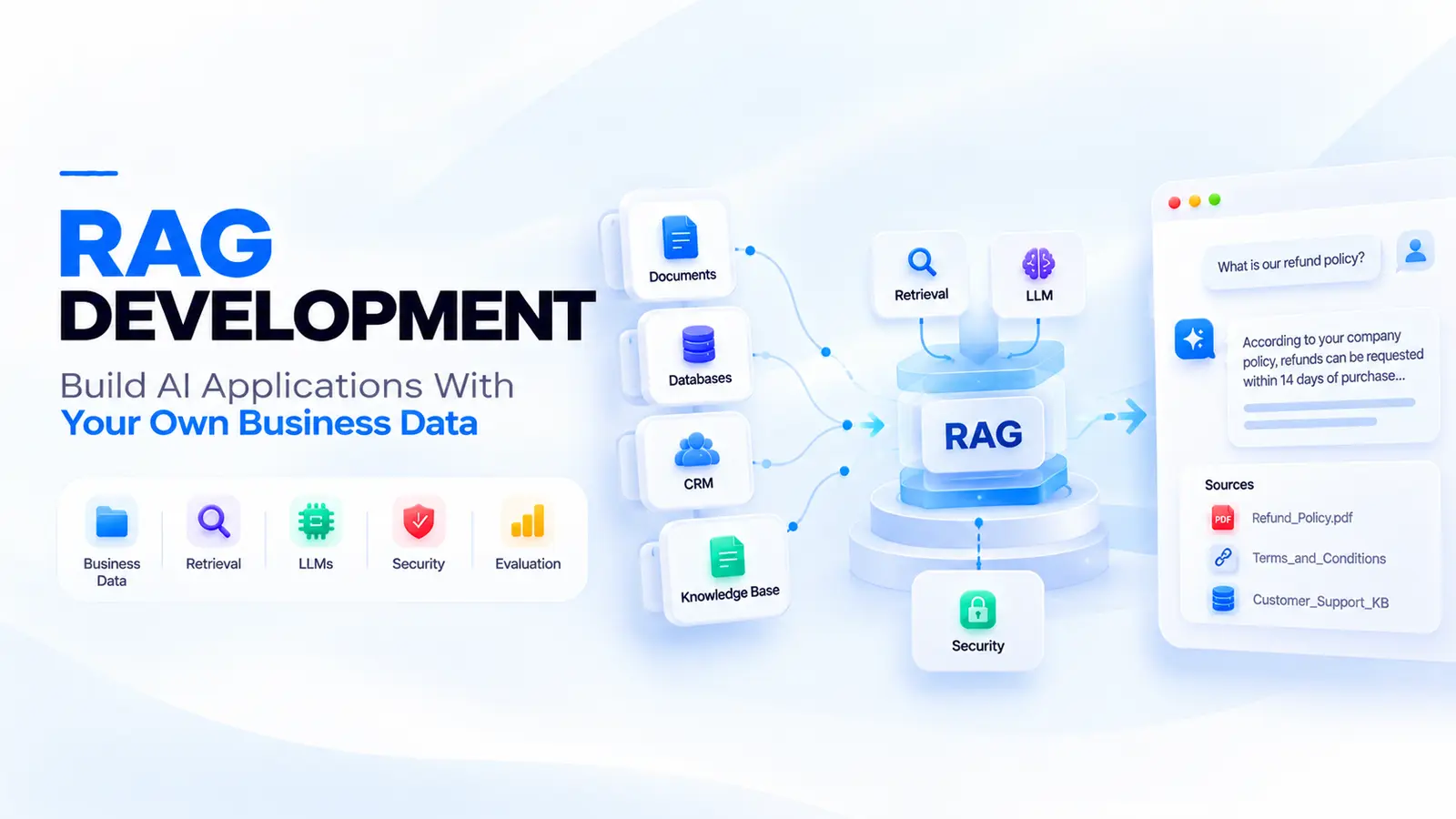
A language model knows an enormous amount about the world and nothing at all about your business. It has never seen your product documentation, your pricing rules, your internal policies or last quarter's support tickets. That gap is the reason most useful business AI applications are retrieval systems wearing a chat interface.
RAG development - building applications that retrieve relevant information from your own data before generating an answer - is how that gap gets closed. It is also widely misunderstood as a simple matter of putting documents in a vector database and pointing an LLM at it. In production, retrieval quality, chunking, permissions, context management and evaluation determine whether the system is genuinely useful or confidently unreliable.
This guide covers what RAG development is, how a RAG system actually works end to end, its architecture and components, business use cases, the RAG-versus-fine-tuning decision, what drives cost, security, how to reduce hallucinations, and how to evaluate RAG development services.
What Is RAG Development?
RAG stands for Retrieval-Augmented Generation. It combines information retrieval with generative AI: rather than relying on what a model learned during training, the system searches your business data for relevant information and supplies it to the model as context before the answer is generated. The approach was first described by researchers at Facebook AI Research, University College London and New York University in 2020 (Lewis et al.).
The basic concept:
User Question → Retrieve Relevant Business Data → Add Context → LLM Generates Response
This matters because foundation models have two hard limits on business knowledge. They have never seen your proprietary information, and their training has a cutoff, so they cannot know what changed last week. RAG addresses both without retraining anything - you update the data, and the next answer reflects it.
RAG development is the engineering around that idea: the ingestion pipeline, the retrieval design, the context assembly, the security model and the evaluation that together decide whether the retrieved information is actually the right information.
What Is RAG in Software Development?
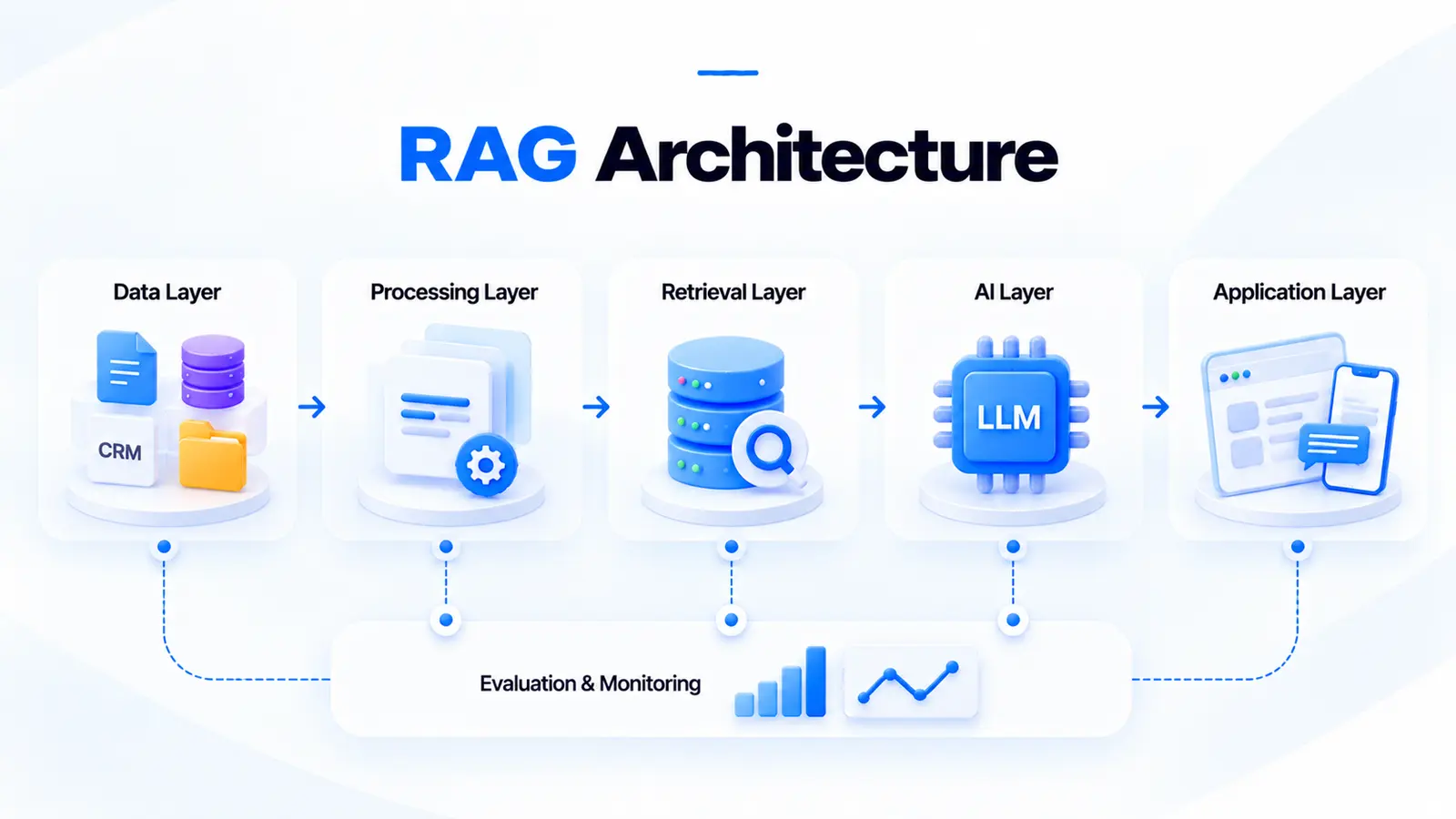
From a software engineering perspective, a RAG system is a pipeline with distinct, testable stages: data ingestion, document processing, chunking, embedding generation, vector search, metadata filtering, retrieval, prompt construction, LLM generation, an application or API layer, and monitoring and evaluation.
Framing it as a pipeline is useful because each stage fails differently and can be debugged separately. Poor answers might come from bad source data, unhelpful chunking, a weak embedding model, imprecise retrieval, or context assembly that buries the relevant passage. Teams that treat RAG as one opaque component spend weeks tuning the wrong stage.
It is also worth saying that RAG is not necessarily a chatbot. Retrieval can sit inside an existing application - surfacing relevant precedent in a case management screen, answering a question inside your CRM, powering a search box that returns answers rather than links. The conversational interface is a presentation choice, not part of the architecture.
How Does RAG Work?
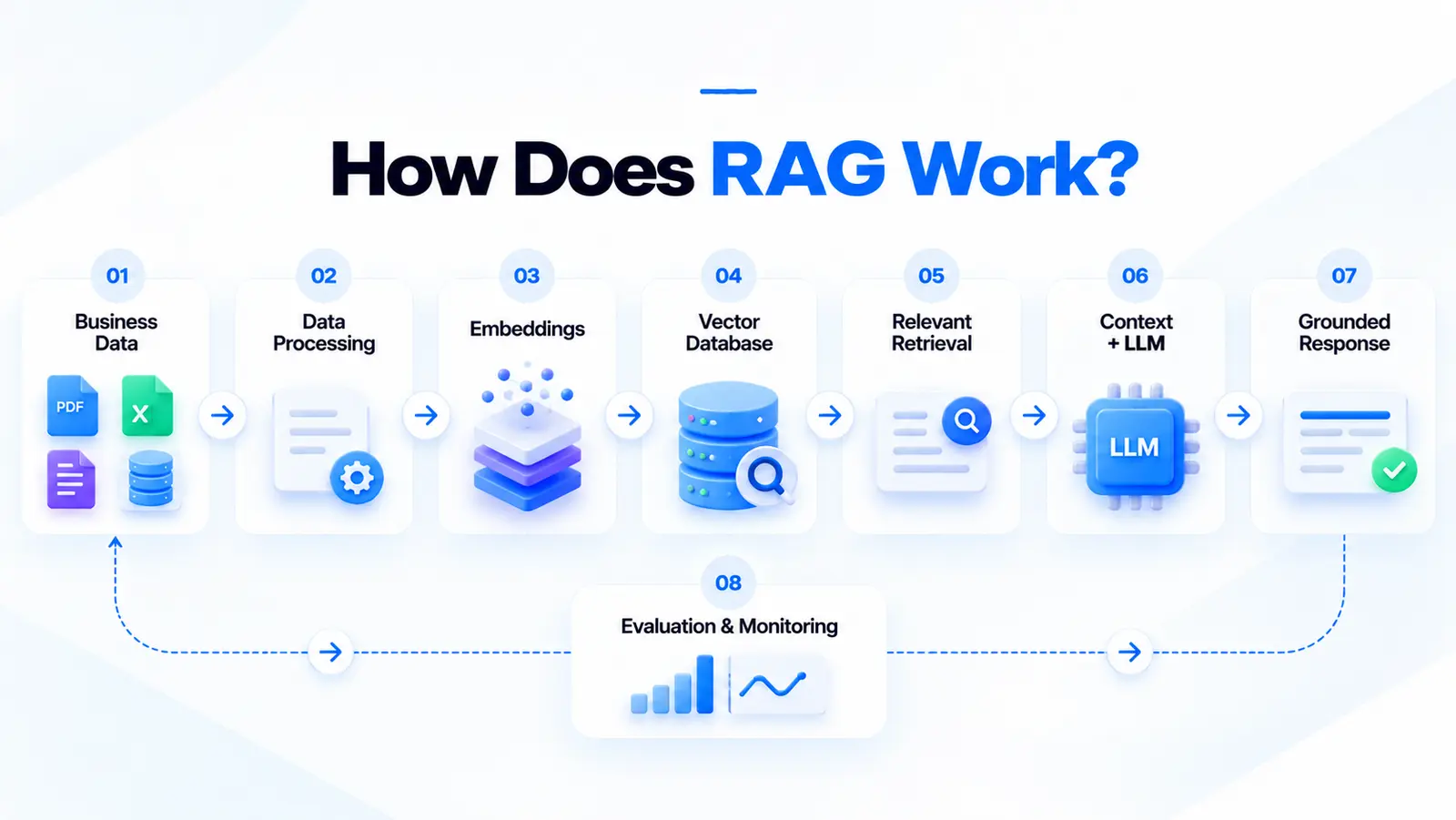
Business Data → Data Processing → Embeddings → Vector Database → User Query → Retrieval → Context → LLM → Response
1. Collect Business Data
PDFs, documents, websites, knowledge bases, product catalogues, internal policies, databases, CRM information and support documentation - whatever holds the answers today.
2. Process and Prepare the Data
Cleaning, formatting, deduplication, metadata assignment, document parsing and chunking. Deduplication matters more than expected: three versions of a policy in the index means retrieval may surface the outdated one.
3. Generate Embeddings
Text is converted into numerical vectors that place semantically similar content near each other, so a search for "refund window" can match a passage about "return period" without sharing a keyword.
4. Store Data in a Vector Database
Vectors are stored alongside metadata, indexed for similarity search and filtering. Metadata - document type, department, date, access level - is what makes precise retrieval possible later.
5. Retrieve Relevant Information
The user's question is embedded and matched against stored content, usually with filters applied and often combined with keyword search. This mix is called hybrid search, and vector databases such as Weaviate support it directly (Weaviate docs).
6. Provide Context to the LLM
Retrieved passages are assembled into the model's context alongside the question and instructions. How much context, in what order, and how it is framed all affect the answer. Research shows models use information at the start or end of a long context better than information in the middle (Liu et al.).
7. Generate a Grounded Response
The model answers from the supplied context rather than from memory - ideally citing which sources it used.
8. Evaluate and Monitor the Result
Relevance, accuracy, retrieval quality, hallucination rate, latency and user feedback, measured continuously rather than once at launch.
RAG Architecture: Key Components
| Component | Purpose |
|---|---|
| Data sources | Provide business knowledge |
| Document processor | Extracts and cleans information |
| Chunking system | Breaks documents into retrievable sections |
| Embedding model | Converts content into vectors |
| Vector database | Stores and retrieves embeddings |
| Retriever | Finds relevant information |
| Reranker | Improves relevance of retrieved results |
| Prompt/orchestration layer | Combines query and retrieved context |
| LLM | Generates the final response |
| Application layer | Delivers the experience to users |
| Evaluation system | Measures retrieval and response quality |
| Monitoring | Tracks performance and failures |
The two components most often omitted from a first build are the reranker and the evaluation system. A reranker re-scores retrieved candidates for actual relevance (Cohere Rerank docs) and is frequently the cheapest large improvement available. Without an evaluation system, you have no way to know whether any change helped.
What Business Data Can Be Used With RAG?
Documents and PDFs
Contracts, manuals, reports and specifications - the most common starting point, and the one where parsing quality varies most.
Internal Knowledge Bases
Wikis, Confluence spaces and documentation portals, where content is already structured but often outdated in places.
Websites and Web Content
Public documentation, help centres and marketing content.
Product and Service Information
Catalogues, specifications and pricing rules - usually best retrieved from a live source rather than a stale index.
Customer Support Data
Historical tickets, resolutions and macros, which encode how problems actually get solved.
Databases
Structured business data, often better queried directly and combined with retrieved documents.
CRM and Business Systems
Account, contact and interaction records, where permissions matter most.
Policies and Internal Documentation
HR policies, SOPs and compliance documentation - high-value because they are frequently consulted and rarely findable.
Across all of these, four properties determine performance: data quality, permissions, freshness and structure. A RAG system inherits the state of the content it indexes, which is why the honest first step is usually an audit rather than an architecture.
RAG Development Use Cases
Enterprise Knowledge Assistants
Employees ask questions in natural language and get answers grounded in internal documentation. Usually the highest-return first project.
Customer Support AI
Product documentation, FAQs, policies and support history used to answer customer questions accurately, with citations that let agents verify.
Document Intelligence
Querying large document collections - contracts, reports, research - where the alternative is someone reading for hours.
E-Commerce Product Assistants
Product information and specifications used to answer questions and recommend, grounded in live catalogue data.
Legal and Compliance Knowledge Systems
Policies, regulations, contracts and internal compliance documentation made searchable. These systems should surface sources and support professional review rather than substitute for it - anywhere a decision carries legal or regulatory consequence, a qualified human makes it.
Healthcare Knowledge Applications
Clinical documentation, protocols and administrative information, subject to privacy, security, accuracy requirements, regulatory obligations and human oversight. Scope should be explicitly bounded and clinical judgement always human.
Financial Services Applications
Internal research, product information, policy retrieval and customer support - again with security and human oversight wherever a decision affects a customer's money or risk position.
RAG vs. Fine-Tuning: What's the Difference?
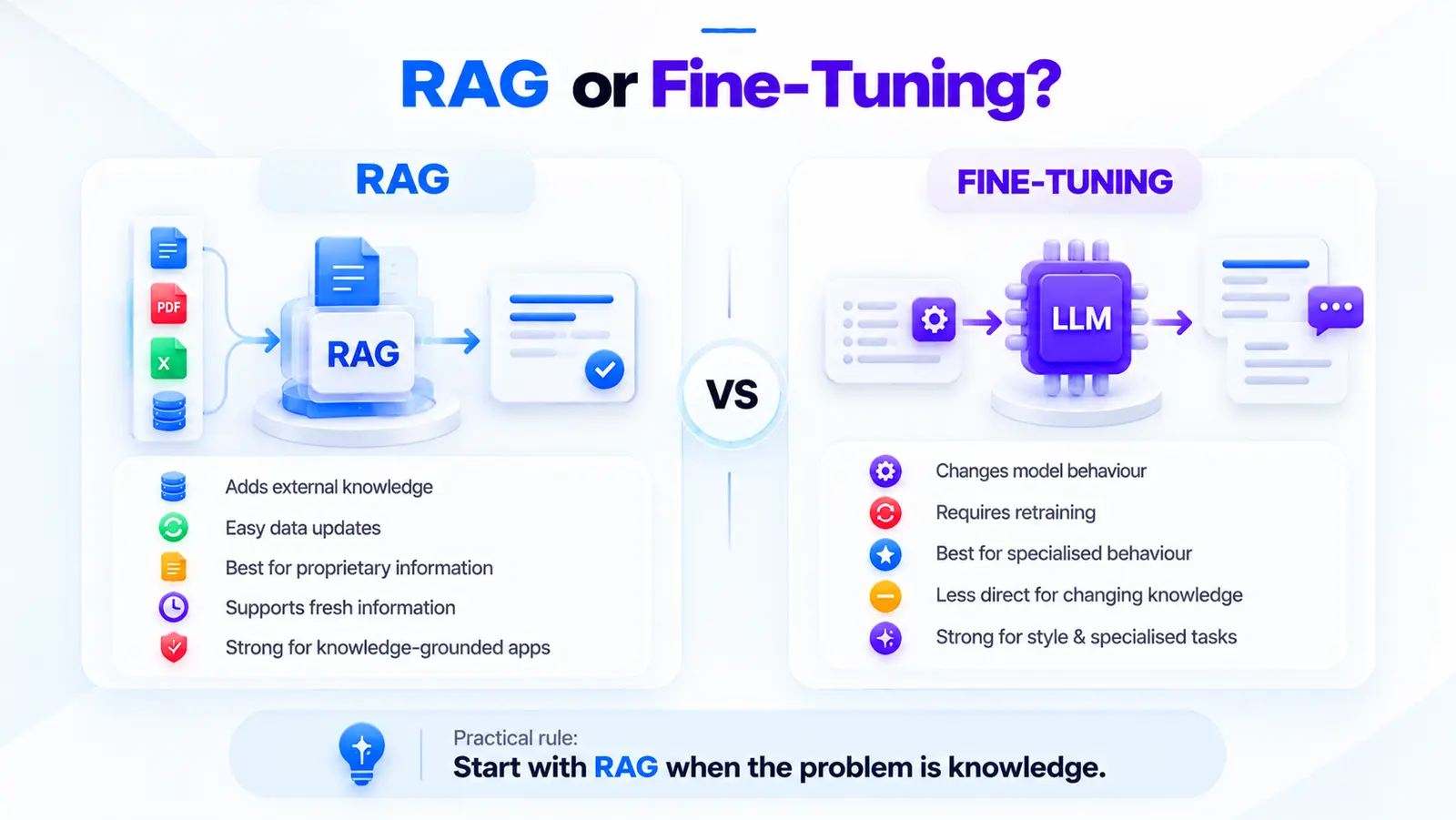
| Factor | RAG | Fine-Tuning |
|---|---|---|
| Primary purpose | Provide external knowledge | Adapt model behaviour |
| Business data updates | Easy - reindex | Usually requires retraining |
| Knowledge retrieval | Yes | Not inherently |
| Model behaviour | Limited impact | Can change significantly |
| Fresh information | Well suited | Less direct |
| Proprietary documents | Strong use case | Not always necessary |
| Cost | Depends on architecture and usage | Training adds cost and complexity |
| Best suited for | Knowledge-grounded applications | Specialised behaviour, style, tasks |
They solve different problems. RAG answers "the model doesn't know our information." Fine-tuning answers "the model doesn't behave the way we need." Most business requirements are the first, which is why RAG is usually the right starting point, and the two combine well when you need both grounded knowledge and consistent specialised behaviour. Our fine-tuning versus prompt engineering framework covers the decision further.
RAG vs. Traditional Database Search
Keyword search matches literal terms and is precise when users know the vocabulary. Database queries retrieve exact structured records. Semantic search matches meaning rather than words. RAG adds a generation step on top of retrieval, producing an answer rather than a list of results.
The distinction that matters commercially: RAG does not replace databases or search. If a user needs an exact record, a database query is faster, cheaper and correct by construction. RAG earns its complexity when the answer is spread across several documents, when users cannot phrase a precise query, or when a synthesised answer beats a list of links. Plenty of "we need RAG" requirements are better served by fixing search.
Key Features of a Production-Ready RAG Application
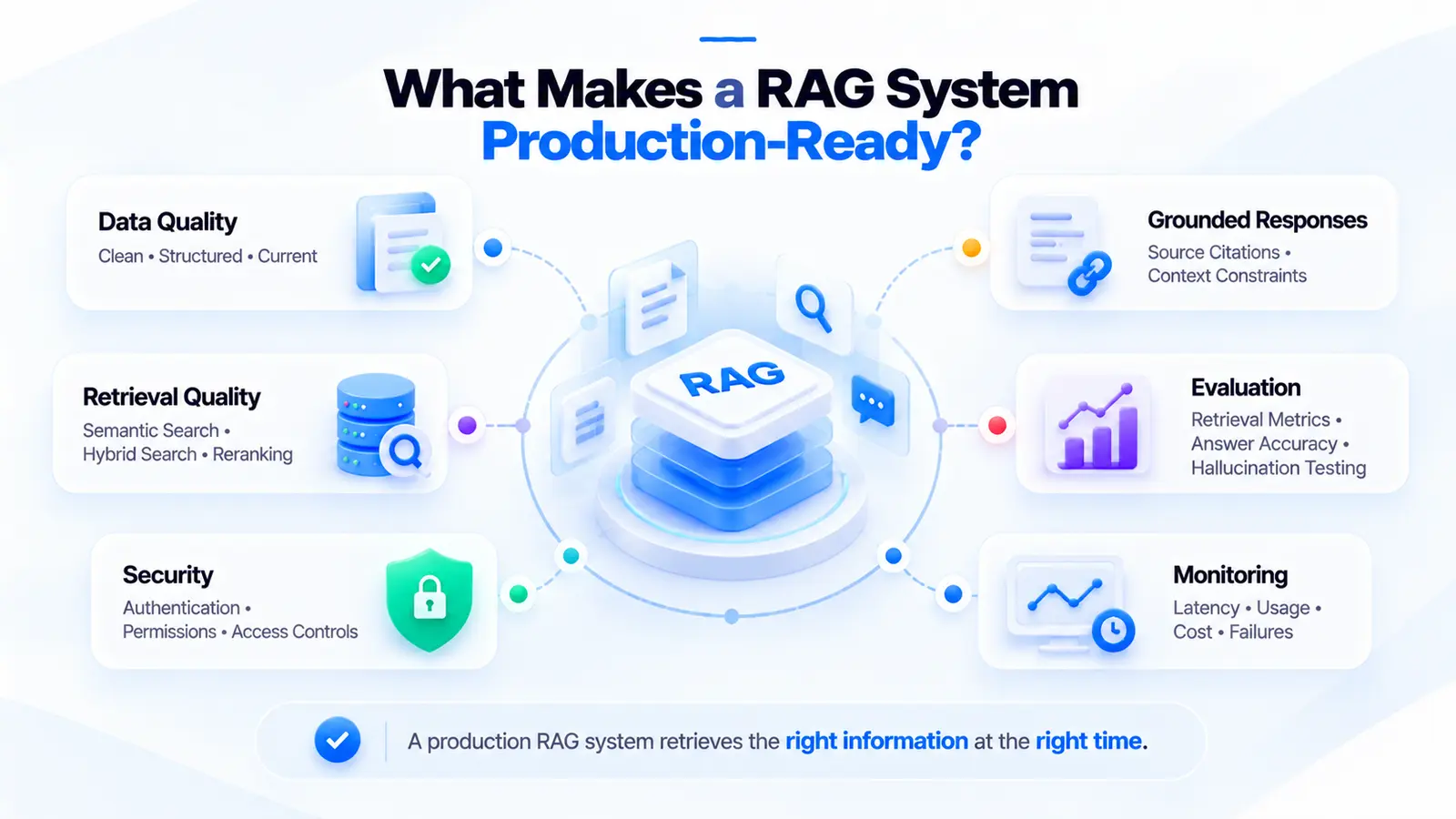
| Feature | Purpose |
|---|---|
| Semantic search | Finds conceptually relevant information |
| Metadata filtering | Narrows results by attributes |
| Hybrid search | Combines keyword and semantic retrieval |
| Reranking | Improves relevance of retrieved results |
| Source citations | Lets users verify answers |
| Access control | Restricts data by permission |
| Conversation history | Maintains relevant context |
| Multi-source retrieval | Searches several repositories |
| Feedback collection | Drives improvement |
| Analytics | Measures usage and effectiveness |
| Monitoring | Surfaces system problems |
| Evaluation | Measures retrieval and response quality |
Source citations deserve particular emphasis. They let users verify, they make errors visible instead of invisible, and they change the system's role from oracle to research assistant, which is both more honest and more useful.
Technology Stack for RAG Development
| Layer | Common Technologies / Considerations |
|---|---|
| Frontend | React, Next.js, Vue, mobile frameworks |
| Backend | Python, Node.js, Java, .NET |
| LLM | Commercial or open-source models |
| Embeddings | Commercial or open-source embedding models |
| Vector database | Pinecone, Weaviate, Milvus, pgvector |
| RAG framework | LangChain, LlamaIndex, or custom orchestration |
| Database | PostgreSQL, MySQL, MongoDB |
| Cloud | AWS, Azure, Google Cloud |
| APIs | REST, GraphQL, webhooks |
| Authentication | OAuth, SSO, JWT, enterprise identity |
| Monitoring | Application and AI observability tools |
One practical note on vector databases: if you already run PostgreSQL and your corpus is modest, pgvector avoids adding a new system to operate. Dedicated vector databases earn their place at larger scale or with demanding filtering requirements. No vendor is universally correct here.
RAG Development Process
1. Define the Business Use Case
Target users, the business problem, available data sources, expected outcomes and success metrics.
2. Audit and Prepare Business Data
Data quality, formats, permissions, duplicates, outdated content and metadata. This stage frequently reshapes the project and is the best predictor of the final result.
3. Design the RAG Architecture
Retrieval strategy, data pipeline, vector database, LLM, embedding model and application architecture.
4. Build the Data Ingestion Pipeline
Document extraction, cleaning, chunking, metadata assignment, embedding and indexing - built to run repeatedly, since data changes.
5. Implement Retrieval
Semantic search, keyword search, hybrid retrieval, metadata filtering and reranking.
6. Integrate the LLM
Prompt construction, context management, response generation, guardrails and source attribution.
7. Build the Application
Interface, APIs, authentication, conversation management and business workflows.
8. Test and Evaluate
Retrieval relevance, answer accuracy, grounding, hallucination rate, latency, security and edge cases - evaluating retrieval and generation separately, as our guide to LLM evaluation sets out.
9. Deploy and Monitor
Cloud infrastructure, logging, monitoring, usage tracking, cost monitoring and performance monitoring.
10. Continuously Improve
Updating business data, improving retrieval, optimising prompts, evaluating models and acting on user feedback.
How to Build a RAG Application With Your Own Data
A practical sequence: identify the business problem; gather relevant proprietary data; clean and structure it; divide documents into appropriate chunks; generate embeddings; store them in a vector database; build a retrieval pipeline; connect retrieval to an LLM; create the application interface; test retrieval and response quality; add security and access controls; deploy and evaluate continuously.
The step that decides the outcome is not connecting the LLM - that part is close to trivial. It is building a pipeline that reliably retrieves the right information at the right time. Almost every disappointing RAG system is a retrieval problem misdiagnosed as a model problem.
How Much Does RAG Development Cost?
| Cost Factor | Potential Impact |
|---|---|
| Number of data sources | Each source adds integration work |
| Data volume | Larger datasets increase processing and infrastructure |
| Data quality | Poor data requires substantial preparation |
| Retrieval complexity | Hybrid search and reranking add development |
| Vector database | Infrastructure and usage costs vary |
| LLM usage | Model choice and volume drive ongoing cost |
| Custom UI | Custom interfaces add development |
| Integrations | CRM, ERP and APIs add complexity |
| Security | Enterprise requirements increase architecture work |
| User volume | Higher usage raises infrastructure and model costs |
| Evaluation | Systematic testing requires development |
| Monitoring | Production observability is ongoing |
| Maintenance | Data, model and application updates recur |
Data quality is the factor most likely to surprise a budget. A well-organised document set is straightforward to index; a decade of inconsistently formatted files across three systems is a data engineering project before it is an AI one. A scoping exercise on the actual corpus is what turns this table into a number. See AI software development cost for the wider framework.
RAG Development Challenges
Poor-quality or outdated data, which propagates directly into answers. Incorrect chunking, splitting content so context is lost or diluted. Irrelevant retrieval, the most common cause of bad answers. Hallucinations, reduced but not eliminated by grounding. Large context requirements, raising cost and diluting model attention. Data access and permissions, particularly across departments. Slow response times, since retrieval adds latency before generation begins. Increasing AI usage costs as adoption grows. And keeping knowledge up to date, which is an ongoing operational commitment rather than a launch task.
Architecture, evaluation, monitoring and data governance address these. Switching models rarely does.
RAG Security and Data Privacy
RAG systems read business data on behalf of users, which makes permission handling the central security question.
The requirements: data encryption in transit and at rest, authentication, authorisation, role-based access, document-level permissions, tenant isolation, defined data retention, careful handling of sensitive information, API security, audit logging and secure data pipelines.
The governing principle is simple and frequently violated: a RAG system must respect the same access permissions as the underlying data. If a user cannot open a document directly, retrieval must not surface its contents to them. That means filtering at the retrieval layer using permission metadata - not instructing the model to withhold information it has already been given. OWASP lists weak access control in vector stores as a top risk for LLM applications and recommends permission-aware vector databases (OWASP LLM08:2025). A model asked to keep a secret it can see is not a security control.
How to Reduce Hallucinations in RAG Applications
Improve retrieval quality first, since most hallucinations follow from the model not being given the right context. Use authoritative, deduplicated sources. Improve chunking so passages carry complete thoughts. Apply metadata filtering to narrow the search. Add reranking to push the most relevant passage to the top. Provide source citations so users can verify. Constrain responses to the supplied context. Instruct the model explicitly to say when the information is not available, and test that it does. Evaluate systematically. And add human review where the cost of an error is high.
The honest framing: RAG reduces hallucinations by grounding answers in retrieved information. It does not eliminate them. A system can still misread a passage, blend two sources, or answer confidently from a document that was itself wrong. Treating RAG as a guarantee is how teams stop checking.
How to Measure RAG Application Performance
Retrieval Performance
Retrieval relevance, recall, precision, ranking quality and search latency - measured against queries with known correct sources.
Generation Performance
Answer accuracy, faithfulness to the retrieved context, relevance to the question, citation quality, user satisfaction and task completion.
Measuring these separately is what makes RAG debuggable. Evaluation frameworks such as RAGAS score retrieval quality and answer faithfulness as separate metrics (Es et al.). A strong LLM produces poor answers when the retrieval layer hands it the wrong context, and no amount of prompt engineering fixes that. Reading both layers together tells you whether to work on chunking and embeddings or on prompts and validation.
RAG Development Services: What Should They Include?
Full RAG development services span RAG strategy, architecture consulting, data preparation, document processing, embedding implementation, vector database development, retrieval development, LLM integration, custom application development, API integration, security implementation, testing and evaluation, deployment, monitoring and maintenance.
Data preparation and evaluation are the two that distinguish a serious engagement. A proposal that treats data as an input rather than a work item, or that has no evaluation methodology, is describing a prototype.
When Should a Business Choose Custom RAG Development?
Custom RAG development services fit when you have proprietary knowledge that is genuinely valuable, multiple data sources to unify, complex permission requirements, enterprise integrations, custom workflows, advanced retrieval needs, a specific user experience, strict security requirements, scale demands, or a domain-specific application.
Where a business has a modest, well-organised document set and standard requirements, an off-the-shelf tool with document upload may deliver most of the value at a fraction of the cost. That is worth checking before commissioning a build.
How to Choose a RAG Development Company
RAG and AI Expertise
Experience with retrieval systems specifically - not just LLM applications generally - including embeddings, vector databases and orchestration.
Data Engineering Capabilities
Document processing, data pipelines, databases, APIs and data quality work. RAG projects are data engineering projects with an AI layer, and teams without this depth struggle.
Security and Enterprise Experience
Authentication, authorisation, data privacy, access controls and secure infrastructure - especially permission-aware retrieval.
Evaluation and Monitoring
Ask precisely how they measure retrieval quality, response accuracy, hallucinations, performance and cost. This question separates teams who have run RAG in production from teams who have demoed it.
Post-Launch Support
Maintenance, monitoring, data updates, optimisation, model updates and scaling. RAG systems degrade as content ages, so this is not optional.
Searches for the best companies for RAG development services will return directory listings and paid placements. The evaluation above is more useful than any ranking, because RAG quality depends on fit with your data rather than on general reputation.
Common RAG Development Mistakes
Treating RAG as simply a vector database, ignoring chunking, reranking, evaluation and permissions. Using poor-quality business data, which caps performance regardless of engineering. Chunks that are too large or too small, either diluting relevance or destroying context. Ignoring metadata, giving up precise filtering. Using only semantic search, when hybrid retrieval usually outperforms it. Failing to implement access controls, the most serious mistake available. Not testing retrieval quality, leaving you tuning the wrong layer. Assuming RAG eliminates hallucinations, so nobody verifies. Ignoring ongoing data updates, letting the system go stale. And choosing technology before defining the use case, which is how projects acquire a vector database before they have a question to answer.
How to Know If Your Business Needs RAG
- Employees need to search large amounts of internal information
- Business data changes frequently
- Existing AI tools do not know your proprietary information
- Customers need answers based on company documentation
- Multiple documents need to be searched together
- Users need conversational access to business information
- The application requires source-grounded, verifiable responses
- The business maintains its own evolving knowledge base
- Existing search tools are difficult for people to use
- AI needs access to controlled business information under permissions
Not every AI application needs RAG. If the task relies on general knowledge, or on a single structured record a database query could return, a retrieval architecture adds cost and latency for no benefit.
Why Professional RAG Development Matters
Choosing an architecture that fits the data, designing reliable ingestion pipelines, improving retrieval quality beyond a first naive implementation, selecting appropriate models, implementing permission-aware security, managing costs as volume grows, testing AI outputs systematically, monitoring production performance, planning for scale, and keeping data fresh - these are what separate a RAG demo from a RAG system.
Professional RAG development services are worth their cost mainly because the failure modes are known. The gap between a naive implementation and a well-engineered one is usually the difference between roughly half the answers being useful and nearly all of them being useful, and that gap is entirely engineering.
Why Choose Eunix Tech for RAG Development?
At Eunix Tech, RAG sits at the centre of most of the AI systems we build, because most business AI problems turn out to be retrieval problems. Our work spans LLM architecture, retrieval engineering, data pipelines, integration with existing business software, evaluation and observability, and full-stack application development.
We also do a lot of diagnosis on RAG systems that were built quickly and answer inconsistently - where the fix is almost always in chunking, retrieval or permissions rather than the model. Senior engineers do the work directly, including the data audit that determines whether the project is viable as scoped.
Build an AI Application With Your Business Data
Ready to turn your business data into an AI-powered application? The first useful conversation is about your data - where it lives, what state it is in, and who is allowed to see what.
Our approach runs discover → prepare data → build → integrate → evaluate → deploy → optimise. Talk to us about your use case, existing data sources, AI requirements, security needs, integrations and scope, and if your problem is better solved by improving search than by building RAG, we will say so.
Conclusion
RAG lets AI applications retrieve information from business-specific data before generating a response, closing the gap between what a model knows and what your organisation knows. RAG development involves considerably more than connecting an LLM to a vector database: data preparation, chunking, embeddings, retrieval, reranking, context management, security and evaluation all shape the result.
It supports enterprise knowledge assistants, customer support, document intelligence, e-commerce and many other applications. RAG and fine-tuning solve different problems and sometimes complement each other. Costs depend on data volume, integrations, architecture, model usage, security and complexity - with data quality the most common surprise.
When evaluating a RAG development company, weigh AI expertise, data engineering depth, security practice, integration capability and post-launch support. A well-designed RAG system makes proprietary knowledge genuinely accessible while respecting the controls that already govern it.
For related reading, see our guides to generative AI development and AI integration services.
Sources
- Retrieval-Augmented Generation for Knowledge-Intensive NLP Tasks - Lewis et al., Facebook AI Research, UCL and NYU, 2020
- Lost in the Middle: How Language Models Use Long Contexts - Liu et al., Transactions of the ACL, 2023
- Ragas: Automated Evaluation of Retrieval Augmented Generation - Es, James, Espinosa-Anke and Schockaert, 2023
- Hybrid search - Weaviate Documentation
- An Overview of Cohere's Rerank Model - Cohere Documentation
- pgvector: Open-source vector similarity search for Postgres - pgvector project, GitHub
- LLM08:2025 Vector and Embedding Weaknesses - OWASP Top 10 for LLM Applications, 2025
Frequently Asked Questions
What is RAG development?
RAG development is the engineering of applications that retrieve relevant information from your business data and supply it to a language model as context before generating an answer. It covers the ingestion pipeline, retrieval design, context management, security and evaluation - not just storing documents in a vector database.
What is RAG in software development?
From an engineering perspective, RAG is a pipeline with distinct testable stages: data ingestion, document processing, chunking, embeddings, vector search, metadata filtering, retrieval, prompt construction, generation, an application layer, and monitoring. Treating it as a pipeline rather than one opaque component is what makes it debuggable.
How does RAG work?
Business data is processed and chunked, converted into embeddings and stored in a vector database. When a user asks a question, it is embedded and matched against stored content, relevant passages are retrieved and assembled into the model's context, and the model generates an answer grounded in that retrieved information.
How do you build a RAG application?
Identify the business problem, gather and audit proprietary data, clean and structure it, chunk documents appropriately, generate embeddings, store them in a vector database, build a retrieval pipeline with filtering and reranking, connect retrieval to an LLM, build the interface, test retrieval and response quality separately, add access controls, then deploy and evaluate continuously.
How can RAG use my company's own data?
By indexing it rather than retraining on it. Documents, knowledge bases, databases and support content are processed into a searchable index, and relevant passages are retrieved at query time. Because nothing is baked into the model, updating your data is a matter of reindexing rather than retraining.
What types of business data can be used with RAG?
Documents and PDFs, internal knowledge bases, websites, product and service information, customer support history, databases, CRM records, and policies and SOPs. Data quality, permissions, freshness and structure determine performance more than the choice of model does.
What is the difference between RAG and fine-tuning?
RAG supplies external knowledge at query time; fine-tuning adapts the model's behaviour through training. RAG suits knowledge problems and changing information and is updated by reindexing; fine-tuning suits specialised behaviour or style and requires retraining when requirements change. Most business use cases should start with RAG.
What technology stack is used for RAG development?
Typically Python or Node.js on the backend, React or Next.js on the frontend, a commercial or open-source LLM, an embedding model, a vector database such as Pinecone, Weaviate, Milvus or pgvector, LangChain, LlamaIndex or custom orchestration, a major cloud, and observability tooling. If you already run PostgreSQL with a modest corpus, pgvector avoids operating a new system.
What is a vector database in RAG?
A database that stores embeddings - numerical representations of content, and retrieves them by similarity rather than exact match, usually alongside metadata for filtering. It is what lets a search for "refund window" match a passage about "return period" without shared keywords.
What are embeddings in RAG?
Embeddings are numerical vectors representing the meaning of text, positioned so that semantically similar content sits close together. They are what enables semantic search: the user's question and your content are compared by meaning rather than by wording.
How much does RAG development cost?
It depends on the number of data sources, data volume and quality, retrieval complexity, vector database infrastructure, LLM usage, custom UI, integrations, security requirements, user volume, evaluation depth, monitoring and maintenance. Data quality is the factor most likely to surprise a budget - a messy corpus is a data engineering project before it is an AI one.
How long does it take to develop a RAG application?
It varies with the number and state of data sources, retrieval complexity, integration requirements and security needs. A single-source assistant on clean, well-structured documents is a matter of weeks; a multi-source system with document-level permissions and enterprise integrations is a matter of months. Data readiness predicts timeline better than technical complexity.
Can RAG reduce AI hallucinations?
Yes, meaningfully - grounding answers in retrieved source content substantially reduces invention, especially with citations, reranking and instructions to acknowledge missing information. But it does not eliminate hallucinations: a system can still misread a passage, blend sources, or faithfully repeat a document that was wrong.
How do you evaluate a RAG application?
Evaluate retrieval and generation separately. On retrieval, measure relevance, recall, precision, ranking quality and latency against queries with known correct sources. On generation, measure answer accuracy, faithfulness to the retrieved context, relevance, citation quality and task completion. Reading both tells you which layer to fix.
Is RAG secure for proprietary business data?
It can be, when permissions are designed in. Requirements include encryption, authentication and authorisation, role-based and document-level access, tenant isolation, defined retention, API security and audit logging. The governing rule is that retrieval must respect the same permissions as the underlying data, enforced by filtering at the retrieval layer rather than by instructing the model.
When should a business use RAG?
When employees or customers need answers from large amounts of internal information, when business data changes frequently, when existing AI does not know your proprietary content, or when responses need to be verifiable against sources. If the task relies on general knowledge or a single structured record, RAG adds cost and latency without benefit.
What are RAG development services?
They span RAG strategy, architecture consulting, data preparation, document processing, embeddings, vector database development, retrieval engineering, LLM integration, application development, API integration, security, testing and evaluation, deployment, monitoring and maintenance. Data preparation and evaluation are what distinguish a production engagement from a prototype.
What are custom RAG development services?
Building a RAG system shaped around your specific data sources, permission model, integrations, workflows, retrieval requirements and user experience rather than configuring a generic document-chat tool. They suit proprietary knowledge, multiple sources, complex permissions and strict security requirements.
How do I choose a RAG development company?
Look for retrieval-specific experience rather than general LLM work, genuine data engineering capability, permission-aware security practice, integration experience and post-launch support. Ask exactly how they measure retrieval quality and hallucinations - that question separates production experience from demo experience.
Who developed Retrieval-Augmented Generation?
RAG was introduced in a 2020 research paper by Patrick Lewis and colleagues at Facebook AI Research (now Meta AI), working with University College London and New York University. The paper combined a retriever over an external knowledge source with a generative model for knowledge-intensive language tasks. The core idea - retrieve relevant context, then generate - remains the basis of production RAG systems today, though the surrounding engineering has developed considerably.
