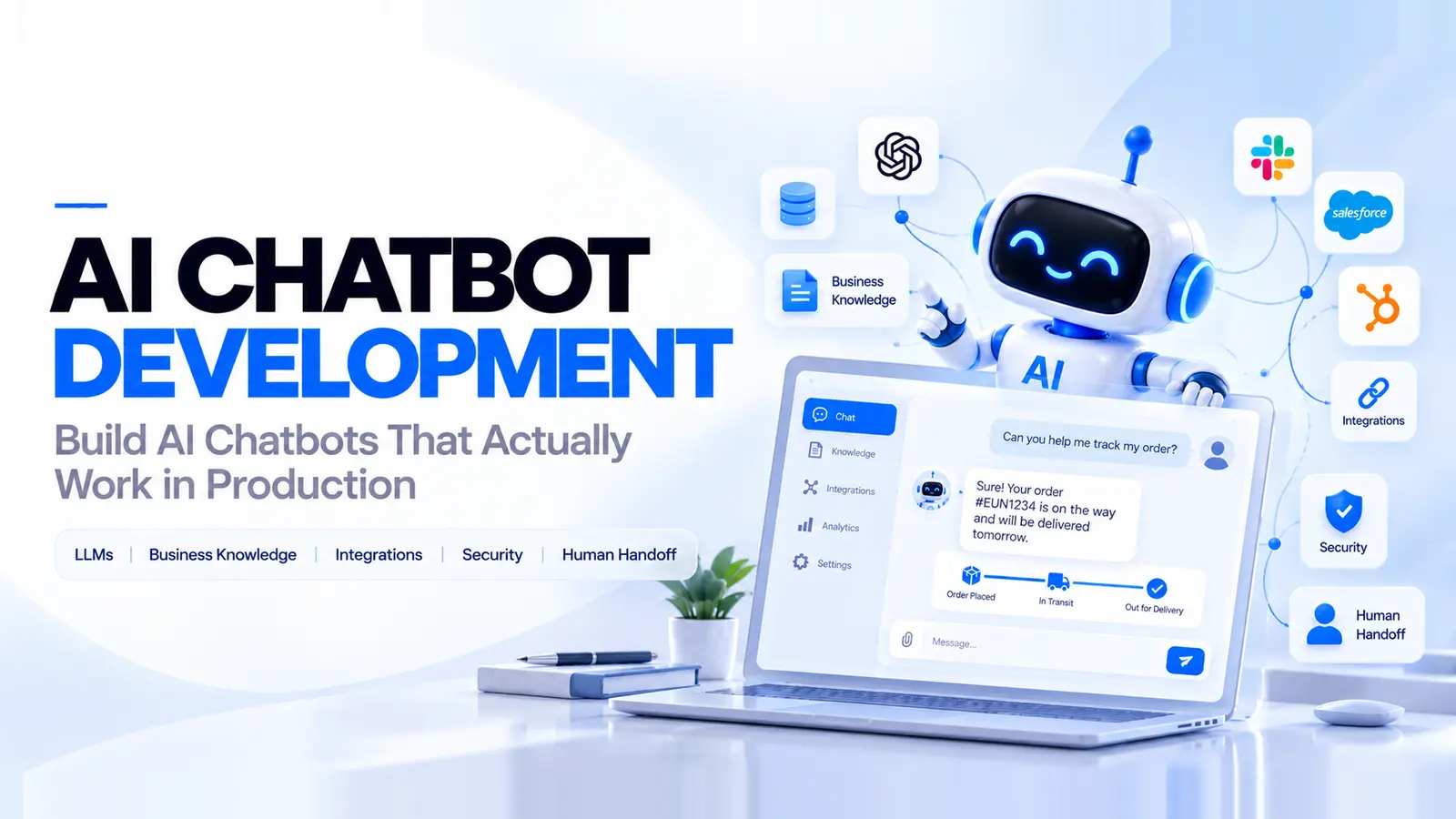
Almost every business has now tried a chatbot. A good number have quietly switched one off. The difference between the two outcomes is rarely the model - it is whether the chatbot was built around a specific business objective, connected to real company knowledge, and given a clean route to a human when it reached its limits.
AI chatbot development is the work of getting those things right. Modern chatbots understand natural language, answer from your own documentation, take actions in your systems, and know when to escalate. Getting there involves rather more than pointing a chat widget at an LLM API, and this guide covers the whole path: how AI chatbots work, what features matter, custom versus platform, the technology stack, the development process, what drives cost, security, measurement, and how to evaluate AI chatbot development services.
What Is AI Chatbot Development?
AI chatbot development is the process of building conversational applications that understand user intent, retrieve relevant information, generate useful responses, and connect to the business systems where the actual work happens.
The distinction from traditional chatbots is fundamental. A rule-based chatbot follows a decision tree someone drew: it recognises phrases it was configured for and fails on everything else. An AI chatbot uses natural language processing and generative models to interpret what the user meant, including phrasings nobody anticipated. One is a flowchart with a chat interface; the other genuinely handles variation.
Modern AI chatbots draw on several capabilities at once. Natural language processing handles understanding. Machine learning and generative models produce responses. Retrieval (retrieval-augmented generation, first described by Lewis et al. in 2020) connects the chatbot to company documents, FAQs and databases so answers reflect your business rather than the model's general training. Integrations let it read and write in the systems your team already uses.
In practice that supports text conversations, knowledge-base queries, customer support, lead qualification, recommendations, appointment scheduling, internal employee assistance, data retrieval, and workflow automation.
How Does an AI Chatbot Work?
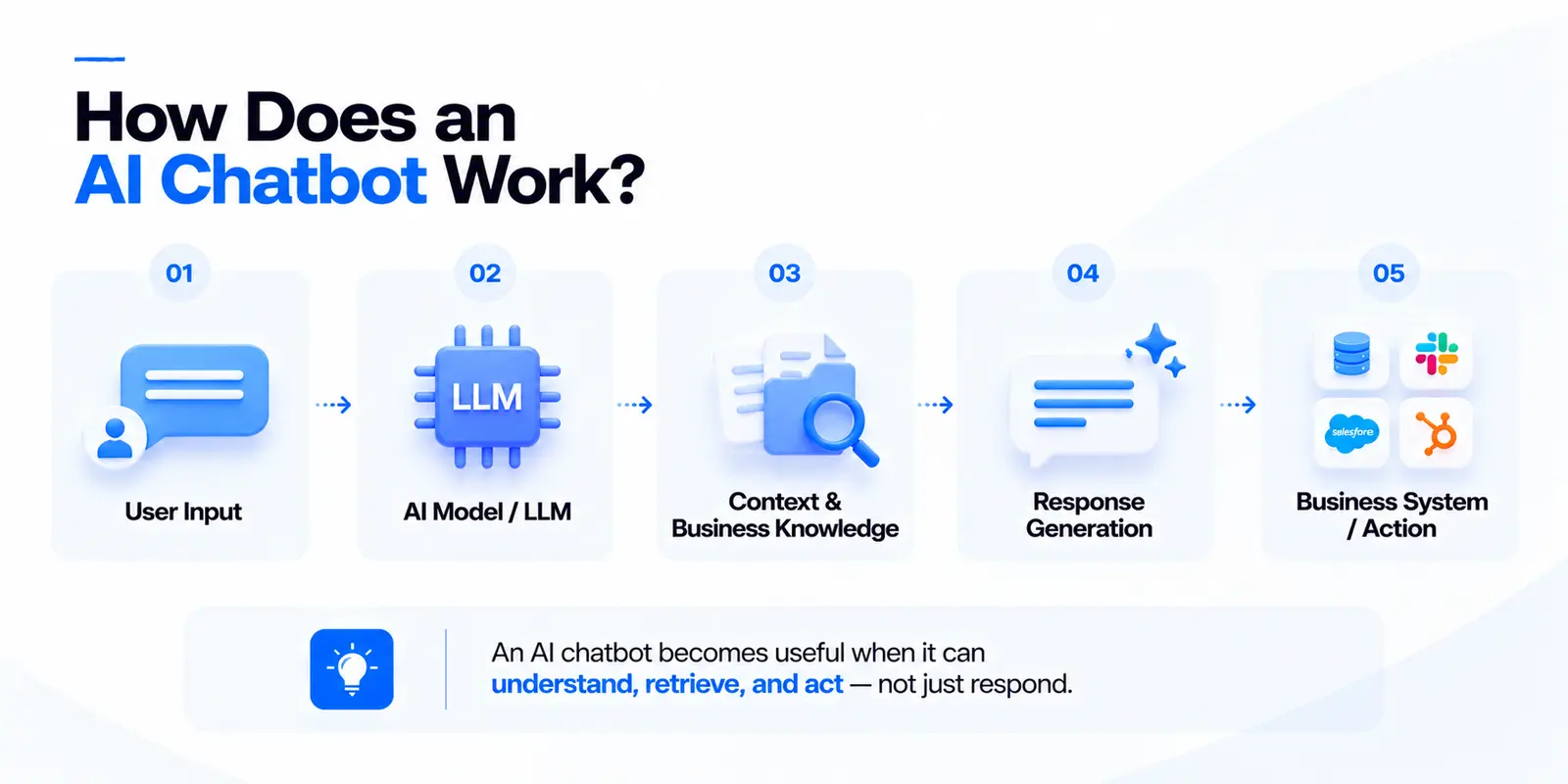
User Input → Natural Language Processing / LLM → Context & Knowledge → Response Generation → Business System or Action
User Input
Users arrive through a website widget, a mobile application, messaging platforms like WhatsApp or Slack, or voice interfaces. Each channel carries its own constraints - voice in particular, which we cover in our guide to voice AI agent cost per month.
AI Model
A large language model handles natural language understanding, intent recognition and response generation. Model choice affects accuracy, latency and running cost, and the best fit depends on the conversations you actually expect rather than on benchmark rankings.
Knowledge Base
Company documents, FAQs, product information, internal knowledge and structured databases - retrieved at query time so the chatbot answers from current, accurate information. This layer is what separates a chatbot that knows your refund policy from one that invents a plausible-sounding version. This has legal weight: in Moffatt v. Air Canada (2024), a tribunal held the airline liable after its chatbot gave wrong information about its bereavement fare policy.
Integrations and Actions
Connections to CRM, ERP, help desk, e-commerce platforms, calendars, payment systems and internal APIs. This is what turns a chatbot from something that talks into something that does, usually through tool calling - checking an order, booking a slot, creating a ticket.
Why Do Businesses Invest in AI Chatbot Development?
The benefits are well established: round-the-clock support, faster response times, reduced repetitive workload for support teams, lead generation and qualification, customer engagement, personalised experiences, employee productivity, automated workflows, scalability under load, and easier access to business information.
The caveat matters more than the list. A chatbot should be designed around a specific business objective - deflect a defined category of support ticket, qualify inbound leads before a rep sees them, answer HR questions without an email. Chatbots built because AI is available, without a measurable outcome attached, are the ones that get switched off six months later. The objective is what tells you which conversations to support, what accuracy is good enough, and whether it worked.
Common AI Chatbot Use Cases
Customer Support
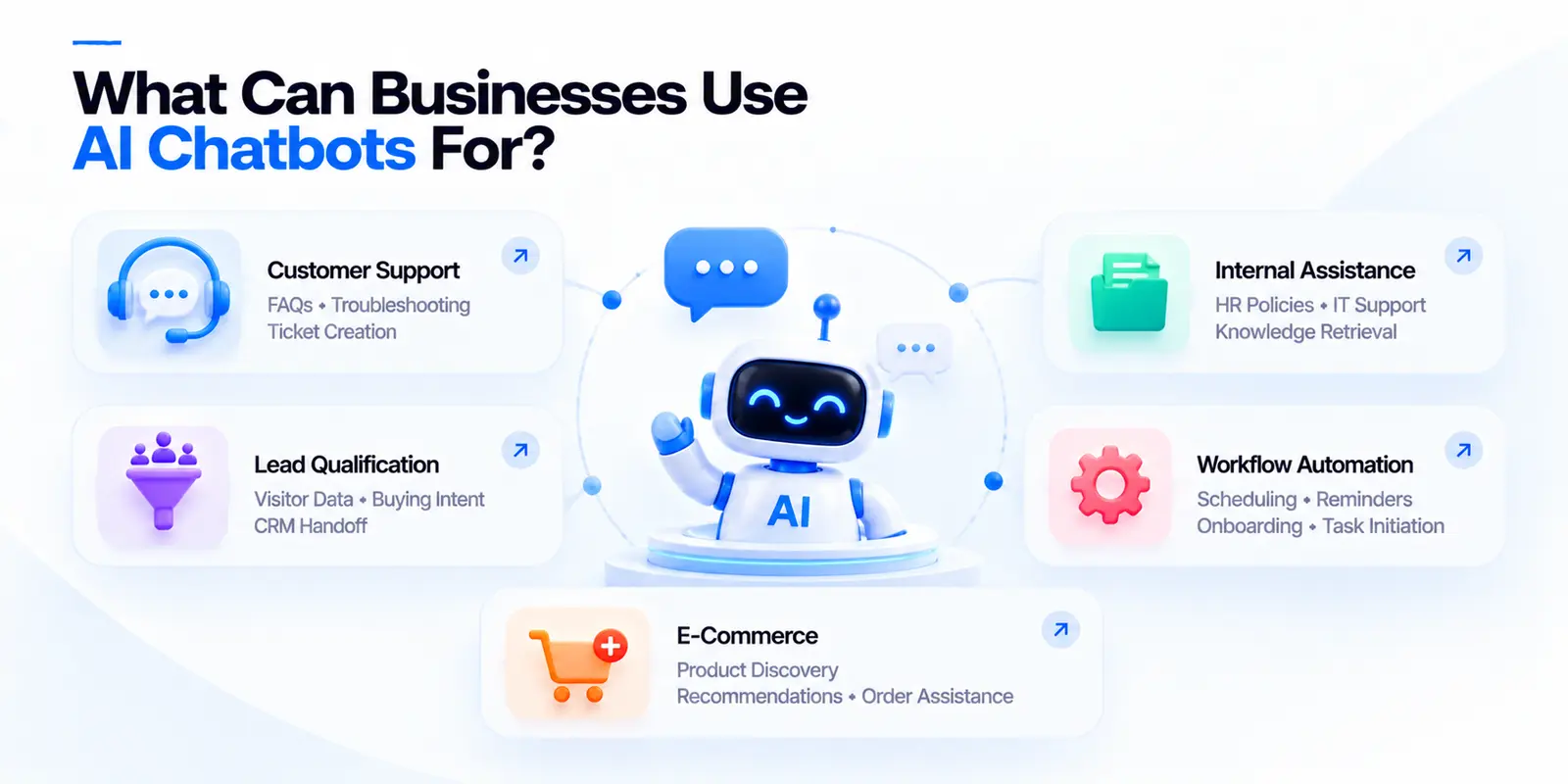
FAQs, order and status questions, troubleshooting, ticket creation and support routing. Starting with suggested responses that an agent approves, rather than fully automated replies, builds accuracy and trust before you remove the human.
Lead Generation and Qualification
Collecting visitor information, asking qualifying questions, identifying buying intent, handing off to the CRM and notifying the sales team - particularly valuable where response speed determines conversion.
E-Commerce
Product discovery, recommendations, order assistance, product questions and cart help, grounded in live catalogue and inventory data so the chatbot never recommends something out of stock.
Internal Employee Assistant
HR questions, company policies, knowledge retrieval, IT support and internal documentation. Usually the safest place to start: internal users tolerate early imperfection and give immediate, specific feedback.
Healthcare and Financial Services
Both sectors have real applications - appointment scheduling, policy retrieval, general product information, and both demand more than the technology. Data privacy, security, regulatory compliance, human oversight and clearly bounded scope are prerequisites rather than enhancements. A chatbot in these contexts should be explicit about what it will not answer.
Appointment and Workflow Automation
Scheduling, reminders, form completion, customer onboarding and automated task initiation, where custom AI chatbot development services typically earn their cost because the workflows are specific to the business.
Key Features of an AI Chatbot
| Feature | Purpose |
|---|---|
| Natural language conversations | Lets users ask in their own words |
| Context awareness | Maintains relevant conversation history |
| Knowledge base | Answers from business information |
| Retrieval-augmented generation | Grounds responses in real source content |
| Multi-language support | Serves users in their own language |
| CRM integration | Connects conversations to customer records |
| API integrations | Enables real business actions |
| Lead qualification | Identifies and routes prospects |
| Analytics | Measures performance against objectives |
| Human handoff | Transfers complex conversations to staff |
| Personalisation | Tailors responses to user context |
| Authentication | Protects restricted information |
| Admin dashboard | Enables management without engineering |
| Feedback collection | Feeds continuous improvement |
Two of these are load-bearing and frequently deferred. Human handoff determines what happens in every conversation the chatbot cannot complete, which is where user trust is won or lost. Authentication determines whether the chatbot can safely discuss anything account-specific at all.
Custom AI Chatbot vs. AI Chatbot Builder
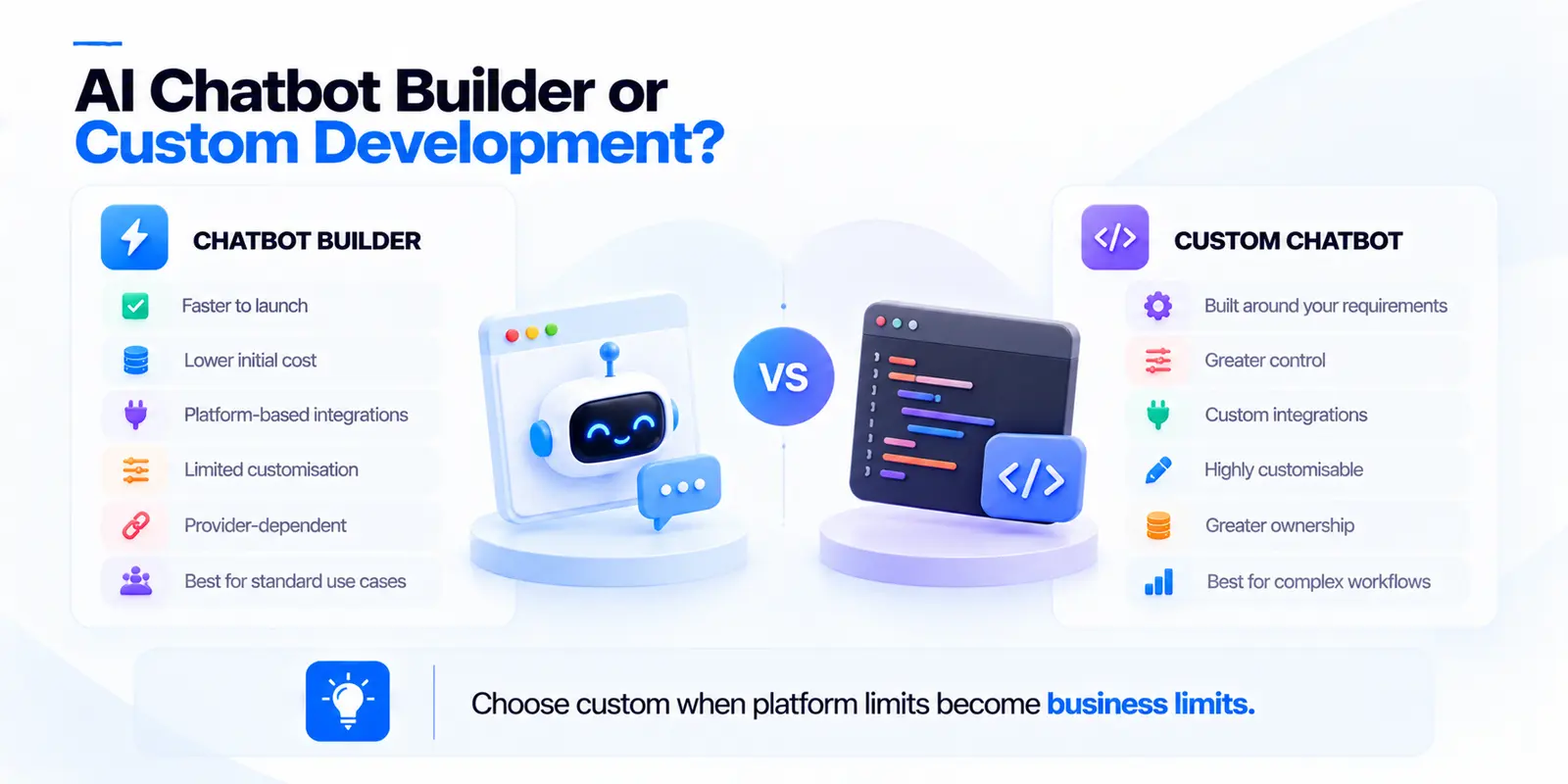
| Factor | AI Chatbot Builder | Custom AI Chatbot |
|---|---|---|
| Development speed | Generally faster | Requires development |
| Customisation | Limited to platform capabilities | Highly customisable |
| Integrations | Depends on platform | Built to requirements |
| User experience | Template dependent | Custom designed |
| AI model control | May be limited | Greater flexibility |
| Scalability | Provider dependent | Architected to need |
| Ownership | Platform dependent | Greater control |
| Cost | Often lower initially | Higher development investment |
| Maintenance | Provider handles infrastructure | Requires development resources |
Builders are the right answer more often than a development agency will admit. If a platform covers your conversations, connects to your systems, and will still fit after your next two requirements, use it - the total cost of ownership is genuinely lower.
Custom AI chatbot development services earn their cost when integrations exceed platform support, when proprietary knowledge or unusual workflows are central, when security or data residency requirements are strict, or when the chatbot is close enough to your core operation that platform limits become business limits.
What Can Developers Do With AI Chatbot Builders?
Builders have improved considerably, and it is worth being honest about what they now handle. Developers can create conversational interfaces, configure workflows, connect knowledge bases, integrate APIs, add business rules, connect CRM systems, configure analytics, create automated responses, customise behaviour, and stand up working prototypes in days rather than weeks.
That last point is the underrated one: a builder is an excellent way to validate whether a chatbot solves the problem at all, before committing to custom development. Where platforms typically run out is deep integration with internal systems, unusual retrieval requirements, fine-grained permissions, and control over the model layer, which is precisely when custom development starts to make sense.
AI Chatbot Development Features for Enterprise Applications
Enterprise deployments add requirements that rarely appear in a pilot: role-based access, enterprise authentication and SSO, custom knowledge bases spanning multiple data sources, API orchestration across systems, durable conversation memory, reliable human escalation, audit logging, analytics, multi-tenant architecture, advanced security controls, custom admin dashboards, and workflow automation.
Comprehensive AI chatbot development services should treat these as architecture decisions made early rather than features bolted on later. Retrofitting role-based access onto a chatbot that assumed one permission level is close to a rebuild.
Technology Stack for AI Chatbot Development
| Technology Layer | Common Options / Considerations |
|---|---|
| Frontend | React, Next.js, Vue, mobile frameworks |
| Backend | Node.js, Python, Java, .NET |
| AI/LLM | Commercial or open-source language models |
| AI frameworks | LangChain, LlamaIndex, or custom orchestration |
| Database | PostgreSQL, MySQL, MongoDB |
| Vector database | Pinecone, Weaviate, pgvector, or equivalent |
| Cloud | AWS, Azure, Google Cloud |
| APIs | REST, GraphQL, webhooks |
| Authentication | OAuth, SSO, JWT, enterprise identity providers |
| Analytics | Custom or third-party platforms |
| Monitoring | Logs, performance monitoring, AI evaluation tools |
No stack is universally correct. The right one follows your existing engineering environment, the integrations required, your privacy constraints and your team's ability to maintain it. A stack your team cannot support is a liability regardless of its technical merits.
AI Chatbot Development Process
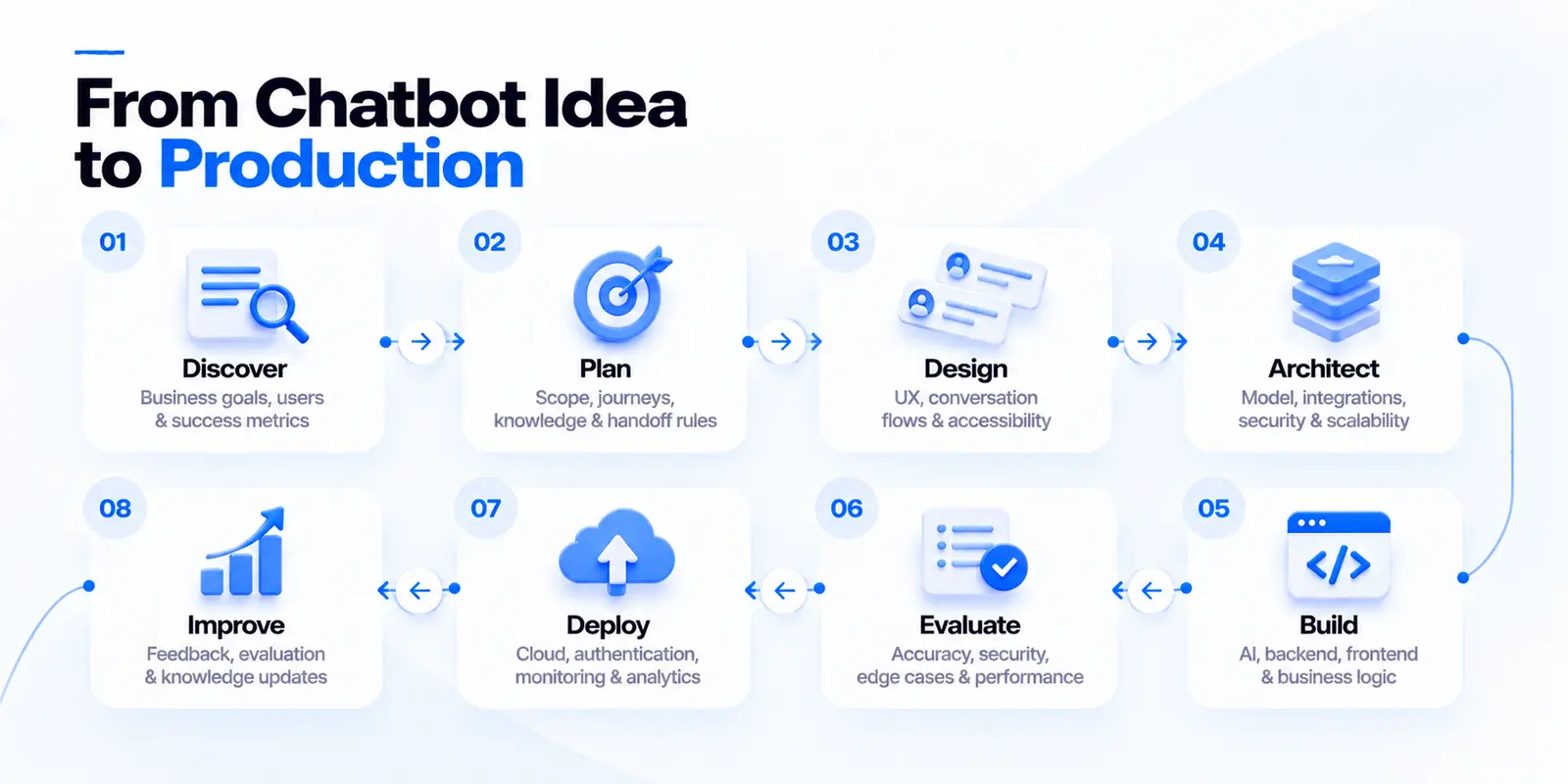
1. Requirement Discovery
Identify business objectives, target users, use cases, the conversation types you actually expect, required integrations, security requirements and success metrics.
2. Chatbot Strategy and Planning
Define scope, user journeys, knowledge sources, AI model requirements, human handoff rules and automation opportunities. Deciding what the chatbot will not handle is as important as deciding what it will.
3. UX/UI Design
The chat interface, conversation flows, branding, mobile responsiveness, accessibility and the handoff experience. How the chatbot communicates uncertainty and lets users correct it matters more than visual polish.
4. AI Model and Architecture Selection
Evaluate model capabilities, accuracy on your conversations, cost at expected volume, latency, data requirements, privacy and scalability.
5. Knowledge Base and Data Integration
Business documents, FAQs, databases, APIs and CRM data - cleaned, structured and given a retrieval strategy. This stage determines answer quality more than model choice does, and it is covered in depth in our guide to RAG development.
6. Chatbot Development
Frontend, backend, AI integration, prompt and orchestration logic, business rules and API integrations.
7. Testing and AI Evaluation
Functional testing, conversation testing, accuracy measurement, hallucination testing, security testing, performance under load, edge cases and human handoff verification. See LLM evaluation for the methodology.
8. Deployment
Cloud deployment, production environment, authentication, monitoring, analytics and a launch strategy - often a limited rollout before full exposure.
9. Continuous Improvement
Conversation analytics, user feedback, model evaluation, knowledge-base updates, prompt improvements and feature work. Real conversations reveal questions no test set contained.
How to Develop an AI Chatbot
At a high level: define the use case, identify the target users, select the architecture, choose the AI model, prepare business data, design the conversation experience, develop the chatbot, integrate business systems, test responses and workflows, deploy and monitor, then continuously improve.
The step that most affects the outcome is preparing business data, and it is the one most often rushed. A chatbot with an excellent model and disorganised source content will underperform one with a modest model and clean, well-structured knowledge. Production-grade chatbot development is mostly this kind of unglamorous work rather than model selection.
How Much Does It Cost to Develop an AI Chatbot?
There is no universal price, because "an AI chatbot" describes both a FAQ assistant on a marketing site and a multi-system enterprise assistant with role-based access. These are the variables that decide which you are commissioning.
| Cost Factor | Impact on Development Cost |
|---|---|
| Chatbot complexity | More conversation types require more development |
| AI model | Model selection affects build and ongoing usage costs |
| Number of integrations | Each system adds engineering and testing |
| Knowledge base | Data preparation and retrieval design add effort |
| Custom UI/UX | Custom interfaces require design and development |
| Voice capabilities | Voice adds technology and integration requirements |
| Authentication | Enterprise access controls add complexity |
| Security | Sensitive data requires stronger controls |
| Analytics | Advanced reporting requires implementation |
| Testing | Extensive AI evaluation increases effort |
| Deployment | Infrastructure and production setup |
| Maintenance | Ongoing improvement is recurring |
The figure worth focusing on is total cost of ownership, not initial development. A chatbot carries per-conversation model costs, infrastructure, monitoring and continued knowledge-base upkeep. A cheaper build with a worse retrieval design frequently costs more within a year.
AI Chatbot Development Cost: What Are You Paying For?
The investment breaks into discovery and strategy, UX/UI design, architecture, AI model integration, knowledge-base development, backend development, frontend development, API integrations, testing, deployment, monitoring and maintenance.
Three distinct cost types deserve separate lines in a budget:
Initial development cost - the build, one-time. Infrastructure and usage cost - model calls, hosting, vector storage, scaling with conversation volume. Ongoing maintenance cost - knowledge updates, prompt refinement, model changes, feature work.
Budgets that account only for the first are the most common reason a working chatbot becomes an argument six months after launch. Our guide to AI software development cost covers the wider framework.
How Long Does AI Chatbot Development Take?
Timeline depends on the number of features, conversational complexity, integrations, data preparation, model selection, security requirements, UI customisation, testing depth and internal approval processes.
| Development Stage | Typical Complexity |
|---|---|
| Discovery | Low-Medium |
| UX/UI | Low-Medium |
| Architecture | Medium |
| AI integration | Medium-High |
| Knowledge integration | Medium-High |
| Development | Medium-High |
| Testing | Medium-High |
| Deployment | Medium |
| Optimisation | Ongoing |
Knowledge integration is the stage that most often runs long, because it depends on the state of content the business already has rather than on engineering speed.
AI Chatbot Security and Privacy Considerations
Chatbots sit at an awkward intersection: they talk to the public and they read internal data. That makes security an architecture decision rather than a review step.
The surface covers data encryption in transit and at rest, authentication, authorisation, role-based access, data retention policy, handling of sensitive information, API security, prompt injection risk, access controls, logging, monitoring and any compliance regime you operate under.
Two points are worth stating directly. Access control belongs in the retrieval and integration layer, not in the prompt - an instruction telling the model not to reveal something is a request, while a permission check is a guarantee. OWASP notes that prompt-level restrictions can be bypassed, and recommends least-privilege data access. And prompt injection is a genuine risk for any chatbot that reads untrusted input, which is every public-facing one. Both are far cheaper to design in than to retrofit.
How to Measure AI Chatbot Performance
Useful KPIs: resolution rate, containment rate, response accuracy, user satisfaction, escalation rate, conversation completion rate, lead conversion, response time, task completion and cost per conversation.
The measurement that matters most is against the original business objective. A chatbot with a 90% containment rate that frustrates the 10% it fails may be worse for the business than one containing 70% and escalating cleanly. High containment achieved by never escalating is a metric moving in the wrong direction while looking like success, which is why escalation rate should be read alongside satisfaction, not instead of it.
Common AI Chatbot Development Challenges
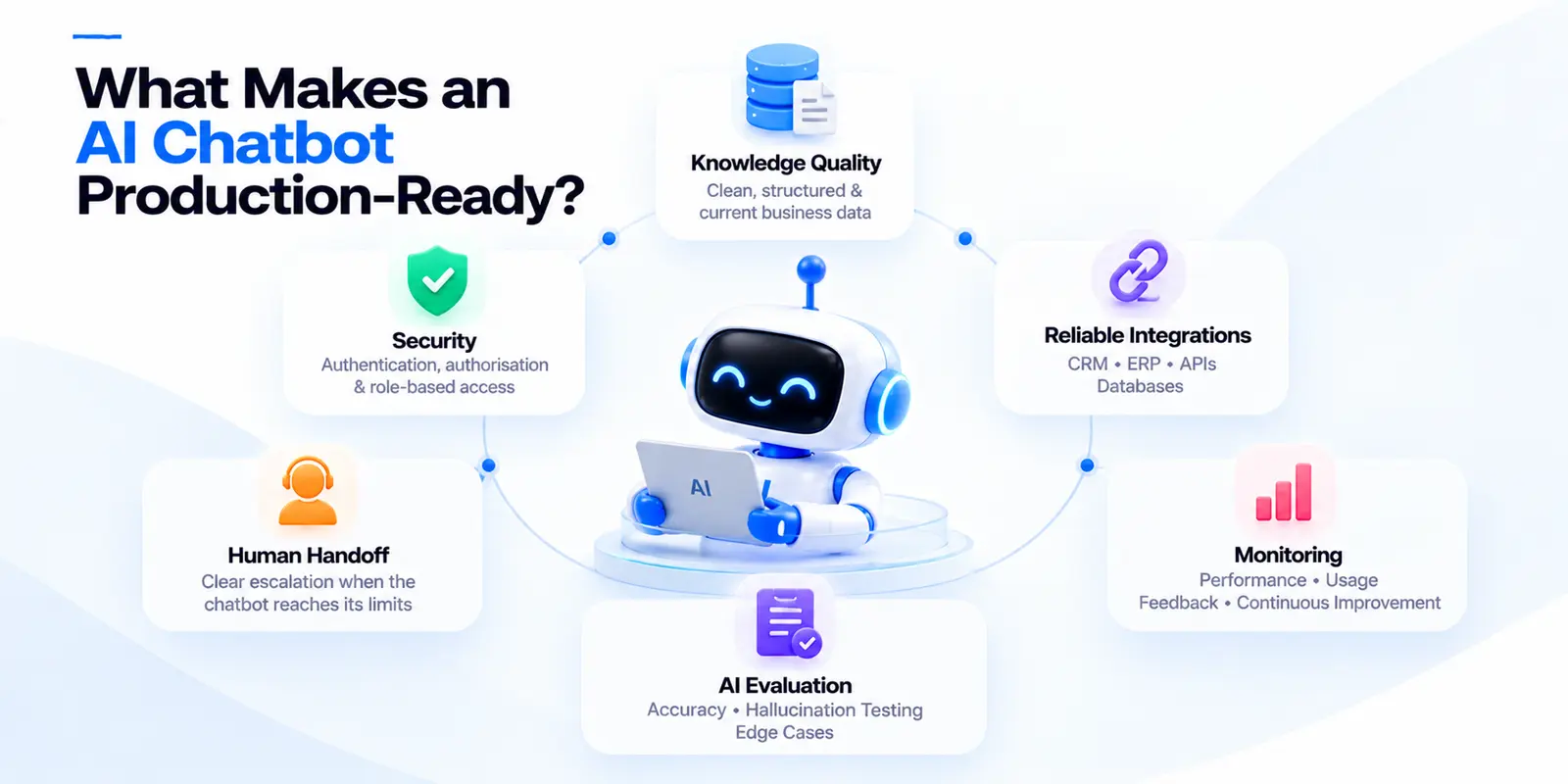
Hallucinations and incorrect responses, addressed with retrieval grounding, structured outputs, validation and honest "I don't know" behaviour. Poor-quality business data, which limits performance more than model choice does. Complex integrations, usually the largest engineering portion. Maintaining conversation context across long or resumed conversations. Security and privacy, especially with authenticated users. User adoption, which depends on early accuracy and visible escalation. AI model costs, scaling with conversation volume. And ongoing maintenance, because knowledge goes stale and models change.
Architecture, testing, data preparation, monitoring and human escalation address all of these. None are solved by switching models.
Common Mistakes Businesses Make When Developing AI Chatbots
Building without a clear business objective - the root cause of most abandoned chatbots. Choosing an AI model before defining requirements, which converts an open question into a constraint. Ignoring data quality, guaranteeing mediocre answers. Over-automating customer support, trading measurable containment for unmeasured frustration. Not including human handoff, leaving users stuck. Skipping AI evaluation, so nobody can say whether it works. Underestimating integration requirements, the most common schedule overrun. Ignoring security, creating rework at the worst moment. Focusing only on initial development cost, missing usage and maintenance. And failing to plan for continuous improvement, letting a good launch decay.
When Should a Business Choose Custom AI Chatbot Development?
Custom development fits when you need unique workflows, complex integrations, proprietary knowledge, advanced personalisation, enterprise security, a custom user experience, specific AI behaviour, scalable architecture, or greater control over data and infrastructure.
If none of those apply, a platform is very likely the better decision, and an honest partner will say so before quoting. Custom AI chatbot development services are worth their cost when the constraints are real - not by default.
How to Choose an AI Chatbot Development Company
AI and Technical Experience
Look for experience with LLM applications, AI integrations, NLP, knowledge retrieval, API development and cloud architecture, and specifically for chatbots that have run in production, not just been demoed.
Relevant Industry Experience
Whether they understand your business workflows, your customers, industry requirements and how sensitive your data is. Industry familiarity shortens discovery considerably.
Integration Capabilities
Experience integrating CRM, ERP, help desks, e-commerce platforms, databases and internal APIs - where these projects most often stall.
Testing and Security
Ask specifically about AI evaluation methodology, security testing, data protection, monitoring and human escalation design. A team without a concrete evaluation method has never had to prove a chatbot worked.
Post-Launch Support
Maintenance, performance monitoring, AI optimisation, model updates and feature development. Chatbots need continued attention more than most software.
AI Chatbot Development Services: What Should They Include?
A full AI chatbot development services engagement covers strategy and consultation, UX/UI design, custom development, AI model integration, knowledge-base integration, API development, CRM integration, enterprise features, testing, deployment, analytics, maintenance and optimisation.
Scope should be defined explicitly before development starts - particularly who owns knowledge-base updates after launch, which is the most commonly unassigned responsibility in chatbot projects.
Why Choose Eunix Tech for AI Chatbot Development?
At Eunix Tech, chatbot work sits where production AI engineering meets full-stack software engineering. A reliable chatbot is mostly a retrieval, integration, permissions and escalation problem, which means it is built by engineers who take production seriously.
Our work spans LLM and RAG engineering, AI agent development, integration with existing business software, evaluation and observability, and API reliability. A significant share is stabilisation - including rescuing a failed AI chatbot project that had been rushed into production. Senior engineers do the work directly, including the discovery that decides whether a custom build is warranted at all.
Build a Custom AI Chatbot for Your Business
Ready to turn AI into a business-ready chatbot? The useful starting point is a specific objective and an honest look at the knowledge and systems the chatbot would need to reach.
Our process runs discover → design → develop → integrate → test → launch → optimise. Talk to us about your business objectives, use cases, required integrations, AI capabilities, security requirements and scope, and if a platform would serve you better than a custom build, we will tell you that.
Conclusion
AI chatbot development lets businesses build conversational experiences around specific needs - customer service, sales, employee assistance, recommendations and workflow automation. Features and technology follow the use case rather than the other way round.
Custom development gives flexibility to businesses with complex requirements, while platforms remain the better answer for standard ones. Costs depend on features, integrations, models, data, security, UX and ongoing support, and total cost of ownership matters more than the build quote. Success requires planning, data preparation, testing, deployment, monitoring and continuous improvement.
When evaluating an AI chatbot development company, weigh technical expertise, integration capability, security practice and post-launch support, and above all, design the chatbot around a measurable business outcome rather than around the technology.
For related reading, see our guides to AI agent development and generative AI development.
Sources
- Retrieval-Augmented Generation for Knowledge-Intensive NLP Tasks - Lewis et al., 2020
- Moffatt v. Air Canada, 2024 BCCRT 149 - British Columbia Civil Resolution Tribunal, 2024
- Function calling - OpenAI API documentation, 2026
- LLM02:2025 Sensitive Information Disclosure - OWASP Gen AI Security Project, 2025
- LLM01:2025 Prompt Injection - OWASP Gen AI Security Project, 2025
- Structured model outputs - OpenAI API documentation, 2026
Frequently Asked Questions
What is AI chatbot development?
AI chatbot development is the process of building conversational applications that understand user intent using natural language processing and generative models, retrieve relevant information from business knowledge, generate useful responses, and connect to business systems to take actions. It differs from rule-based chatbots, which follow a fixed decision tree.
How does AI chatbot development work?
A user message goes through natural language processing or an LLM, relevant context is retrieved from the knowledge base, a response is generated, and where needed an action is taken in a connected business system. Building this requires discovery, strategy, UX design, model and architecture selection, knowledge integration, development, testing, deployment and continuous improvement.
How to develop an AI chatbot?
Define the use case, identify target users, select the architecture, choose the AI model, prepare business data, design the conversation experience, develop the chatbot, integrate business systems, test responses and workflows, deploy with monitoring, then improve continuously. Preparing business data affects the outcome more than model choice does.
How much does it cost to develop an AI chatbot?
It depends on complexity, AI model, number of integrations, knowledge base preparation, custom UI, voice capabilities, authentication, security, analytics, testing, deployment and maintenance. Evaluate total cost of ownership rather than build cost alone - model usage, infrastructure and knowledge upkeep are recurring.
How long does it take to develop an AI chatbot?
It varies with feature count, conversational complexity, integrations, data preparation, security requirements, UI customisation and testing depth. Knowledge integration most often runs long, because it depends on the state of the content the business already has rather than on engineering speed.
What features should an AI chatbot have?
Natural language conversation, context awareness, a knowledge base with retrieval grounding, CRM and API integrations, lead qualification where relevant, analytics, human handoff, personalisation, authentication, an admin dashboard and feedback collection. Human handoff and authentication are the two most often deferred and most consequential.
What technology stack is used for AI chatbot development?
Typically React or Next.js on the frontend; Node.js, Python, Java or .NET on the backend; a commercial or open-source LLM; LangChain, LlamaIndex or custom orchestration; a relational database plus a vector database; a major cloud; REST or GraphQL APIs; OAuth or SSO; and analytics and monitoring. The right stack follows your existing environment and what your team can maintain.
What is custom AI chatbot development?
Building a chatbot around your specific workflows, proprietary knowledge, integrations, security requirements and user experience rather than configuring a platform. It suits businesses whose requirements exceed what builders support, and is harder to justify when a platform already covers the use case.
What is the difference between an AI chatbot and a chatbot builder?
An AI chatbot is the application itself; a chatbot builder is a platform for creating one with limited code. Builders are faster and cheaper initially but constrained by platform capabilities on integrations, retrieval, permissions and model control. Custom development trades speed for flexibility and ownership.
What can developers do with AI chatbot builders?
Create conversational interfaces, configure workflows, connect knowledge bases, integrate APIs, add business rules, connect CRM systems, configure analytics and build working prototypes quickly. Builders are an excellent way to validate whether a chatbot solves the problem before committing to custom development.
Can an AI chatbot integrate with a CRM?
Yes, and it is one of the most valuable integrations - connecting conversations to customer records, updating contacts, logging interactions and handing qualified leads to sales. Modern CRMs generally integrate straightforwardly through documented APIs.
Can AI chatbots connect to business databases?
Yes, through an integration layer that enforces authentication and permissions. Access should be least-privilege and scoped to what the requesting user is entitled to see, with the enforcement in the integration layer rather than in prompt instructions.
How do AI chatbots use company knowledge?
Through retrieval-augmented generation: company documents, FAQs, product information and structured data are processed, indexed and retrieved at query time, then supplied to the model as context. This grounds answers in current business information instead of the model's general training.
Are AI chatbots secure?
As secure as their architecture. The requirements are encryption, authentication and authorisation, role-based access, defined data retention, API security, protection against prompt injection, logging and monitoring. Access control belongs in the retrieval and integration layer, not the prompt - an instruction is a request, a permission check is a guarantee.
How do you test an AI chatbot?
Combine functional testing, conversation testing across realistic and awkward phrasings, accuracy measurement against a representative dataset, hallucination testing with questions it should decline, security testing including prompt injection, performance testing under load, edge cases and verification that human handoff works.
How do I choose an AI chatbot development company?
Evaluate LLM and NLP experience, knowledge retrieval capability, API and integration experience, cloud architecture, industry familiarity, security practice, a concrete AI evaluation methodology and post-launch support. Ask for chatbots they have run in production, not just demonstrated.
What are AI chatbot development services?
They span strategy and consultation, UX/UI design, custom development, AI model integration, knowledge-base integration, API and CRM integration, enterprise features, testing, deployment, analytics, maintenance and optimisation. Define scope explicitly before starting - especially who owns knowledge-base updates after launch.
Does an AI chatbot require ongoing maintenance?
Yes, more than most software. Knowledge goes stale, models are updated by providers, users ask things no test set contained, and prompts need refinement as patterns emerge. Budget for continuous improvement as a recurring cost rather than a project phase.
When should a business choose custom AI chatbot development services?
When you need unique workflows, complex integrations, proprietary knowledge, advanced personalisation, enterprise security, a custom user experience, specific AI behaviour, or greater control over data and infrastructure. If a platform covers your workflow now and after your next two requirements, the platform is the better decision.
